Feeds:
Posts
Comments

Posts Tagged ‘Economics’

Well, we had quite a week this past week. Crooked Hillary became deplorable Hillary became collapsing Hillary. The tide bad economic data kept rolling in. There was more evidence (as if we needed any) that there is very little of Christianity left in our nation’s mainstream culture.

Deplorable Hillary

For someone who’s always seemed to lack a sense of humor, Hillary managed to inject a healthy dose of LOL humor last week with her “basket of deplorables” speech. Based on her comments, about 25% of the US population qualified for deplorable status due to their, drum roll please, racism, sexism, homophobia, Islamophobia and/or whateverophobia.

For my part, I’m glad she said what she said and don’t think she should take back any of it. I rather enjoy it when people speak their mind. At least we know where we all stand. In that regard, it’s a bit like Obama’s “‘bitterly clinging to their guns and religion” comments a few years back. Hillary was trying to gain SJW street cred with her LGBT friends and Barbara Streisand. And who am I to deny her such an honor?

Of course, this is a bit self-serving on my part. After all, I find her lying, war-mongering, Saul Alinsky loving, oligarch schmoozing, feminist, anti-American, crony capitalist, charity fraudster self to be not a little deplorable, and, as I would like to preserve my right to say so, I’m more than willing to grant her free rein to bare her soul to the world.

It was the very next day that Hillary collapsed like the twin towers at the 911 ceremony in New York. We can only hope that her campaign does likewise.

As a closing thought on the Hillary, I believe that while it is necessary to point out her many lies, appalling record as Secretary of State, and ideological unfitness to serve as president, it is not sufficient. There are many outlets capable of doing that. As I have pointed out elsewhere, as a Christian I must also object to the idea of a woman president. Period. As Isaiah tells us, female rulers are a sign, not of a healthy society, but of a ruined nation. Only by pointing out this rather unpopular point can a Christian writer be said to have done his job with respect to Mrs. Clinton’s campaign.

(more…)

Read Full Post »

Ruth_and_Naomi_Leave_Moab

Ruth and Naomi Leave Moab, 1860, by Julius Schnorr von Carolsfeld (1794-1872).


“…America is a dying nation. I tell the Mexicans when I am down in Mexico to keep on having children, and then to take back what we took from them: California, Texas, Arizona, and then to take the rest of the country as well.”

    — Paul Marx, Roman Catholic priest

It would likely come as a surprise to many Americans, even to Evangelicals who really should know better, just how hostile the Roman Church-State is to what they believe is just the common sense concept of national sovereignty.

But in truth, what is widely considered a matter of common sense, “the idea that each nation state has sovereignty over its territory and domestic affairs, to the exclusion of all external powers” (“Westphalian sovereignty“, Wikipedia),” is really a product of the Protestant victory in the Thirty Years’ War years war that concluded with the Peace of Westphalia in 1648.

This Westphalian Order has always been a focus of hatred for the globalists in the Roman Church-State, who work constantly to hasten the day when all the nations of the world bow the knee to the authority of the See of Rome, as had been the case in Europe up until Westphalia.

For proof of this, consider the words of a recent document issued by Rome,

Conditions exist for going definitively beyond a “Westphalian” international order in which States feel the need for cooperation but do not seize the opportunity to integrate their respective sovereignties for the common good of the peoples” (Pontifical Council for Justice and Peace, Towards Reforming Financial and Monetary Systems in the Context of Global Public Authority).

The problem, as Rome sees it, is that sovereign nations states are too concerned with pursuing their own self interest and are not focused on the “common good.” Now the term “common good” is one of those buzzwords one often finds in Romanist documents. But what does it mean? In short, it is a collectivist fiction of Romanist political theory by which Rome attempts to justify governmental intrusion into the lives and liberty of ordinary people (see paragraphs 1907 and 1908 of the Catechism of the Catholic Church). As John Robbins explains it, “The common good becomes the reason for extensive government intervention into the economy” (Ecclesiastical Megalomania, 159).

According to Rome, the common good requires extensive provision by government for the “needs” of the people.

Certainly, it is the proper function of authority to arbitrate, in the name of the common good, between various particular interests; but it should make accessible to each what is needed to lead a truly human life: food, clothing, health, work, education and culture, suitable information, the right to establish a family, and so on (Catechism of the Catholic Church, 1908).

This paragraph, which easily could have been written by Karl Marx, is essentially a call for unlimited government. And since governments, in the eyes of Rome at any rate, are not doing an adequate job on their own of taking from each according to his ability and giving to each according to his need, Rome would like to “go beyond the Westphalian order” and move the nations toward world government, with itself at the very pinnacle of power.

But how does can this be done? How is it possible for Rome to overturn Westphalia and bring back the good old days of the Holy Roman Empire? Broadly speaking, the sovereignty of nation states must by undermined to make way for its New World Order. And one of the most effective ways Rome has for undermining nations states is by encouraging mass immigration/migration, especially into the historic nations of the West.

(more…)

Read Full Post »

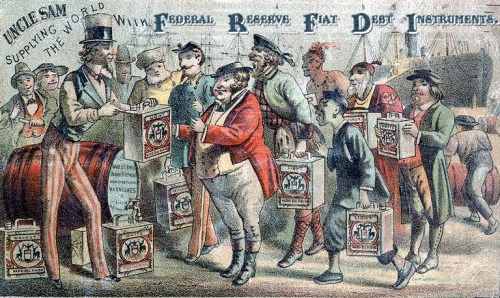
uncle_sam_supplying_federal_reserve_fiat_debt.jpg

Ever since the spring of 2009 when The-Powers-That-Be (TPTB) were out there claiming to see “green shoots” everywhere, the public has been treated to a non-stop propaganda campaign pushing the narrative of economic recovery.

President Obama himself proclaimed his belief in the strength of the American economy, stating for all the world to hear in his 2016 State of the Union Address that anyone who doubted everything was awesome in the main street economy was, to use his words, “peddling fiction.”

And surely Obama couldn’t be wrong. After all, good doctor Ben Bernanke spent several years injecting the US economy with his concoction of Zero Interest Rate Policy (ZIRP) and three rounds of Quantitative Easing (QE). How could anyone doubt but that the wise heads at the Fed have cured what ails us? The stock market just set a new record!

But if you dig down beneath the surface, you’ll find that everything is not awesome. Corporate earnings are down for the fifth quarter in a row. According to the report on Factset, “The second quarter [2016] marks the first time the index has recorded five consecutive quarters of year-over-year declines in earnings since Q3 2008 through Q3 2009.” In other words, corporate earnings haven’t had a losing streak this long since the height of the last financial crisis.

Or take worker productivity, a measure of hourly output per worker, which has declined now for three straight quarters. As the Reuters article pointed out, “U.S. nonfarm productivity unexpectedly fell in the second quarter, pointing to sustained weakness that could raise concerns about corporate profits and companies’ ability to maintain their recent robust pace of hiring.” No kidding.

But why is worker productivity in the US declining? The Reuters article fails to provide a reason. So let me suggest one possibility: businesses are no longer investing in property, plant and equipment, the very things that drive productivity. As Forbes reports, “Corporate executives now shy away from capital spending. Companies are spending money to cut costs – labor cost especially, and also electricity – but few companies are increasing productive capacity.”

So what have executive been spending on if not new productive capacity? Stock buybacks that serve to boost earnings per share and increase bonuses. “Stock buybacks by big American companies are near a historical peak [as of May 2014], but the practice appears to do little to improve their underlying operations and robs them of money for research and future growth. USA Today’s John Waggoner calls stock buybacks a ‘sugar high’,” as John Morgan reports.

Morgan goes on to cite a 1999 quote from Warren Buffett, who said, “Repurchases are all the rage, but are all too often made for an unstated and, in our view, an ignoble reason: to pump or support the stock price.”

Let’s see then, we have stock markets at near record levels, while at the same time corporate earnings are on the decline as worker productivity erodes, which very likely is a consequence of businesses showing greater interest in engineering stock buy-backs rather than in capital spending. Sure sounds like a plan for long-term economic success to me.

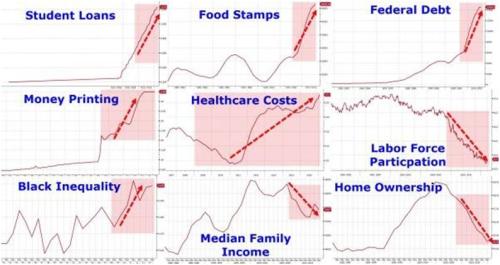
I’ve mentioned only a few data points to illustrate that the economy, far from being robust, is in reality quite weak. But for more of the same, consider the following nine ugly charts. Obama’s term in office is highlighted in red.


Things that should be going up in a healthy economy – Labor Force Participation Rate, Median Family Income, Home Ownership – are all going dramatically down. Those items that one would expect to see going down if the economy really were as good as The-Powers-That-Be tell us – Food Stamps, Federal Debt, Money Printing, Healthcare Costs – are going straight up.

These charts tell a very different story from what Obama’s putting out. Maybe he’s the one peddling fiction.

(more…)

Read Full Post »

Read Full Post »

Crooked Hillary

Hillary Clinton

Fairness. Such an innocent sounding word. So why do I always loath to hear politicians speak of it?


Very likely my trepidation has something to do with the way political hacks abuse the English language. Our public discourse has reached what could be called peak dishonesty. Whatever words our public servants use, if you understand the opposite you’re probably pretty close to catching their drift. And so it is with fairness. If some wanna-be office holder starts using that word, think “mega-ripoff” and you won’t go far wrong.

Hillary Clinton, to no one’s surprise, is the latest politician to use the oft-exploited term “fairness” as cover for more theft by government. One need only look at her proposed “fairness” tax to see this principle in operation.

According to the factsheet Investing in America by Restoring Basic Fairness to Our Tax Code,

There is essentially a “private tax system” for the wealthiest Americans that lets them lower their tax bill by billions, while working families play by the rules and pay their fair (sic) share. In 2013, the 400 highest-income taxpayers – those making more than $250 million per year on average – paid an effective tax rate of just 23 percent, in part because of tax gaming and sheltering to reduce their tax bills. Some multi-millionaires can pay lower rates than their employees.

Now there is much here that is true. The US tax code is hopelessly complex and provides ample opportunity for those who can afford top-notch CPAs and tax-lawyers to take advantage of legal loopholes to shelter vast wealth from the tax man. Ordinary Americans, on the other hand, are not so positioned. Most of us dupes on Main Street end up forking it over big-time to the IRS.

(more…)

Read Full Post »

The Religious Wars of the 21st Century by John W. Robbins – http://www.sermonaudio.com/sermoninfo.asp?SID=53101448594

Conservatism, An Autopsy by John W. Robbins – http://www.trinityfoundation.org/journal.php?id=115

Read Full Post »

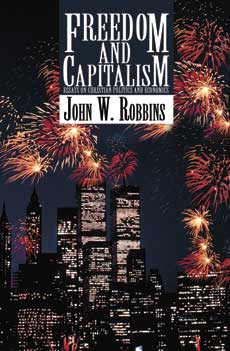
Freedom_CapitalismFreedom and Capitalism: Essays on Christian Politics and Economics by John W. Robbins (The Trinity Foundation, Unicoi Tennessee, 650 pages, 2006), $29.95 (E-Book $10.00).
“Brevity, clarity, and profundity are three virtues missing from the modern world,” wrote John Robbins in the introduction to his commentary on Philemon, (Christianity & Slavery, 7). But while these admirable qualities are missing from the works of most contemporary writers, such is not the case with Robbins’ work.

This reviewer has long been of the opinion that one can get more sound theology and philosophy from reading a single short essay by the late Dr John Robbins that he can get from entire shelves full of books by other authors. In Freedom and Capitalism, Robbins once again displays his remarkable talent for presenting profound ideas in a compact and readable package.

Robbins, who is likely well known to followers of this blog as the founder and former president of The Trinity Foundation, held a Ph.D. in Political Philosophy from The Johns Hopkins University and worked on the staff of Congressman Ron Paul of Texas, serving as Paul’s Chief of Staff from 1981-1985.

He was also an active lecturer and writer. Concerning the latter, Robbins commented in his introduction to Capitalism and Freedom that, “Over the past 40 years, as a student (high shcool, college, and graduate) and adult, I have written hundreds of essays, articles, and letters-to-the-editor” (9). This book represents a collection of thirty-one of articles, all but four by Robbins, on the subjects of politics and economics.

The essays presented in Freedom and Capitalism concern a variety of topics within the broad fields of politics and economics and were written over a period of thirty-four years. But for all that, there is a common theme that runs through them, the Scripturalism of Gordon Clark. Robbins nicely summarizes Clark’s Christian system of thought as follows:

Epistemology: The Bible tells me so.

Soteriology: Justification is by belief alone.

Metaphysics: In Him we live and move and have our being.

Ethics: We ought to obey God rather than men.

Politics: Proclaim liberty throughout the land, unto all the inhabitants thereof.

Economics: Laissez-faire capitalism: Have I not the right to do what I will with my own? (9)

(more…)

Read Full Post »

Elisha Prophesies the End of Samaria's Siege

Elisha Prophesies the End of Samaria’s Siege by Nicolas Fontaine, 1625-1709.


When beginning the Siege of Samaria series on Biblical economics, I never intended it to go on for more than two or perhaps three posts. Due to an embarrassment of material and positive response from the readers of this blog, the series stretched into five posts.  In no small part the success of this series has been due to the generous support of Sean Gerety over at the God’s Hammer blog, who has been kind enough to republish my posts.

It’s certainly been an encouragement to me to see so many people interested in what the Bible has to teach us about economics. Most of the economic talk one hears in the mainstream media is misleading, and, I suspect, it’s designed to be that way. After all, if too many folks were to get wise to the economic evil troika of central banking, fiat currency and demand-side Keynesian economics, it would be a lot harder for the financial masters of the universe to loot the poor and middle class of the world for their benefit.

The lies of the statists enslave, but the truth of God’s Word makes men free. And it is to the end of furthering this truth that I have presented the series on Biblical economics.

And because Biblical economics is both a fascinating and worthwhile study, it seemed good to me to take this opportunity to share with others the intellectual ammunition I’ve found helpful in developing my understanding of the subject. Below is a list of resources along with my comments.

(more…)

Read Full Post »

Elisha Prophesies the End of Samaria's Siege

Elisha Prophesies the End of Samaria’s Siege by Nicolas Fontaine, 1625-1709.


Inflation – What it is and what it isn’t (continued)

In the last installment of this series, I mentioned that the big takeaway point was the definition of inflation. As you may recall, we defined inflation a bit differently than is commonly understood. Most people, when they talk about inflation, mean to say that prices – the amount we pay for items such as gas or bread or rent – have gone up.

The most common statistic used to report rising prices is the Consumer Price Index (CPI). The CPI measures the cost of a representative basket of goods and services, comparing the average price of these items in one period with their average price in the following period.

When the CPI shows average prices going up from one reporting period to the next, the rising prices are reported in the news as inflation. Occasionally, average prices fall. When this happens, we are told that deflation has occurred.

But the definition of inflation that was presented in Part 4 of this series did not rely on measuring the average cost of goods. Instead, inflation was defined as the increase in the supply of money. Conversely, deflation was not defined as decreasing prices, but rather the decrease in the supply of money.

But even though inflation and deflation are not the same thing as rising and falling prices, there is a relationship among them. When the money supply increases, assuming the amount of goods and services in the economy remain the same, prices go up. Conversely, when the money supply falls, prices go down. As Peter Schiff puts it, “The money supply expands and contracts. Prices go up and down. Inflation and price increases are not the same thing. One is cause. The other is effect” (Crash Proof, 69).

Now you may be asking yourself why I bother to define inflation as I do. Isn’t the common definition of inflation good enough as long as we all agree that inflation is rising prices? Why confuse things be bringing in the concept of money supply?

The best argument for defining inflation as the increase in the supply of money is that it clearly identifies the cause of rising prices: central banks creating too much money, usually in response to governments spending too much money.

If we are satisfied with the usual definition of inflation, government officials can easily fool us into thinking that prices are going up for reasons that have nothing to do with their own policies. Bad weather, profiteering by greedy speculators and lack of sufficient governmental regulations are common scapegoats for rising prices, even though prodigal politicians and the central bankers that fund their wasteful spending are the real culprits.

(more…)

Read Full Post »

Elisha Prophesies the End of Samaria's Siege

Elisha Prophesies the End of Samaria’s Siege by Nicolas Fontaine, 1625-1709.

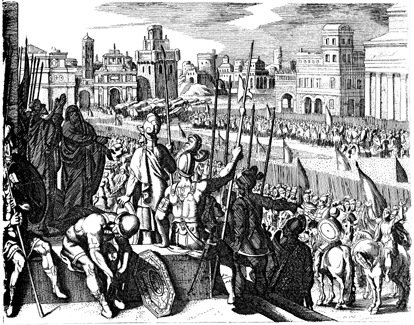
In our last installment, we discussed opportunity cost using the example of the four lepers at the gate of Samaria (2 Kings 7:3-5).


The prospects facing of these gentlemen were all seemingly poor. They could remain where they were and die, they could enter the city of Samaria and die, or they could defect to the Syrians and maybe die or maybe live. Choosing any one of the three options meant forgoing the other two opportunities.

Quite rationally, the lepers elected to forgo the opportunity of dying in Samaria, either outside its gates or within the city itself, for the outside chance that they might survive among the Syrians. The two options of dying in Samaria, we concluded, represented the opportunity cost to the lepers of their decision to go over to the Syrians.

The Samaritan Consumer Price Index

At the same time the lepers were reasoning among themselves about their opportunity cost, inside the city walls of Samaria another discussion was taking place.

By this point, King Jehoram of Israel had had quite enough of the whole siege business and was ready to take it out on someone. The most obvious scapegoat in his mind was the prophet Elisha. Such was the king’s anger with Elisha that he had dispatched one of his high ranking officers to take off the prophet’s head.

This came as no surprise to the prophet, who, apparently forewarned by God that a plot had been hatched against him, told those with whom he was sitting, “Do you see this son of a murderer has sent someone to take away my head? Look, when the messenger comes, shut the door, and hold him fast at the door. Is not the sound of his master’s feet behind him?” (2 Kings 6:32).

When the king’s messenger arrived, Elisha had a message for him. Said Elisha, “Hear the word of the LORD. Thus says the LORD: ‘Tomorrow about this time a seah of fine flour shall be sold for a shekel, and two seahs of barley for a shekel, at the gate of Samaria’ ” (7:1).

Incredulous, the officer responded, “Look, if the LORD would make windows in heaven, could this thing be?” To which Elisha answered, “In fact, you shall see it with your eyes, but you shall not eat of it” (7:2).

(more…)

Read Full Post »

« Newer Posts - Older Posts »