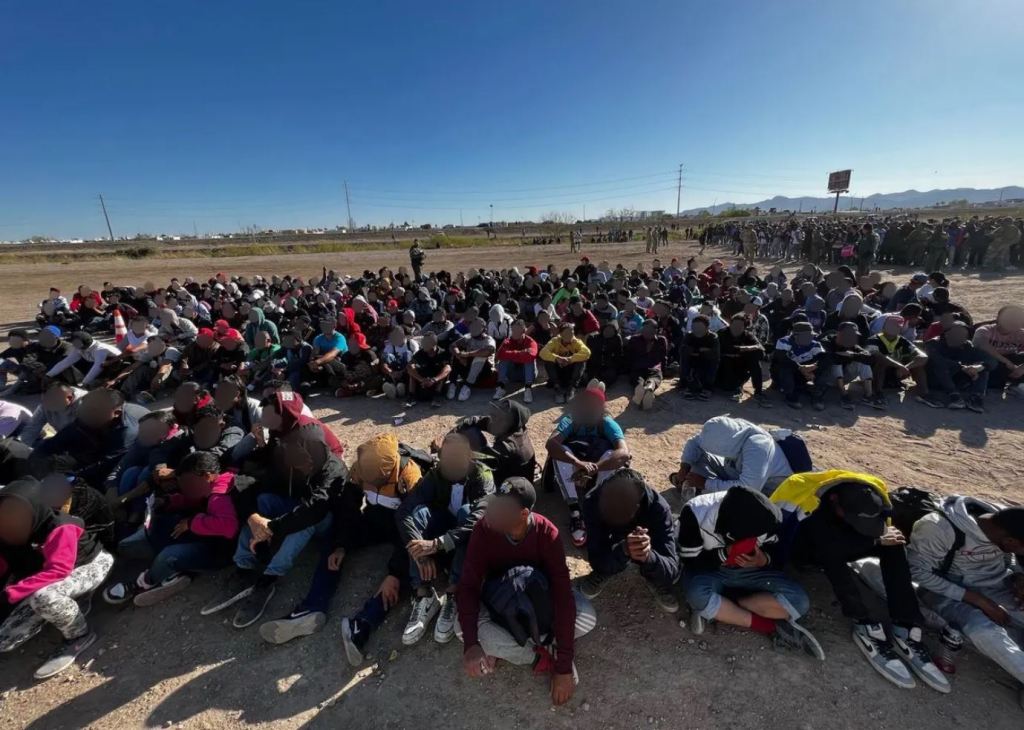
Over 1,000 migrants surrendered to Border Patrol in late March in El Paso, Texas, after cartels spread social media rumors that migrants would be allowed to stay in the US. USBP
“And I will stretch over Jerusalem the line of Samaria, and the plummet of the house of Ahab: and I will wipe Jerusalem as a man wipeth a dish, wiping it, and turning it upside down.”
2 Kings 21:13.
I haven’t written about immigration for a little while, but not because the Biden Regime’s treasonous, Vatican-directed destruction hasn’t been proceeding apace. Perhaps I’ve been a bit distracted. At any rate, if the immigration stories over the past few days are true, and I have every reason to believe they are, Biden’s border treason is about to go next level.
Per the New York Post, “Biden all but admits we’ll see even worse border chaos in May.” Why will it be worse? The Vaticanite Biden Regime will be removing one of the remaining legal barriers to a complete overrun of our southern border by illegal alien welfare invaders, the Title 42 restrictions. Title 42 is a code that has been in place for decades, but which the Trump administration used to remove bogus asylum seekers on the argument that they posed a public health risk during the Covid emergency.
Of course, we’re glad the Covid emergency is ending. It should never have been declared in the first place. But Title 42 has been effective in keeping the Biden Regime’s border invasion less disastrous than it otherwise would have been. According to this piece from PBS, “Since 2020, there have been more than 2 million expulsions of migrants by U.S. Customs and Border Protection at the southern border using Title 42.”
For as in Adam all die, even so in Christ shall all be made alive.
1 Corinthians 15:1
I’m a natural pessimist. A glass half empty kind of guy.
Yesterday I took some time to watch the Cincinnati Reds play the Philadelphia Phillies. The Reds are coming off a miserable season that saw them lose 100 games. The Phillies, on the other hand, were the National League champs last year. But going into the bottom of the ninth and against all odds, the Reds held a slim 2-0 lead, needing just 3 outs to claim the victory. My comment at the time was, they’re probably going to find some way to choke. And sure enough, they did. The Reds’ bullpen imploded, giving up 3 runs, the lead, and the game.
Oh well.
As the line from the movie A League of Their Own goes, “There’s no crying in baseball.”
Now in the ranking of life’s disappointments, watching your favorite team snatch defeat from the jaws of victory rates as a minor thing. But it is an example of the disappointments we all encounter in life. Maybe you didn’t make the varsity team in high school. Maybe you didn’t get into that college you set your heart on attending. That big promotion you thought you were going to get; it went to someone else. And to these examples can be added countless others.
I spend a great deal of time on this blog analyzing the news. Have you heard any good news lately? If you’re like me, probably not very much. It’s ugly out there.
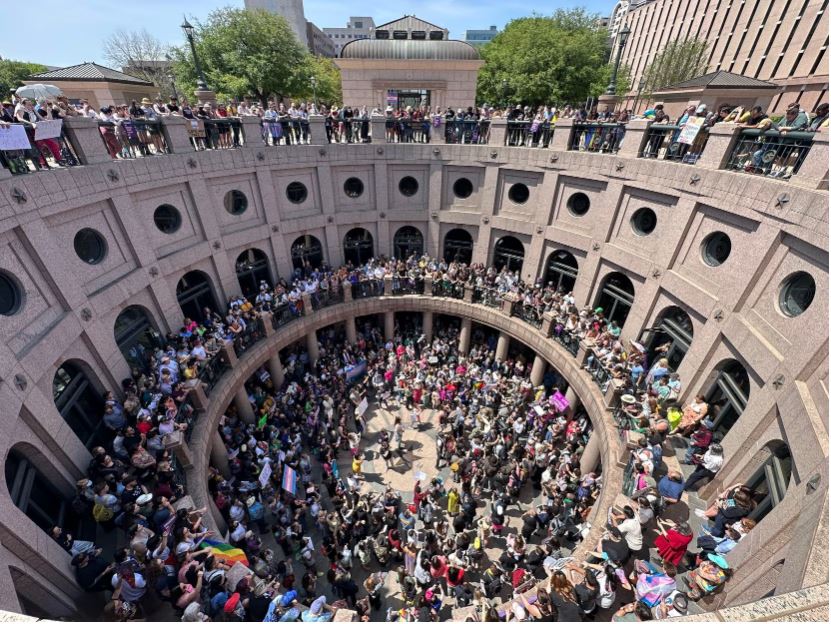
LGBTQ rights activists rally at the Texas Capitol in Austin, Texas on March 27, 2023. (Lauren McGaughy / Lauren McGaughy)
Over 2,500 years ago, the prophet Isaiah penned the words, “Woe unto them that call evil good, and good evil; that put darkness for light, and light for darkness; that put bitter for sweet, and sweet for bitter!” Isaiah was writing about the collapsing theocracy in Judah in the 7th and 8th centuries B.C., but he could just as easily have been commenting on 21st-century America.
What Isaiah was describing has been termed by some a “satanic inversion.” That is, what is put forth by the devil’s votaries as good is the mirror opposite of what is commanded by God and vice versa. God cannot lie. But when Satan lies, he speaks from his own resources. For lies are his native language.
Lies have become the native language of America’s ruling class. Their daddy is the devil. And by ruling class, I mean not just those in positions of political authority – mayors, governors, senators, judges, presidents – but leaders in business, leaders in the schools, leaders in the universities, leaders in publishing companies, leaders in entertainment, leaders in the media, and, yes, leaders in many churches as well. 24/7, Americans are subject to the most extraordinary propaganda, yet many seem blissfully unaware of it.
Last Monday’s horrible shooting at a Nashville church school and the aftermath is an obvious example of a satanic inversion and one that bears closer examination.
It’s not the Guns
Predictably, the gun grabbers were fighting over who could get to the microphone the fastest to call for the disarming of the American people. Oh, they’ll tell you they just want to keep AR-15s out of peoples’ hands. Why, those are weapons of war!
But of course, the gun grabbers have no intention of stopping with AR-15s. If they get their way, their next target likely will be 9mm pistols. Joe Biden himself signaled this last year when he appeared to call for the banning of 9mm handguns. Said Biden in his garbled way, “So the idea of these high-caliber weapons (9mm handguns) is, uh, there’s simply no rational basis for it in terms of thinking about self-protection.”
It’s not surprising that the Roman Catholic, Jesuit-linked Joe Biden would come out against handguns. His Vatican handlers have been pushing for handgun control since at least 1975.
But here’s something to think about. I graduated high school in the mid-1980s. And while younger readers may find this hard to believe, no one was worried about school shootings. The subject just never came up. There were no metal detectors in my high school. There were, as far as I’m aware, no armed resource officers in my high school. The doors were not locked and barred.
And there were guns around in the 1980s. Lots of ‘em.
I don’t say this to suggest everyone at my high school was a perfect angel or that there were no behavior problems. There was a lot of bad stuff happening in the 1980s, including some school shootings. It’s just that if you had used the term “school shooter” in 1980s America, no one would have known what you were talking about. It wasn’t a “thing” at that time.
And school shootings didn’t become a “thing” until two demon-possessed students at Columbine High School went on a shooting spree in 1999 killing 12 other students and one teacher before they killed themselves.
So, if there were guns around in the 1980s and school shootings were rare, then how can guns be the cause of the raft of school shootings we’ve seen since the 1990s?
It was in early March 2020 that my family and I went out to eat to celebrate my birthday at a local restaurant. Little did I know at the time that it would be my last time eating out for over a year. About a week later, Ohio Governor Mike DeWine issued his lockdown orders and life as we knew it came grinding to a halt.
At that point, Covid had been in the news for about 2 months. At first, I wasn’t sure what to make of it. But the more I studied it, the more of a hoax the whole thing seemed. To be clear, when I say “hoax,” I don’t mean to say that it Covid wasn’t a real virus, although some people did make that claim. When I say “hoax,” I don’t mean that people didn’t get sick or die from it either. When I say Covid was a hoax, I mean that the entire narrative created around it was false. Everything from its origin, which still has not been adequately explained by official sources, to suspiciously conspiratorial undertakings events such as Event 201 held in October 2019, to the fact that it was made out to be much more deadly than it actually was by health officials using statistical legerdemain, to the fact that there was no attempt by the medical community to provide early treatment or preventative steps to keep from getting it, to the obvious attempt to censor anyone on social media who didn’t lockstep repeat the regime Covid propaganda, to the deadly hospital treatment protocols, to the forced vaccination campaigns using an obviously deadly shot, to the egregious destruction of civil liberties, to the obvious double standards – BLM and Antifa were allowed to riot while everyone else was expected to shelter in place, big box stores could remain open but mom and pop shops were locked down tighter than a drum, churches were closed but shopping malls and liquor stores could remain open – to the obvious attempts by nefarious individuals such as Bill Gates and organizations such as the Vatican, the World Health Organization, and the World Economic Forum to use Covid as an excuse to promote globalism. All these points were huge red flags.
But in my opinion, the reddest of all red flags that served as a tipoff that Covid was an engineered exercise in tyranny was how governments went after the churches. Christians are commanded in the Scriptures not to forsake the assembling of themselves on the first day of the week, the Lord’s Day, which is the Christian Sabbath. But governments everywhere were making it difficult or downright illegal for Christians to do what God had commanded.
Here in Ohio, the state recommended against churches holding services but did not outright ban it. But other states were more aggressive. One of the early, egregious violations of religious liberty took place in Kentucky. As CNN reported on April 11, 2020, Kentucky Governor Andy Beshear warned that anyone attending Easter services that coming Sunday was would be ordered to quarantine for 14 days. How would Beshear’s administration know who attended Easter services? The state police would be taking down license plates, presumably in the church parking lot, and notify the attendees that this was a misdemeanor violation and require them to self-quarantine.
My reaction to this was outrage, and I don’t even live in Kentucky. Also, it was this action that removed any last lingering doubt that I had that we were not dealing with a virus, but with a deliberate, planned medical tyranny. When governments forbid what God requires, Christians should have no doubt about who is in the right and who is in the wrong.
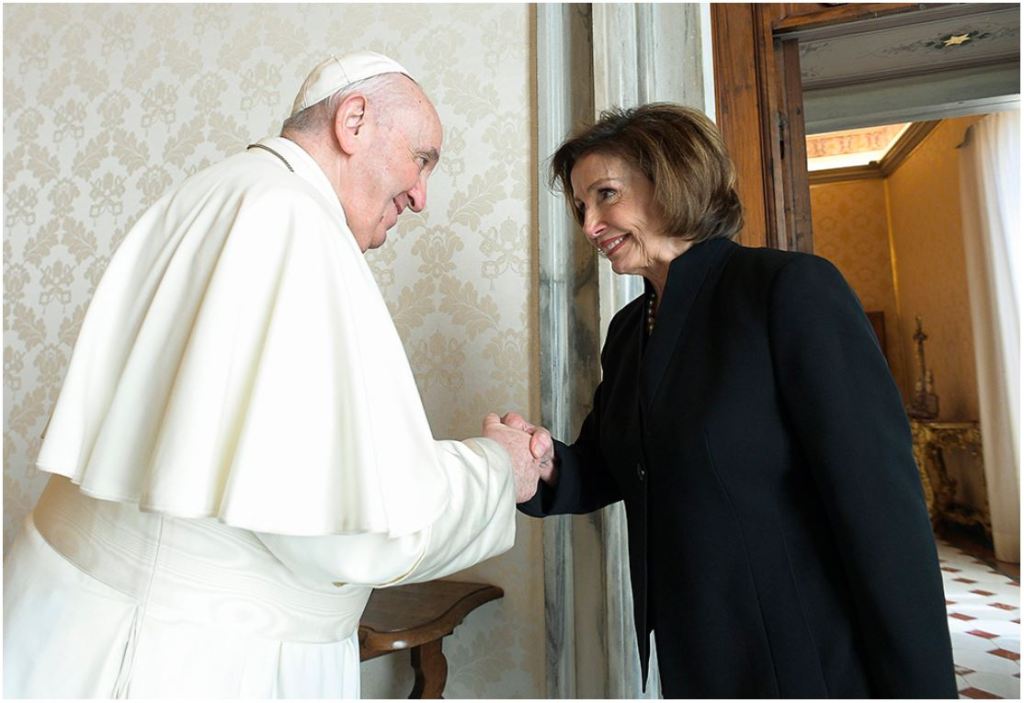
Nancy Pelosi pays a visit to her boss, Pope Francis, for a private audience, on October 9, 2021. (CNS/Vatican Media)
And then shall that Wicked be revealed, whom the Lord shall consume with the spirit of his mouth, and shall destroy with the brightness of his coming: Even him, whose coming is after the working of Satan with all power and signs and lying wonders.
2 Thessalonians 2:8-9
It was on March 13, 2013, that Jorge Bergoglio of Argentina was elected Pope, taking the name Francis I. Francis’s election was notable for several reasons. First, his predecessor, Benedict the XVI, had just left office, becoming the first Pope in 600 years to resign.
Second, Bergoglio was the first Pope to take the name Francis, after St. Francis of Assisi. Assisi, according to Pope Francis, “‘was the man of poverty, the man of peace, the man who loves and protects creation, the same created world ‘with which we don’t have such a good relationship.’” This is significant because Francis has aggressively pushed globalism under the aegis of care for the environment. An example of this can be seen in his 2015 encyclical Laudato Siˊ. In this letter, Francis, “commands the nations to confess their collective sins of exploiting the environment with capitalism.” He also noted, “there is an urgent need of a true world political authority,” to ensure conformity with his call for globalist environmentalism.
Third, Francis is the first Jesuit Pope. This is not a small thing, as the Jesuits have a well-earned reputation for dishonesty, subversion, and murder that has gotten the order kicked out of many nations over the centuries and even officially suppressed by Pope Clement XIV. It was Bergoglio’s Jesuit background that caused former Roman Catholic Priest turned Protestant Evangelist Richard Bennett to call Francis the most dangerous Pope we’ve faced in our lifetime.
Many people, both Christian and non-Christian, would agree that the past several years have seen a rise in many dangerous, anti-liberty trends and that those trends seem to be intensifying and not abating. While these trends did not begin with Francis’s pontificate, they have certainly grown stronger since he took office. Is it possible that there is a connection between the pernicious social, political, and economic trends we’ve seen over the past 10 years and the rise of this Jesuit Pope? In my opinion, I believe there is a connection. Let’s look at the evidence.
Do these bank failures and rumored bank failures signal an imminent collapse of the financial system? I don’t know. I’ve learned to be careful about predicting such things. The Wall Street/Washington/Central Banker establishment has thus far shown itself both dedicated to and capable of kicking the can down the road to a degree that many financial observers, myself included, did not think possible.
In my opinion, these bank failures and possible future bank failures stem from the 2008 financial crisis, which itself was never properly dealt with. The problems in the financial system that cause the Great Recession were never faced squarely and were only papered over with the “untampered mortar” of money printing, bailouts, and accounts tricks. Instead of dealing with our problems honestly, we tried to cheat our way out of the financial crisis. So it should come as no surprise that it appears to be coming back.
So what is a Christian to make of all this? How are we to respond? The Bible has a lot to say about ideas such as prudence, wisdom, and discernment. These traits were highly prized at the time of the Reformation and in the following centuries by the heirs of the Reformation.
Those with a financial or business background may be familiar with the prudent man rule. According to one definition I found, the prudent man rule is, “a rule giving discretion to a fiduciary and especially a trustee to manage another’s affairs and invest another’s money with such skill and care as a person of ordinary prudence and intelligence would use in managing his or her own affairs or investments.” According to this, not only are fiduciaries to manage the financial affairs of others in a prudent fashion but the notion of prudence is also tied to how they would manage their own affairs. That is, the prudent man standard encompasses the golden rule, whereby we are to treat others as we ourselves would like to be treated.
Prudence in financial and other matters served our Protestant forebears well, as it enabled them to build the greatest civilization in history. But as Christianity faded from the scene in America and other nations formerly under the influence of the Reformation, a new ethic took hold. No longer did prudence govern the thinking of men, but a sense of entitlement and instant gratification.
John Maynard Keynes, the most influential economist in the past 100 years, hated the Christian ethic of financial prudence demonstrated in the 19th century and railed against it. In his 1920 book The Economic Consequences of the Peace, Keynes wrote,
And on the other hand the capitalist classes were allowed to all the best part of the cake theirs and were theoretically free to consume it, on the tacit underlying condition that they consumed very little of it in practice. The duty of ‘saving’ became nine-tenths of virtue and the growth of the cake the object of true religion. There grew round the non-consumption of the cake all those instincts of puritanism [n.b. the Puritans are universally despised by unbelievers such as Keynes] which in other ages has withdrawn itself from the world and has neglected the arts of production as well as those of enjoyment. And so the cake increased; but to what end was not clearly contemplated. Individuals would be exhorted not so much to abstain as to defer, and to cultivate the pleasures of security and anticipation. Saving was for old age or for your children; but this was only in theory, – the virtue of the cake was that it was never to be consumed, neither by you nor by your children after you.
Keynes, The Economic Consequences of the Peace, pp. 19-20.
With a mindset like this, it should come as no surprise that Keynes was an apostle of deficit spending and government debt, both of which he mistakenly saw as necessary for ending the 1930s Great Depression, which itself was caused and prolonged by the interventions of central bankers and governments. Asking central bankers and politicians to fix a depression or a banking crisis is like inviting an arsonist to put out your house fire.
How widespread is the influence of Keynesian economics? A famous 1971 quote from then-President Richard Nixon is a clue. “We are all Keynesians now,” said the President. It was true then, and it remains true today. All, or nearly all, economists working in academia, on Wall Street, in corporate America, and in Washington are Keynesians of some sort or another. The baleful influence of Keynesian economic thought is substantially responsible for the sorry economic predicament of America and other western nations. What is Keynesian economics? Without delving into a lot of technical details, it’s the idea that you can deficit spend yourself rich. The “puritanical” prudence demonstrated in more Christian centuries said that hard work, savings, and investment were how you built wealth and financial security in the long run. But Keynes famously said, “In the long run we are all dead.” Various apologists for Keynes have tried to rehabilitate this statement by arguing that Keynes really wasn’t saying he had no regard for the future. But when you consider Keynes’s “in the long run we are all dead” comment in the context of his other statements such as the extended quote above, it seems entirely fair to see it as a Keynes’s dismissing the future for gratification in the now.
So back to our earlier question, how is a Christian to respond to the ongoing financial crisis? Proverbs 22:3 quoted at the top of this post provides good guidance. Notice that the prudent man does two things, he foresees trouble coming and then hides himself.
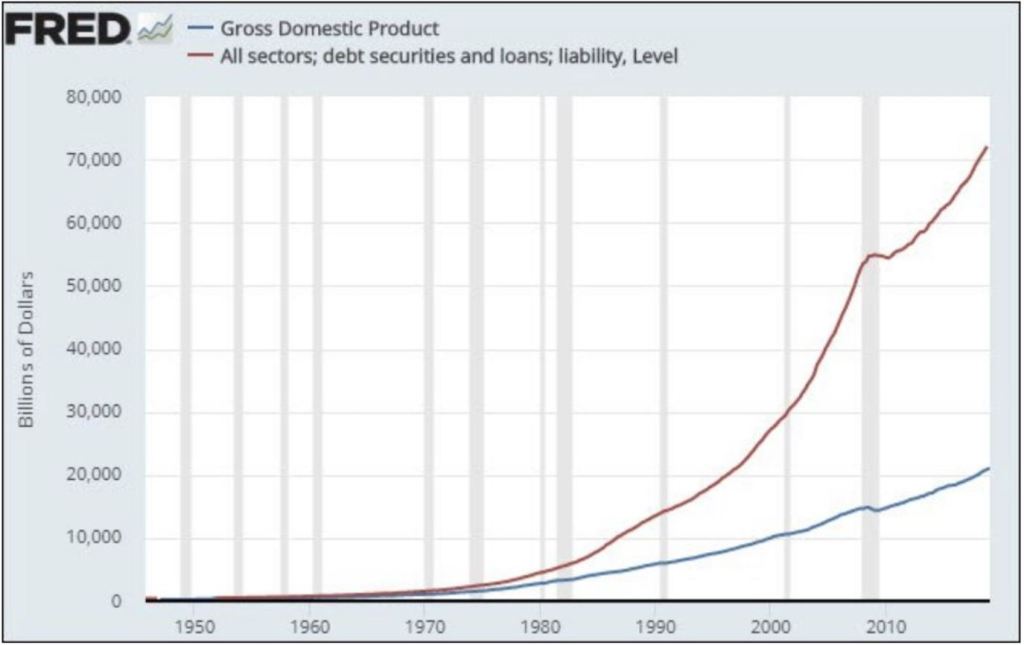
The first thing you and I need to do is to recognize that there is trouble coming. Many people, even many Christian people, do not realize the serious economic danger America and other western nations are in. The United States is over $30 trillion in debt. And that’s just federal debt. It doesn’t include state, municipal, corporate, or individual debt. And the debt keeps growing. In fact, given that our financial system is based on debt, the debt must keep growing to sustain the system. Obviously, debt cannot expand infinitely and forever. God has so constructed the universe that all debts must be paid. Just look at the chart at the top of this post. Do you think debt can continue to grow faster than income? If not, the current financial system must come to an end. It’s a matter of when, not if, we have a system-down event. The timing of the collapse is uncertain. But in my opinion, it’s probably sooner rather than later.
Second, as Christians, we must hide ourselves. What does this mean in the context of a financial crisis? A lot of those old-fashioned “puritanical” ideas, the sorts of things that Keynes and others of his ilk hated and made war on a century ago, are a good place to start. Eliminating debt and building savings is wise counsel. And when I say savings, I mean at least some of that savings should be held outside the financial system. That means having some ready physical cash at home. It also means holding some savings in dollar alternatives. The best dollar alternatives are physical gold and silver, but there are other options as well.
One-Time
Monthly
Yearly
Make a non-tax-deductible donation to support the work of Lux Lucet
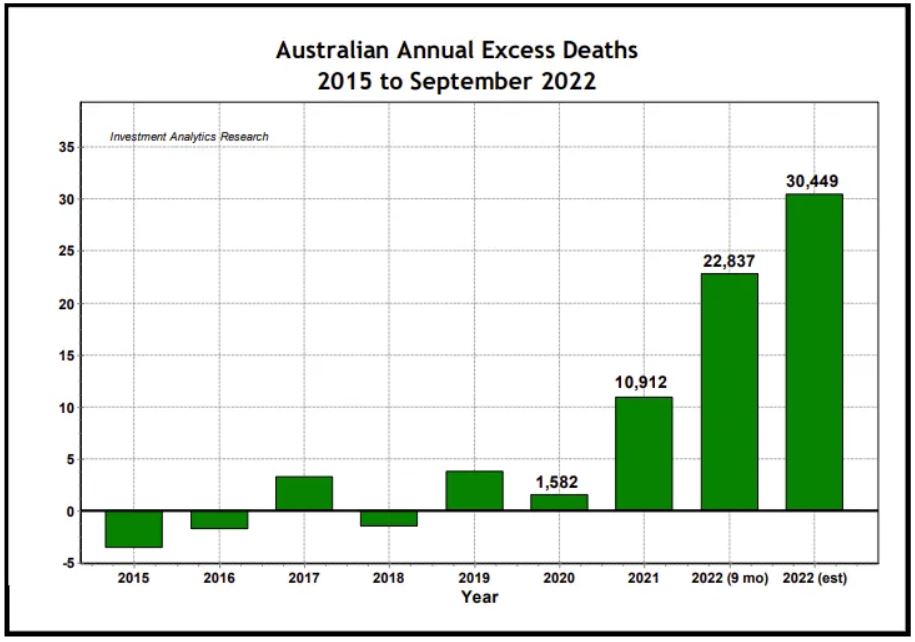
A friend of mine who works for an insurance company recently commented that he just received his annual 2022 bonus. It was down from what he’d expected. The reason, according to his employer, was that there were record death claims in the life insurance line of business.
Wait, what?
Record death claims in the life insurance division? What could possibly be causing that?
I think I know. And if you’re reading this blog post, I think you probably know as well.
It’s the jab. The poison death shot. The mRNA special. That’s what’s killing so many people.




 Lux Lucet