Feeds:
Posts
Comments

Archive for the ‘Uncategorized’ Category

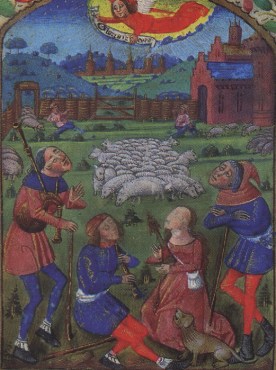
shepherds_illuminationFor the law was given through Moses, but grace and truth came through Jesus Christ (John 1:17).

“I have no idea why justification is by faith alone,” said the hapless minister in story related to my class by Dr. Robert Reymond. The minister, it would seem, was a well intentioned but rather confused fellow.

“Good grief!,” Dr. Reymond continued, “the Bible tells right in Romans chapter 4 the reason why we’re justified by faith alone. ‘Therefore it is of faith that it might be according to grace, so that the promise might be sure to all the seed…’ ”

The saints of God of justified – that is, they are declared righteous by God – not on the basis of their works, but on the basis of faith alone in the finished work of Christ alone, so that their salvation may be on the basis of God’s grace – that is, his unmerited favor – alone.

The redeemed have nothing to boast in except their great Savior. As the old hymn puts it, “Noting in my hand I bring, Simply to the cross I cling.”

Grace is God’s giving his people, not what they deserve, but the blessings he has purposed for them out of the mere good pleasure of his will.

And nowhere is God’s grace more evident than in the birth of Christ Jesus, who, as Paul tells us, was “born of a woman, born under the law, to redeem those who were under the law, that we might receive the adoption as sons.”

In Christ, God has made a way to save his people. The law was given through Moses. And the law condemns us, for we all are guilty of violating it. In it, we have no hope. But Christ fulfilled the law perfectly. And those who believe in him are credited with his righteousness, that they may live for God.

And while it’s important to understand the graciousness of God’s grace, it is also important to remember that his grace is never apart from the truth.

Unlike what some modern day theologians would tell you, God does not speak to us through myth or falsehood. Those who say such things impugn the character of God by their words and bring condemnation upon themselves.

God speaks to us through his Word, and his Word is truth. Always.

Jesus declared that he himself was truth, “I am the way, the truth and the life. No one comes to the Father except through Me.”

How is it that Christ could say “I am the truth”? Doesn’t that seem to be a rather strange way to speak? We might say that so-and-so spoke the truth. But we don’t say of him “he is the truth.” Yet Jesus described himself, not as speaking the truth, but as truth itself.

The answer, I believe, lies in what Gordon Clark taught about truth and persons. Truth, as Clark insisted, is a characteristic of propositions only. A proposition is the meaning of a declarative sentence.

For example, “The ball is red,” is a propositional statement, because it states that a certain property, in this case “red”, attaches to a certain subject, “the ball”. Now if we perceive that the ball is in fact red, we would say the proposition “The ball is red” is true. If, on the other hand, the ball appears green to us, we would say the statement is false.

But what do propositions have to do with the person of Christ? It has to do with how one defines a person. A person, in Clark’s definition, is a complex of propositions. Or to put it a little less philosophically, a person is the thoughts he thinks.

Christ could say of himself “I am the truth” because all his thoughts were true. And since a person is defined by his thoughts, it is proper for Jesus to speak of himself as “the truth.”

When Christ was born in Bethlehem all those years ago, it was the birth, not of one who merely spoke the truth, but of truth itself.

Read Full Post »

fake-news

It’s been a while since I’ve written a Week In Review. Too long for my taste. I’ve been a political/economic/world events junkie for as long as I can remember, and I really do enjoy reading and writing about the events of the day.

So, let’s get on with the business at hand…

(more…)

Read Full Post »

It’s ten days to go until the big election, but to me it feels a bit like fourth and goal with the clock ticking down.

On the one side you have the establishment interests desperate to shove Hillary across the goal line.

On the other side of the ball, you have the American people, at least the ones who have enough sense not to support a criminal for president, seeking to push back against the onslaught of lies and fraud to make the big defensive stop.

It’s do or dies time.

So how’s this going to play out? Do the American people make the big stop, or does the Evil Empire win the day.

My Scripturalist convictions prevent me from making knowledge claims apart from Scripture and for that reason I tend to shy away from predictions. There’s that, plus I really just don’t like setting myself up to look foolish.

That said, I’m going to take a baby step out on a limb on offer an opinion, not a knowledge claim, but an opinion, and say that come Friday January 20, 2017 we’re going to bear witness to the inauguration of President Trump.

Why do I say this? Well for starters…

(more…)

Read Full Post »

Read Full Post »

Read Full Post »

Read Full Post »

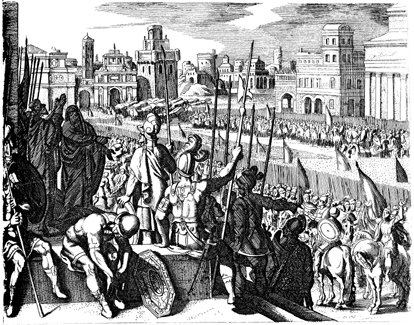
Elisha Prophesies the End of Samaria's Siege

Elisha Prophesies the End of Samaria’s Siege by Nicolas Fontaine, 1625-1709.

My goal in this series is to demonstrate that many of key concepts of economics are either explicitly or implicitly taught in Bible’s account of the siege of Samaria as found in 2 Kings 6:24-7:20.


In Part One, we looked at 2 Kings 6:25 and what we could learn from the exorbitant prices people were paying for undesirable food under siege conditions. In Part 2, we looked at the relationship between two economics and politics. Especially, we considered how economic hardship is frequently brought on by the ill-conceived policies of politicians, who, being loath to take the blame themselves, often will attempt to find a scapegoat to divert public dissatisfaction away from themselves.

Today, I would like us to look at another important economic concept demonstrated in 2 Kings: opportunity cost. But before diving into that, perhaps it would be advisable to offer a definition of economics.

Economics, What is it?

In his lecture series on economics, John Robbins offered the following definition of economics: it is the study of the logic of choice.

That may sound a bit surprising to many people. It is common to think of economics as news about what the stock market did today, but that is history. Some may think of economics as mathematics. Still others, when they consider the subject at all, hold very negative views about economics. For example, 19th century Scottish thinker Thomas Carlyle famously dubbed economics “the dismal science.”

But starting with the axiom of Scripture, the idea that the Bible has a monopoly on truth, Robbins makes a strong case for his definition. He starts with four principle statements about man taken from Scripture:

  • Men are rational creatures made in the image of God.
  • Men always act purposefully.
  • Men always act in their perceived self-interest.
  • Only individuals choose/make plans/act.

From these concepts, Robbins provides us with the following chain of reasoning: To be human is to be rational > To be rational is to have purposes > To have purposes is to plan > To plan is to arrange ends and means (in other words, to choose). And economics, as Robbins defines it, is the study of the logic behind the choices we make.

(more…)

Read Full Post »

meltdown-620Today we may apply the Apostle’s words first to those (rulers) who without cogent cause inflict exorbitant taxes upon the people, or by changing and devaluating the currency, rob them, while at the same time they accuse their subjects of being greedy and avaricious.

    – Martin Luther, Commentary on Romans 2:2, 3

Now, if the laws of buying and selling are corrupted, human society is in a manner dissolved; so that he who cheats by false weights and measures, differs little from him who utters false coin.

    – John Calvin, Commentary on Leviticus 19:35

But if life is an equal value to all, there is something strange, when war comes and large military expenditures are necessary, in requiring the person who has saved for a life insurance policy to lose half its buying power by inflation, while the spendthrift loses nothing and enjoys high wages to boot.

    – Gordon H. Clark, A Christian View of Men and Things, pp. 101-102

Read Full Post »

« Newer Posts - Older Posts »