Feeds:
Posts
Comments

Archive for the ‘Theology’ Category

Thoughts on Thankfulness

Having just celebrated Thanksgiving Day, thankfulness has been on my mind lately.

I know I’ve said on my podcast that I’m not always the best when it comes to seeing the bright side of things. More to the point, I’m a natural pessimist. I tend to expect the worst. This mindset has one advantage: I don’t get overly hyped up about something, only to later get disappointed when it doesn’t come to pass.

Just to illustrate my point, last night I was watching a football game between my alma mater the University of Cincinnati and Texas Christian University. UC went down early in the game. But in the second half, they started to mount a comeback. UC closed to within 7 points with a touchdown and had the opportunity to cut the lead to 6 with an “automatic” extra point.

Alas, it was not to be.

UC’s kicking game has had problems the past few years. This time, the kicker pushed the ball to the right of the goalpost. No good.

But wait! There was a flag on the play. TCU, as it turned out, had jumped offside! UC would get another shot at the extra point. There’s no possible way they could miss two extra points in a row. Right?

Wrong.

The second kick was worse than the first. This time, instead of the extra point going wide right, the kicker gave it a nasty hook to the left. It was almost as if he was aiming for the sideline, not the goalpost. I was reminded of Luther’s comment about mankind being like a drunkard who, having fallen off the horse on one side, gets back on only to fall off the horse on the other side.

Oh well.

Never in a lifetime of watching football have I ever seen a team miss consecutive extra point attempts. I suppose it’s happened before. But it doesn’t happen very often.

The missed extra points spelled the end of the road for UC’s comeback attempt. They went on to lose 20-13. And not only that, but it was also the season finale and UC’s fifth consecutive loss. What a rotten way to close out the year.

Now you know at least one reason I’m a pessimist: I’ve been trained by years of watching Cincinnati sports teams’ futility.

I mentioned earlier that pessimism has one advantage: it keeps you from disappointment. On the other hand, expecting the worst can cultivate a jaded view of life that can keep you from seeing the blessings that the Lord sends your way. I know. I’ve been guilty of missing many of those blessings in my own life or of taking them for granted.

In a men’s Bible study I attend, we always close with prayer by going around the table, each man having the opportunity to pray. One of the regular attendees will always close his prayer with “thank you for loving us.” I’ve always appreciated that. It’s good prayer language, reminding us that God didn’t have to send his Son to die in our place to atone for our sins.   

The Lord didn’t have to love us. He could have left us to die in our ignorance and face judgment clothed in our own “righteousness” rather than that of his Son, Jesus Christ. How would any of us fare under those circumstances? I can safely say that it wouldn’t go well.

The psalmist wrote, “He has not dealt with us according to our sins, nor punished us according to our iniquities.” Now that’s something to be thankful for.

Even for a natural pessimist…or a Cincinnati sports fan.

One-Time
Monthly
Yearly

Make non-tax deductible donation to support the work of Lux Lucet

Make a monthly donation

Make a yearly donation

Choose an amount

$5.00
$15.00
$100.00
$5.00
$15.00
$100.00
$5.00
$15.00
$100.00

Or enter a custom amount

$

Your contribution is appreciated.

Your contribution is appreciated.

Your contribution is appreciated.

DonateDonate monthlyDonate yearly

Read Full Post »

U.S. President Joe Biden, right, greets Pope Francis ahead of a working session on Artificial Intelligence (AI), Energy, Africa-Mediterranean, on day two of the 50th G7 summit at Borgo Egnazia, southern Italy, June 14, 2024.

Many Christians entirely miss the political and cultural influence of the Vatican, even when it’s reported publicly, even when it’s held up right in front of their faces. 

Consider how many influential Americans the pope has met with just recently.

Note well that the papal audiences described above are just with Americans and held over the past month. If you follow the news at all, you’ll know that these are not just ordinary Americans but individuals at the very top of the political and cultural pyramid. 

In recent days, the Pope has also addressed the G7 and met with Canadian Prime Minister Justin Trudeau.

Read Full Post »

I have a confession to make.  I’m a glass-half-empty guy.  I don’t recall any particular event that made me that way.  No crushing tragedy that I can point to or someone I can blame.  It seems that it’s my nature to be so.  But perhaps there’s something more to it than my own personality.

If you pressed me on why I tend to look on the dark side of things, maybe it has something to do with the zeitgeist, the spirit of the age.  I was born in the 1960s into a collapsing civilization, the collapse of which has only accelerated over the course of my life.  Civilizational collapse is not a pretty sight for anyone with a philosophical bent.  Of course, philosophical reflection is not a prerequisite to experiencing the impact of a civilizational collapse.  When the barbarians are scaling the walls and burning your city, even the least reflective man knows he’s in trouble. 

But barbarians scaling the walls and burning the city mark not the beginning of a civilization’s collapse but its end.  What marks the earlier stages of a collapse is the rejection of truth, the belief in the lie, and decisions based on the lie – things which at the time may have seemed righteous and good and progressive to many – but which eventually and necessarily lead to destruction.  “There is a way which seemeth right unto a man, but the end thereof are the ways of death” to quote Proverbs.      


Read Full Post »

For as in Adam all die, even so in Christ shall all be made alive.

  • 1 Corinthians 15:1

I’m a natural pessimist.  A glass half empty kind of guy. 

Yesterday I took some time to watch the Cincinnati Reds play the Philadelphia Phillies.  The Reds are coming off a miserable season that saw them lose 100 games.  The Phillies, on the other hand, were the National League champs last year.  But going into the bottom of the ninth and against all odds, the Reds held a slim 2-0 lead, needing just 3 outs to claim the victory.  My comment at the time was, they’re probably going to find some way to choke.  And sure enough, they did.  The Reds’ bullpen imploded, giving up 3 runs, the lead, and the game. 

Oh well. 

As the line from the movie A League of Their Own goes, “There’s no crying in baseball.” 

Now in the ranking of life’s disappointments, watching your favorite team snatch defeat from the jaws of victory rates as a minor thing.  But it is an example of the disappointments we all encounter in life.  Maybe you didn’t make the varsity team in high school.  Maybe you didn’t get into that college you set your heart on attending.  That big promotion you thought you were going to get; it went to someone else.  And to these examples can be added countless others.      

I spend a great deal of time on this blog analyzing the news.  Have you heard any good news lately?  If you’re like me, probably not very much.  It’s ugly out there.

Read Full Post »

Queen Athaliah Orders The King’s Children to be Killed by Harmen Jansz Muller, Hadrianus Junius, and Gerard De Jode.

And when Athaliah the mother of Ahaziah saw that her son was dead, she arose and destroyed all the seed royal.

  • II Kings 11:1

Today I’d like to wrap up our look at Jehoiada’s righteous interposition on behalf of the legitimate Davidic line of kings and the people of Judah.

As we’ve discussed so far, the purpose of this series is to look at an important but largely ignored Biblical doctrine known as the doctrine of the lesser magistrate.  Last week we defined the doctrine of the lesser magistrate using Matthew Trewhella’s book The Doctrine of the Lesser Magistrates.  In his book, Trewhella gives the following definition of this doctrine,

The lesser magistrate doctrine declares that when the superior or higher civil authority makes unjust/immoral laws or decrees, the lesser or lower ranking civil authority has both a right and duty to refuse obedience to that superior authority.  If necessary, the lesser authorities even have the right and obligation to actively resist the superior authority (1).

It’s important to define and discuss this doctrine because Christians in the West find themselves in situations where more and more they live under governments that are openly hostile to them.  Good is now evil and evil is now good.  In some places, Christians can find themselves prosecuted for quoting what the Bible says about homosexuality, while satanic transgender activists are free to recruit kids for their perverted cause. 

Here in the United States, we have a situation much like what Judah faced under Queen Athaliah, an illegitimate government that goes out of its way to implement evil policies.  Athaliah was a murderess and promoter of Baal worship.  Joe Biden works tirelessly to implement the Vatican’s globalist agenda via his climate change policies, unprecedented illegal immigration, attacking the Americans’ Second Amendment rights, fanning the flames of war in eastern Europe, the promoting sexual perversion, and accusing patriotic, Christian Americans of sedition when they speak out against his evil.

When faced with evil government dictates, some Christians will point to Romans 13:1 – Let every soul be subject to the governing authorities – and argue that there is no legitimate or almost no legitimate reason for Christians ever to push back against evil government commands. If a governor says that you have to shut down your church due to Covid, you shut down your church due to Covid, and that’s just that.  Anything else is unrighteous rebellion.  That this is a widespread opinion can be seen by the number of churches that bent their knee when told to close their doors “to stop the spread.”

On the other hand, there are some people who hold that primate rebellion is a justified response against a tyrannical government.  There are several instances where the kings of Judah and Israel were murdered by political opponents.  Oddly, young king Joash, whom Jehosheba and Jehoiada saved, would later be murdered by his servants.  But the murder of Joash, even though Joash had clearly deviated from the paths of righteousness later in life, is clearly condemned in the Scriptures.     

So we see that neither blind obedience nor private rebellion is the Christian answer to dealing with tyrannical governments.  The Christian answer is the doctrine of the lesser magistrate.  A doctrine we see modeled quite well by the righteous high priest Jehoiada.  Jehoiada hid the young, rightful heir to the throne of Judah for six years.  After that period had elapsed, he organized a military guard, brought the seven-year-old Joash out in public, and made him king.   

That’s where we left off last week.  Let us now consider the beneficial effects of Jehoiada’s actions and what lessons American and other Western Christians can take from his example.

Read Full Post »

Queen Athaliah Orders The King’s Children to be Killed by Harmen Jansz Muller, Hadrianus Junius, and Gerard De Jode.

And when Athaliah the mother of Ahaziah saw that her son was dead, she arose and destroyed all the seed royal.

  • II Kings 11:1

Today we continue our look at how Christians are to conduct themselves when they find themselves living, as we are here in America in 2022, under an evil and hostile government. 

For most of us in America and in the West generally, the idea that we ever would find ourselves living under a government that actively hates us and seeks to harm us has seemed like a paranoid fantasy.  Yet with the growing power of globalist organizations such as the Vatican, the World Economic Forum, the United Nations, and the Bilderbergers, as well as individuals such as Bill Gates and George Soros, Americans, and citizens of other once free Western nations have found themselves living under governments that are actively and openly hostile to their political and economic liberties and even their very lives. 

This state of affairs raises a number of questions for Christians. How is a Christian to respond when living under a hostile government? Does a Christian have a right to resist an evil government, or does he simply have to put up with whatever laws a rogue government enacts, however evil and destructive they are?  If resistance is an option, who does the resisting?  What actions constitute proper resistance if resistance can ever be considered proper? 

Last week we considered the actions of a private citizen to resist the actions of evil, usurping Queen Athaliah by looking at Jehosheba, who took it upon herself to rescue the only remaining heir of the Davidic throne from the murderous queen, thus preserving the David dynasty.  Had Jehosheba not stepped up and saved the infant Joash, there would have been no continuing line of David to sit on the throne of Judah and God’s promise would have been made void.  One lesson we can take from this is that private citizens may resist the commands or the actions of a ruler when those actions are evil. 

The basis for private citizens is clearly seen in Romans 13.  There, we read that the civil magistrate is, “God’s minister to you for good.” If the civil magistrate is “God’s minister,” it is God who is sovereign, not the magistrate.  This means that the magistrate’s power is delegated to him by God and does not originate with himself.  As such, the civil magistrate is bound by the law of God just as is the private citizen.  Rulers do not have a license to lie, cheat, steal, or murder any more than a private citizen does.  But if this is the case, who can call the civil magistrate to account?  Or to put the question slightly differently, is it ever appropriate to rebel against and forcibly remove from power an evil ruler?  And if it is, who can rightfully do this?      

The Scriptures rule out the idea of private citizens taking matters into their own hands.  Christians are enjoined to pray for rulers so that they may live peaceable lives.  Christians can rebuke evil rules for their evil deeds.  Take for example John the Baptist’s rebuke of Philip for taking his brother’s wife.  But leading a violent rebellion is not something Christians as private citizens are called to do.  As further proof of this, we see examples in the Scriptures of men who assassinated evil kings – for example, those men who assassinated King Joash when he went rogue later in life – being treated like murderers.

So, is it ever appropriate for Christians to use physical violence to rebel against an evil ruler?  Not for Christian private citizens.  But it is appropriate for Christians who wield civil power to do so.  In Protestant circles, this idea has historically been known as the doctrine of the lesser magistrate.  In his book The Doctrine of the Lesser Magistrates: A Proper Resistance to Tyranny and a Repudiation of Unlimited Obedience to Civil Government, Matthew Trewhella defines the doctrine of the lesser magistrate thus,

The lesser magistrate doctrine declares that when the superior or higher civil authority makes unjust/immoral laws or decrees, the lesser or lower ranking civil authority has both a right and duty to refuse obedience to that superior authority.  If necessary, the lesser authorities even have the right and obligation to actively resist the superior authority (1).

Note well, as Trewhella has defined it, the doctrine of the lesser magistrate states that lower ranking civil authorities not only have the right to actively resist superior authorities, but when those superior authorities make unjust or immoral laws or decrees, they even have the duty to do so.

Let us now turn to the example of the faithful High Priest Jehoiada to see how his interposition helped to remove a wicked government and restore the God-ordained Davidic monarchy to Judah. 

Read Full Post »

Queen Athaliah Orders The King’s Children to be Killed by Harmen Jansz Muller, Hadrianus Junius, and Gerard De Jode.

And when Athaliah the mother of Ahaziah saw that her son was dead, she arose and destroyed all the seed royal.

“If their princes exceed their bounds, Madam, no doubt they may be resisted, even by power.”  Those were John Knox’s words in response to Queen Mary when she queried him about the rights of subjects to resist their princes. 

Was Knox right?  I contend that he was.  It is my contention that not only may an evil government be resisted, but it is in fact the duty of Christians to resist civil authorities when they, in Knox’s words, “exceed their bounds.”

Last week, we began our look at Christian resistance to an evil, usurping civil magistrate.  Part of the answer given was what Christians should not do:  engage in private rebellion.  One example of sinful rebellion we looked at in the Word of God is found in II Kings 12:20 where we read that King Joash was murdered by two of his servants.  When Joash’s son, Amaziah, came to power, he had the men responsible for the assassination of Joash put to death, and rightfully so.

But what is the positive duty of the Christian?  If Christians are not to engage in private rebellion by assassinating a ruler, even if the ruler is unjust as was Joash in his later years as king, what are believers to do?  We also explored that question last week in our discussion about the Doctrine of the Lesser Magistrate (DLM).  The DLM tells us that when a higher authority becomes corrupt, it is the right, indeed it is the duty, for lesser civil authorities to interpose between the corrupt higher authority and the people. And not only do lesser magistrates have the right and duty to resist, but that right and duty extends up to and includes removing from office and, if the situation calls for it, executing the offending higher authority.

This week I’d like to look at one very clear example of this found in the books of II Kings and II Chronicles concerning the evil, usurping Queen Athaliah.   

Although it is not the main purpose of this essay, it’s worth mentioning that the account of Queen Athaliah is an important text also for refuting feminism.  Many today, including many Christians, have had their minds so twisted by 200-plus years of feminist dogma that they find it strange that anyone would oppose women serving as rulers of cities and nations.  In fact, there a probably few ideas that can incite people to anger than to suggest that God has denied women the right to political leadership. But the thundering Scot John Knox was not so blinded and rightly argued against women rulers in his “First Blast of the Trumpet Against the Monstrous Regiment of Women,” a work which this author considers among the greatest essays ever written by a Christian.

Read Full Post »

Finally, my brethren, be strong in the Lord, and in the power of his might.

  • Ephesians 6:10

Commenting on Ephesians 6:10, Gordon Clark said of this verse, “Here begins the peroration of the epistle.” 

“Peroration” is not a term most of us commonly use.  It means the concluding part of a discourse, especially the concluding part of an oration.  A second meaning of “peroration” is highly rhetorical speech.  In light of this definition, Clark’s calling verse 10 the beginning of the epistle’s peroration certainly seems appropriate.  Verses 10-18 of Ephesians chapter 6 are memorable, not only for the message itself but also for the rhetoric Paul uses to make his point.

In this passage, Paul uses the figure of a Christian soldier armed to do battle against the wiles of the devil

Now this passage on Christian spiritual warfare has many applications.  But the focus of my comments today will be concerning Christians and the present battle against Covid tyranny. 

For nearly two years, Christians the world over have been subjected to a remarkably intense political, economic, and psychological assault by the political, academic, religious, and business elite of the world.  This assault, whether in the form of unprecedented lockdowns, vaccine mandates, or restrictions on movement, ultimately is not a political battle, although it involves political oppression.  Neither is it fundamentally economic in nature, even though the pushers of the Covid narrative have certainly attacked ordinary people economically while at the same time vastly enriching many billionaires who benefited from the lockdowns and vaccine mandates.

Read Full Post »

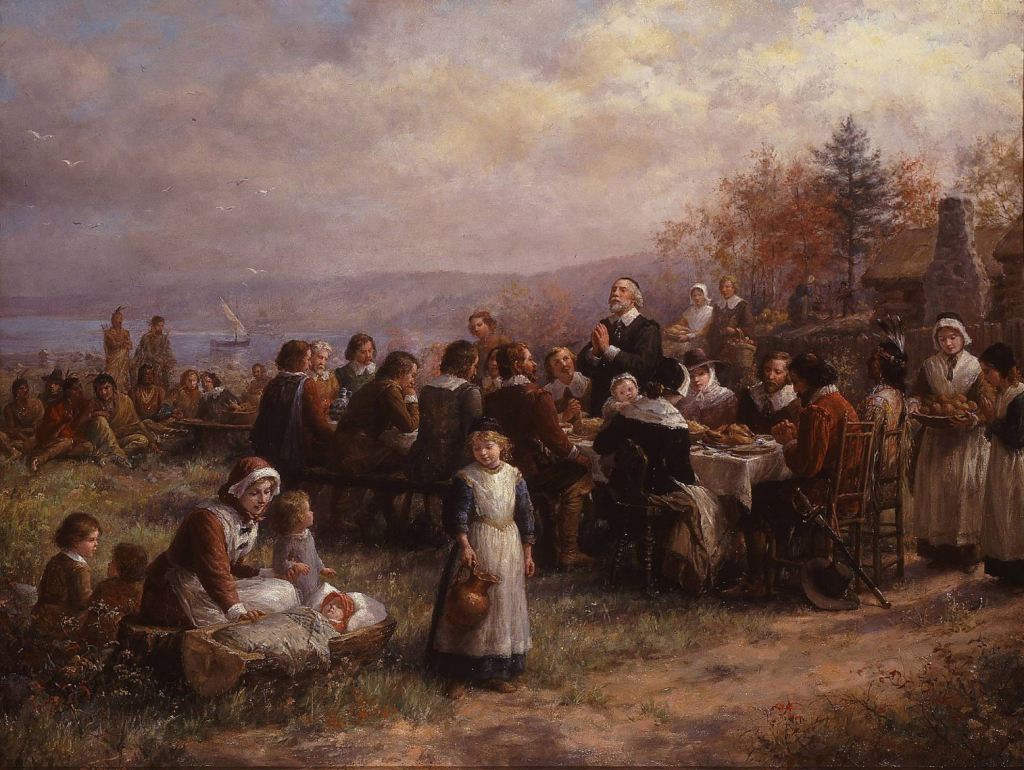
“The First Thanksgiving at Plymouth” (1914) By Jennie A. Brownscombe

In everything give thanks: for this is the will of God concerning you.

  • 1 Thessalonians 5:18

I’ve always been thankful for the Thanksgiving holiday.  From its Christian origin in the early history of America to its central message of giving thanks to God for his providential blessings, to the food and family, it serves as an annual and much-needed reminder to God’s people to consider the many blessings he brings to our lives and express our gratitude for them.

In thinking about my own sinful tendency to see the worst in things, I would add that setting apart a day to give thanks to God for his many blessings is of no small importance. 

The verse from 1 Thessalonians quoted above is remarkable for the extent of its application.  Paul didn’t tell the Christians in Thessalonica to give thanks in some things, or to give thanks in many things, or to give thanks when things went well for them.  He told them, “In everything give thanks,” that is, Christians are to give thanks in all circumstances.

Does anyone else find that a bit challenging and convicting? 

Giving thanks can be hard, even when things turn out as we like.  Perhaps we get caught up in the moment and forget the Lord.  Or maybe we, as did Nebuchadnezzar when overlooking the glory of Babylon, want to attribute some great achievement to our own wisdom or goodness or skill rather than to God who is the giver of all good gifts.   

But if it can be a challenge to give thanks when things go well, much more is this the case when events are not to our liking.  Whether it’s illness, or economic loss, or the suffering of some injustice, it can be hard to see the good in any of those things, let alone give thanks. 

To the natural mind, the thought of giving thanks to God for life’s disappointments and tragedies likely seems not only foolish but even madness. 

Yet the plain language of this passage is a command by the Apostle Paul to give thanks in everything, leaving nothing for which we are not to give thanks.

But how is it that Christians can make the case for giving thanks in all things without sounding like madmen? 

The key is understanding God’s sovereign purposes, both for his own glory and for the good of his people.  In Romans 8, Paul provides an explanation of his broad statement “In everything give thanks.”  There, he writes, “And we know that all things work together for good to those who love God, to those who are the called according to His purpose.”

Note here that while Paul speaks of “all things” working together for good, he qualifies “all things” by limiting the scope of this promise “to those who love God, to those who are the called according to His purpose.” The promise of all things working together for good is true, but it applies only to those who are the called in Christ Jesus.  Those who are outside of Christ have no basis to claim this promise.  Indeed, if all things work together for good – even those things we would call disasters – for those who love God, it follows that nothing ultimately works together for good to those whose minds are enmity against God – even those things we would commonly call blessings.

Whether the events in our lives are blessings or curses depends not on the events themselves but on God who works all things according to his own purpose, for his own glory, and for the good of his people.

Commenting on 1 Thessalonians 5:18, John Calvin noted,

For this is the will of God — that is, according to Chrysostom’s opinion — that we give thanks. As for myself, I am of opinion that a more ample meaning is included under these terms — that God has such a disposition towards us in Christ, that even in our afflictions we have large occasion of thanksgiving. For what is fitter or more suitable for pacifying us, than when we learn that God embraces us in Christ so tenderly, that he turns to our advantage and welfare everything that befalls us? Let us, therefore, bear in mind, that this is a special remedy for correcting our impatience — to turn away our eyes from beholding present evils that torment us, and to direct our views to a consideration of a different nature — how God stands affected towards us in Christ.

Did you catch that?  “For what is fitter or more suitable for pacifying us, than when we learn that God embraces us in Christ so tenderly, that he turns to our advantage and welfare everything that befalls us?”

Many in our own decadent time, some of whom claim to be Christian theologians, will argue that knowledge, if indeed we are able to have knowledge at all, is of little value.  But what could be a greater practical value for dealing with the difficulties that life throws at us than understanding God’s sovereignty and his goodness to his people is such that all things without exception work to their good and not to their harm?

To such a God and Savior how can we, his people, not give thanks? 

Wishing you and your family a happy and blessed Thanksgiving Day 2021,

Steve       

Read Full Post »

I’m really glad I’m not one of those people,” I thought to myself. The year was, I think, 1978 and I was 12 years old and in the 6th grade.

So what was it I was glad I wasn’t? Just who were those people?

Calvinists. Yes, the dreaded Calvinists

You see, I was reading my history textbook. You know, the kind of big, thick general history textbooks we used to have. The ones that started out talking about the Sumerians and ended somewhere around WWII.

This particular textbook had managed to find room for a paragraph or two on the Protestant Reformation. Part of me is tempted to blast the textbook writers for devoting one or two lousy paragraphs to the greatest Christian movement since the days of the apostles. But when I think about it, I shouldn’t be too harsh on them. After all, at least they mentioned the Reformation. I’m not sure if textbooks today would do even that. Further, the textbook writers managed to get at least one important detail right: the importance the Calvinists laid on of the doctrine of election.

It was the doctrine of election that offended me. It struck me as insufferable arrogant. To me, it sounded as if the Calvinists thought they were God’s chosen people because they were innately better than everyone else. Of course, that’s not what Calvinists taught then or teach now. But that was my assumption. Calvinists believed then and believe now that no one is worthy of God’s grace. That’s why it’s called grace! If sinners were in some way worthy of God’s grace, then grace would no longer be grace.

But I didn’t understand that then and wouldn’t until many years later.

I was a church kid growing up. Looking back on it, I believed many true things about God, but I didn’t know the Gospel of Justification by Faith (Belief) Alone.

One of the points I was confused on, and it’s a very common point of confusion in American evangelicalism, is the relationship between regeneration and faith.

In my 12-year-old self’s understanding, I thought that I first had to believe before I could be regenerated.

I’ll come back to this thought later, but for now, let’s leave it at that.

Read Full Post »

Older Posts »