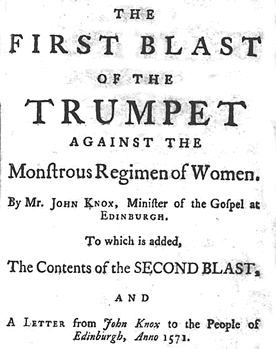
The Monstrous Regiment of Women, title page.
In part one of this series we looked at the history of the idea of a woman president. As it turns out, people have been agitating for a woman president since at least 1872 when Victoria Claflin Woodhull became the first woman to run for president of the United States.
But even though in some quarters there has been a push for a woman president for well over one hundred years, in recent decades the clamor for this has increased considerably. Those who favor this idea scored a major victory with the nomination of Hillary Clinton as the first female presidential candidate of a major political party.
The spirit of the times is such that to question the propriety of having a female chief executive is viewed at best as hopelessly out of date and at worst a thought crime worthy of severe punishment in the gulags of political correctness. No current day political thinker, at least none that I am aware of, questions whether having a woman president is a good idea. Perhaps the only high-profile secular writer of recent times who clearly opposed the notion of a woman head of state was Ayn Rand, who commented that a woman commander-in-chief was “unspeakable.”
Part two of this series took a look at woman suffrage, which was a necessary condition to bring us to the present state. When the nations of the West gave women the vote, by this very act they also implied that it is appropriate to have a woman head of state.
At least some people were aware of this at the time woman’s suffrage was being debated. According to Grace Saxon Mills, one reason to oppose women getting the vote was, “because the acquirement of the Parliamentary vote would logically involve admission to Parliament itself, and to all Government offices. It is scarcely possible to imagine a woman being Minister for War, and yet the principles of the Suffragettes involve that and many similar absurdities.”
Mills obviously understood where the logic of woman suffrage would lead and had the good sense to reject it as absurd. One could hope that today’s Evangelicals would be so perceptive and courageous. But such is not the case.


 Now that convention season is upon us and the thoughts of many are tuned politics, specifically to the party conventions in Cleveland and Philadelphia, it seemed good to discuss the relationship between Evangelical Christians and the political process.

