Feeds:
Posts
Comments

Archive for the ‘Theology’ Category

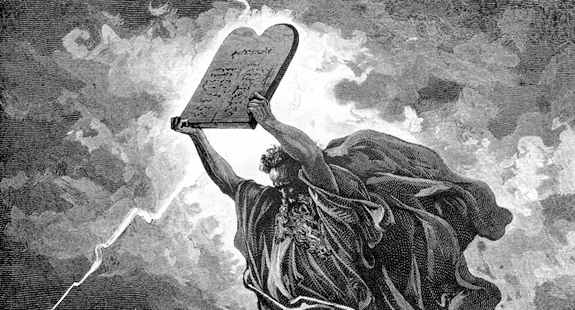
moses

For the law was given through Moses, but grace and truth came through Jesus Christ (John 1:17).

The first chapter of John is a gold mine of theological insight. To paraphrase the apostle himself, if all that could be written on the chapter actually were written, one supposes that the whole earth could not contain the books.

And while it is not the intention of this writer to attempt anything like a comprehensive review of all that John has to tell us, it seems that a look at one small portion of the chapter is not too daunting a task.

In verse 17, John draws an important distinction for us, namely the distinction between Moses and Jesus Christ. The law, John tells us, was given through Moses, but grace and truth came through Jesus Christ.

This brief statement is loaded with implications, a few of which, Lord willing, I will endeavor to point out over the next two weeks.

(more…)

Read Full Post »


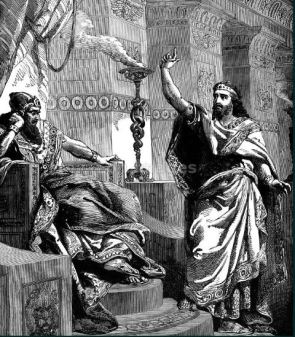
daniel-and-neb

Daniel interprets Nebuchadnezzar’s dream.

One of the key points of Gordon Clark’s Scripturalism is that we are just as dependent on God for knowledge as we are for salvation.


Those in the Reformed community, at least those who are actually Christians, will readily admit that salvation is by grace alone, through belief alone, in Christ alone.

But oddly, many of the same people are sound on the doctrine of salvation at the same time hold to a theory of knowledge (epistemology) that is at odds with their view of salvation.

It is not uncommon to hear some Christians talk as though there are two sources of knowledge, revelation in the 66 books of the Bible and sense experience (empiricism).

This admixture of revelation and sense experience in Christian thought can be traced back to Thomas Aquinas. John Robbins explains,

Thomas Aquinas, the great thirteenth-century Roman Catholic theologian, tried to combine two axioms in his system: the secular axiom of sense experience, which he obtained from Aristotle, and the Christian axiom of revelation, which he obtained from the Bible. His synthesis was unsuccessful. The subsequent career of western philosophy is the story of the collapse of Thomas’ unstable Aristotelian-Christian condominium (An Introduction to Gordon H. Clark)

One of the problems with Protestantism over the centuries is that it never produced a philosopher who challenged Aquinas’ theory of knowledge. As a result, Aquinas’ erroneous synthesis of “the secular axiom of sense experience…and the Christian axiom of revelation” was accepted by large segments of the Christian church.

(more…)

Read Full Post »

egyptAmong the besetting sins of Old Testament Israel was an unfortunate tendency do what seemed right in their own eyes. When faced with a difficult situation, many times the Israelites, both the common people and the leadership, chose to wing it rather than to seek God’s face.

Speaking through the prophet Isaiah, God condemned this way of thinking in no uncertain terms.

“Woe to the rebellious children,” says the LORD,

“Who take counsel, but not of Me,

And who devise plans, but not of My Spirit,

That they may add sin to sin;

Who walk to go down to Egypt,

And have not asked My advice,

To strengthen themselves in the strength of Pharaoh,

And to trust in the shadow of Egypt!” (Isaiah 30:1, 2)

Some commentators believe that the likely targets of these words originally were King Hezekiah’s counselors. Assuming that is the case, how can we apply these words to what is going on in our own day? To do this, a little history is in order.

(more…)

Read Full Post »

you-are-what-you-thinkMost of us have probably hear, and maybe even used, the saying “you are what you eat.” From a strictly physical standpoint, it would seem hard to argue with this. Our bodies are composed of nutrients we take in.

But there is another, more profound way of defining our identity. One that goes beyond the physical, touching on who we really are. And on the authority of the Word of God it is this: You are what you think. Proverbs 23:7 puts it this way, “For as [a man] thinks in his heart, so is he.”

And it is for this reason that God is supremely concerned with the thoughts of our heart, the things we believe, the things we say.

(more…)

Read Full Post »


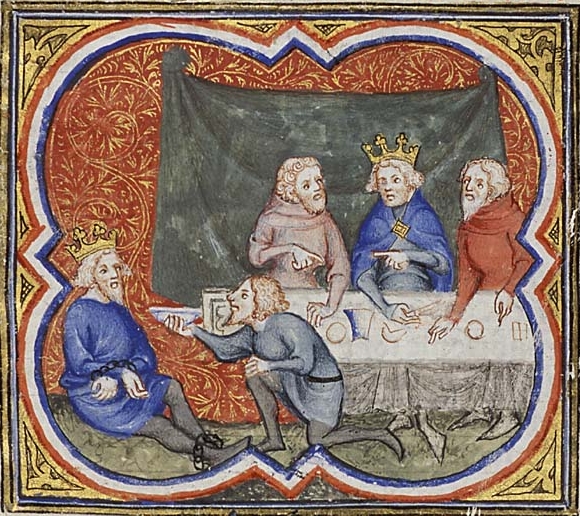
zedekiah_is_chained_and_brought_before_nebuchadnezzar

Zedekiah is chained and brought before Nebuchadnezzar, from Petrus Comestor’s “Bible Historiale.”  

Traditionally attributed to the prophet Jeremiah, Lamentations recounts the author’s reflections on the ruins of Jerusalem in the aftermath of the city’s fall to the Babylonians.


When a city, when a nation, falls, it is natural for people to ask why it happened. Chapter One of Lamentations provides the following succinct summary of the sorry state of Jerusalem.

Her uncleanness is in her skirts;

She did not consider her destiny;

Therefore her collapse was awesome.

Now that’s what I call getting right to the point. Jerusalem, which was really a part standing for the whole of Judah, had become morally unclean. God sent prophets to warn the people, but they did not heed, they, they did not consider their end, therefore judgment befell them.

Now I’ve always been a history buff. And, in particular, I’ve always been fascinated by the notion of civilizational collapse. That sounds pretty depressing, I know. But I don’t say that, because I’m rooting to see a contemporary collapse myself.

(more…)

Read Full Post »


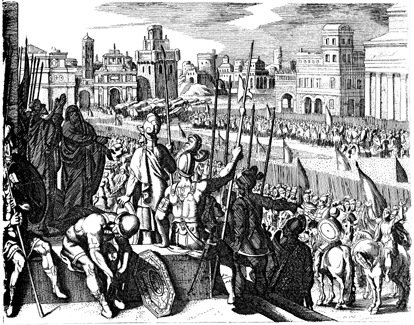
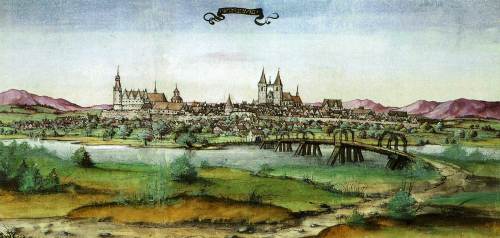
Wittenberg-1536.jpg

Wittenberg as seen from the Elbe, 1536.

October 31 is known to much of the world as the pagan holiday of Halloween. But for Christians, October 31 represents something quite different. It’s what we call Reformation Day.


For it was on that date in 1517 that Martin Luther’s nailed his 95 theses to the Wittenberg church door and forever changed the world for the better.

The Gospel of Justification By Faith Alone – the idea that sinful men are saved, not by doing good works, but solely by faith in Christ Jesus – once again shone forth in all its brilliance after a millennium of suppression by the Roman Church-State and millions were saved as a result.

But Luther’s rejection of church tradition in favor of the objective, written Word of God did not revolutionize the church only. It resulted in a whole new civilization, what we now call the West, coming into existence.

Ideas such as the sanctity of private property, honesty in exchange, the rule of law, capitalism, written constitutions, secular work as pleasing to God all found their origin in the Protestant Reformation that began with Luther.

Though it is not commonly understood by Americans, our nation owes its very existence to the Biblical ideas recovered at the time of the Reformation.

Most of us are taught to trace the foundations of our republic to Greece and Rome. But limited, constitutional government did not begin with Greco-Roman civilization. It began with the Hebrew Republic as recorded for us in the Old Testament. Thus the Bible is foundational to our political system.

In like manner, our economic system of capitalism or free enterprise finds its origins, not in the writings of pagan philosophers, nor in the thought of medieval scholastics, nor in the principles of the Renaissance, but in the propositions of the Word of God, the 66 books of the Bible.

To put it another way: No Protestant Reformation, no United States of America. To quote John Robbins,

One of Luther’s most brilliant followers, John Calvin, systematized the theology of the Reformation. The seventeenth-century Calvinists laid the foundations for both English and American civil rights and liberties: freedom of speech, pres, and religion, the privilege against self-incrimination, the independence of juries, and right of habeas corpus, the right not to be imprisoned without cause. The nineteenth-century German historian Leopold von Ranke referred to Calvin as the “virtual founder of America” (Civilization and the Protestant Reformation).

(more…)

Read Full Post »
The Religious Wars of the 21st Century by John W. Robbins – http://www.sermonaudio.com/sermoninfo.asp?SID=53101448594

Conservatism, An Autopsy by John W. Robbins – http://www.trinityfoundation.org/journal.php?id=115

Read Full Post »

Elisha Prophesies the End of Samaria's Siege

Elisha Prophesies the End of Samaria’s Siege by Nicolas Fontaine, 1625-1709.


When beginning the Siege of Samaria series on Biblical economics, I never intended it to go on for more than two or perhaps three posts. Due to an embarrassment of material and positive response from the readers of this blog, the series stretched into five posts.  In no small part the success of this series has been due to the generous support of Sean Gerety over at the God’s Hammer blog, who has been kind enough to republish my posts.

It’s certainly been an encouragement to me to see so many people interested in what the Bible has to teach us about economics. Most of the economic talk one hears in the mainstream media is misleading, and, I suspect, it’s designed to be that way. After all, if too many folks were to get wise to the economic evil troika of central banking, fiat currency and demand-side Keynesian economics, it would be a lot harder for the financial masters of the universe to loot the poor and middle class of the world for their benefit.

The lies of the statists enslave, but the truth of God’s Word makes men free. And it is to the end of furthering this truth that I have presented the series on Biblical economics.

And because Biblical economics is both a fascinating and worthwhile study, it seemed good to me to take this opportunity to share with others the intellectual ammunition I’ve found helpful in developing my understanding of the subject. Below is a list of resources along with my comments.

(more…)

Read Full Post »

Answering SodomAnswering Sodom by Ralph Ovadal (Madison, Wisconsin: Heart of the Matter Publications, 1998, 252 pages).
It has come as a bit of a surprise to this author just how much space has been dedicated on this blog to various aspects of the aggressive and unbiblical Lesbian, Gay, Bisexual, Transgender, Queer (LGBTQ) agenda. This was not something that was planned. Rather, the alacrity the LGBTQ victories and the ominous implications they portend both for the well-being of America in general, and the welfare of American Christians in particular, cry out for sound Biblical analysis.

It was in the course of researching a recent article on Transgenderism that I discovered the book that is the subject of this review. Written in 1998, it appears that this title is no longer in print. But with tremendous resources available on the internet, it was not hard to find a copy for a reasonable price. In my case, I purchased the book on ABE.com for about $13.00, shipping included.

One may suppose that a book on the subject of the homosexual movement that was written 18 years ago may come off a dated. But this is far from the case. The issue at hand – the push by LGBTQ activists to gain legal sanction for, and societal approval of, their lifestyle – remains largely the same. And not only this, but the arguments used to justify the normalization of homosexuality have not changed much over the past two decades. Add to this Ovadal’s sound exegesis and application of the Bible’s teaching on homosexuality, and you have a book that not only is as relevant today as when it was first written, but perhaps one that is even more so.

Ovadal begins chapter one with the words, “The evening of April 12, 1996 was beautiful and calm in Madison, Wisconsin. Well, at least the weather was calm. By seven o’clock, the night air in front of Trinity Evangelical Fellowship Church was rent with curses, blasphemous invectives, and chants such as “Crush the Christians! Bring back the lions!” and “Queer mob rule!” All this, the author explains, as a result of a joint speaking appearance that included him and Scott Lively, the author of another book titled The Pink Swastika: Homosexuality in the Nazi Party.

(more…)

Read Full Post »

EvangelicalSo what is an evangelical anyway? It’s common term, and not just in church circles either. Now that the US presidential elections are well underway, one often hears the word evangelical in connection with politics, as in such and such a candidate is attempting to garner the evangelical vote. But who are these people whose votes the politicians want?

From stories that appear in the media, one gets the distinct sense that evangelical has come to anyone who’s a non-Roman Catholic, non- mainline liberal Protestant church goer. The popular image of which could be described as a mega-church attending, TBN watching, pre-trib rapture awaiting Christian Zionist.

In his 2007 study concerning who qualifies as an Evangelical, George Barna found that 38% of the US population described themselves as such.

As part of the same survey, Barna used a nine-point definition of Evangelical to identify individuals who belonged to this group. Judged by Barna’s criteria, only about 8% of the US population can be described as Evangelical.

Historically speaking, the definition of Evangelical has encompassed two criteria: justification by faith alone (JBFA) and the authority of Scripture alone. Gordon Clark makes this point in Chapter 4 of God’s Hammer, writing, “The term evangelical, an inheritance from the Reformation, reminds us of the so-called material principle of the origin of Protestantism. Justification by faith alone was the material principle…”

Clark continues, “[T]he so-called formal principle of the Reformation [is] the Scripture itself. No one can rightly appropriate the term evangelical who rejects the one or the other.”

Belief in the twin towers of the Reformation, Scripture alone and Justification by Faith alone, is required of anyone who wishes to be considered an evangelical, at least in the historical sense of the term.

(more…)

Read Full Post »

« Newer Posts - Older Posts »