blob:E6DA3888-B84E-4EA7-8E3A-0979B507DB56blob:E6DA3888-B84E-4EA7-8E3A-0979B507DB56blob:E6DA3888-B84E-4EA7-8E3A-0979B507DB56
Please click the following link for the original blog post on which this podcast is based:
Posted in Immigration, Radio Lux Lucet, tagged Immigration, Immigration Citizensip and the Bible, Immigration Reform, Roman Catholicism on February 16, 2017| Leave a Comment »
blob:E6DA3888-B84E-4EA7-8E3A-0979B507DB56blob:E6DA3888-B84E-4EA7-8E3A-0979B507DB56blob:E6DA3888-B84E-4EA7-8E3A-0979B507DB56
Please click the following link for the original blog post on which this podcast is based:
Posted in Immigration, tagged Immigration, Immigration Citizensip and the Bible, Islam, Islamists, John Robbins, Roman Catholic Social Teaching, Roman Church-State on February 12, 2017| 10 Comments »

Ruth and Naomi Leave Moab, 1860, by Julius Schnorr von Carolsfeld (1794-1872).
Good immigration articles are hard to find. In my experience, just about everything written about immigration in the mainstream press is at best misleading. In many cases, it’s hard not to view it more as fake news than actual reporting, the main purpose of which is not to encourage informed thought on this challenging subject, but to reinforce establishment memes in the mind of John Q. Public.
One such piece is a recent article by Jerry Schwartz titled “US: A nation of immigrants, but ambivalent about immigration.” The piece was published by the very mainstream Associated Press (AP) and found its way to the February 10, 2017 edition of my local newspaper the Cincinnati Enquirer.
Schwartz’ article is remarkable if for no other reason than that it is so typical of what is wrong with the mainstream media in general and its treatment of immigration in particular. Rather than acting to shed light on the topic of immigration, the mainstream media tends to behave more as the ministry of propaganda for establishment interests.
Below are my comments refuting some of the significant the most common errors found in this and many other such bits of establishment immigration propaganda.
Posted in Immigration, Roman Catholicism, tagged Immigration, Refugees, Roman Catholic Social Teaching on January 30, 2017| 3 Comments »
Next, where the Sirens dwell, you plough the seas; their song is death, and makes destruction please. – The Odyssey of Homer Book 12, Translated by Alexander Pope
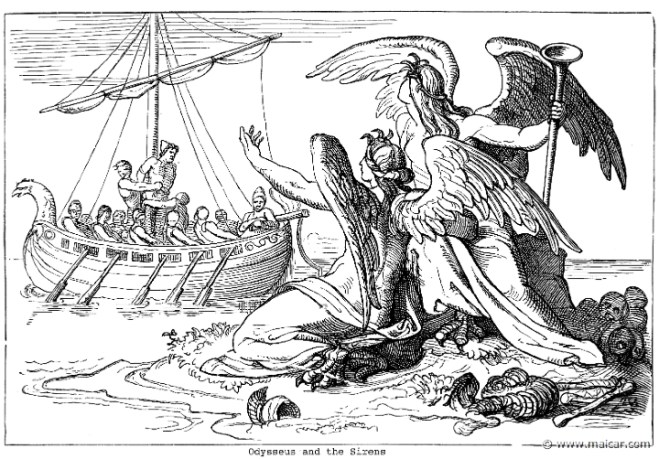
According to ancient Greek mythology, the Sirens were enchantresses who, by virtue of the sweetness of their songs, lured unsuspecting sailors to their death.
But it is not from the Greeks that we fist lean the lesson that appearances can be deceiving. In Genesis, the Bible tells us that Eve brought the curse of God upon her by eating the forbidden fruit, which fruit she took from the tree in the midst of the garden. Scripture tells us the tree appeared to her “pleasant to the eyes, and a tree desirable to make one wise.” Likewise, Proverbs teaches “There is a way that seems right to a man, but its end is the way of death.” In the New Testament, Jesus warned his disciples “Take heed that you not be deceived.”
Clearly, deception was a serious problem for the human race in times past. And a cursory glance at the daily news confirms it’s still very much a problem in times present. I say all this by way of introduction to the topic of this short post, refugees. Specifically the Roman Church-State’s teaching about the supposed rights of refugees and the obligations these rights imply for the citizens of the host societies.
I was prompted to revisit this topic by a headline in today’s local paper, which blared “Pastor: ‘Jesus Was A Refugee.’ ” Later in the article, the pastor is quoted as saying “The main reason I’m here [at a rally held at the Cincinnati airport on behalf of refugees and Muslims] is because Jesus was a refugee.”
Posted in Book Review, Immigration, tagged Immigration, Immigration Citizensip and the Bible, Immigration Reform on January 29, 2017| Leave a Comment »

Ruth and Naomi Leave Moab, 1860, by Julius Schnorr von Carolsfeld (1794-1872).
Although the mainstream media (MSM) is firmly committed to the proposition that that the entire world has the right to immigrate to the US at taxpayer expense, conservatives have increasingly raised their voices in opposition to this practice.
This installment of Immigration, Citizenship, and the Bible (ICB) is an attempt to examine various conservative arguments for immigration reform in light Gordon Clark’s Scripturalism, the system of thought that asserts the Bible and the Bible alone is the Word of God and is the textbook to prepare the man of God for every good work, including the good work of immigration reform.
My critique of conservatives is presented here in the form of a review of Alien Nation: Common Sense About America’s Immigration Disaster by Peter Brimelow.
Posted in Immigration, tagged Donald Trump, Immigration, Immigration Citizensip and the Bible, Immigration Reform, Ten Commandments on January 15, 2017| 2 Comments »
Ruth and Naomi Leave Moab, 1860, by Julius Schnorr von Carolsfeld (1794-1872).
Among the more frustrating aspects of the immigration debate is that, at least as far as immigration and related issues are discussed in the mainstream press, it is not a debate at all.
In general, reporting on immigration issues takes the form of a lecture, in which proponents of keeping and/or expanding the current immigration/refugee/aslyee/migration system are posited as the defenders of all that is just, right and holy, heroically fighting against nativist, racist, xenophobic bigots who complain that current immigration laws do not serve the interests of the American people.
This sort of reporting often has a Kantian undertone to it, by which I mean that in many cases immigration to the US is explicitly or implicitly presented as, on the one hand, a right to which is due to the entire non-American population of the world, and, on the other hand, a duty owed by American people to them. The notion that US immigration policy should serve the interests of the American people – a point that Donald Trump explicitly made part of his immigration platform – is considered beyond the pale of polite discussion. Further, anyone so foolish as to attempt to argue that the interest of the American people should be considered when making immigration policy is immediately scorned and dropped into Hillary Clinton’s “basket of deplorables” from which there is no escape.
There is a second annoying aspect of the immigration debate, the tendency of immigration proponents to commit the informal logical fallacy known as appeal to pity. An appeal to pity is where one argues that you should accept his conclusion, not because of any sound logical reasoning requires that you accept it, but because you feel sorry for him. One example of this sort of argument runs, “If this man is given the death sentence, who will take care of his children?” (Norman Geisler, Come, Let Us Reason, 96). And how many times have we heard this sort of thing from immigration enthusiasts? “You can’t deport X, because you’re breaking up X’s family!” But feeling sorry for someone is not a sound basis for making immigration policy. For example, one can always reply, “Yes, but X should have considered the possibility of deportation before electing to enter the US contrary to American immigration law. No one made him violate the law. He chose to do so. Therefore, the breakup of his family is his own fault.”
Posted in Immigration, tagged Globalism, Immigration, Immigration Citizensip and the Bible, Refugees on January 8, 2017| 3 Comments »
A
“An Ohio State University student posted a rant shortly before he plowed a car into a campus crowd and stabbed people with a butcher knife in an ambush that ended when a police officer shot him dead, a law enforcement official said.” Thus read the headline on the NBC News website on November 28, 2016.
That same day, CBS ran a story titled “What’s known about the OSU attack suspect Abdul Razak Ali Artan”. According to the article, “A Somali-born Ohio State University student plowed his car into a group of pedestrians on campus and then got out and began stabbing people with a butcher knife Monday before he was shot to death by a police officer.”
As it turned out, the November terrorist attack at OSU was a relatively minor example of what has become an all too common pattern of violence by Muslim immigrants and refugees throughout the US and Europe. In the case of the Ohio State attack, the only death was that of the attacker himself. But sadly, this is not always the case.
The Ohio State attack makes a good lead in to the discussion of what I have termed the “refugee racket” for several reasons.
First, it strikes close to home. OSU is located in Columbus, Ohio, about 90 miles up the highway from where I live. It’s bad enough to read about Islamic violence in faraway places. But it hits home all the more when it’s in your backyard.
Second, the attack fits a larger pattern of refugee violence in the West.
Third, there is a direct connection between the OSU attacker and Catholic Charities, by far the largest taxpayer funded refugee resettlement organization in the US.
Posted in Immigration, tagged Economics, Immigration, Immigration Citizensip and the Bible, Immigration Reform, Politics, Roman Catholic Social Teaching, Social Justice, Social Justice Warriros, Socialism on October 9, 2016| Leave a Comment »
Ruth and Naomi Leave Moab, 1860, by Julius Schnorr von Carolsfeld (1794-1872).
Last week we looked the immigration stance of both the Roman Church-State and the liberal protestant Social Justice Warriors (SJWs), and found that they were largely similar. In fact, the language used by the liberal protestants was substantially the same as that used by Rome, showing that the liberal protestant scholarship is in this case, as in so many others, unoriginal and derivative.
Both the Romanists and the liberals charge the American people with racism. Both the Romanists and the SJWs believe in mass, taxpayer-subsidized immigration. Both groups base their immigration platform, at least in part, on a twisted interpretation of Matthew 2:13-21, the account of Joseph taking his family and fleeing to Egypt to escape the murderous Herod.
That the Romanists and the SJW liberal protestants would get is wrong was not a surprise to me. Both groups begin with a faulty view of Scripture, which in turn leads them down the wrong path when formulating their teachings on immigration.
Posted in Immigration, tagged Economics, Immigration, Immigration Citizensip and the Bible, Politics, Pope Francis, Roman Catholic Social Teaching, Social Justice, Social Justice Warriors, Socialism on October 2, 2016| Leave a Comment »
Ruth and Naomi Leave Moab, 1860, by Julius Schnorr von Carolsfeld (1794-1872).
Last week we concluded our look at the immigration proposals of the two major presidential candidates, Donald Trump and Hillary Clinton.
In summary, Donald Trump gets some things right – he understands that immigration policy should be conducted with a view to benefiting the American people and has called for the end of birthright citizenship – and he gets some things wrong – the border wall and E-Verify, the latter of which amounts to a call for a national ID card.
Hillary Clinton on the other hand, her immigration platform is an unmitigated disaster. Not only does she promise amnesty in the first 100 days of her presidency, but she has no proposal to prevent a future massive inflow of immigrant welfare cases. But it’s worse than that. If Hillary gets her way there she intends to increase the welfare giveaway by allowing immigrants, regardless of their immigration status, to buy into Obamacare, a taxpayer subsidized health insurance system. She also wants to make it all but impossible to deport the parents of anchor babies.
But as important as it is to examine the immigration proposals of the presidential candidates, it is also important to remember that they did not spring into existence out of thin air. They are the product of intellectual discussions that have been taking place, usually not in the public eye. The purpose of this post is to examine the immigration proposals of various groups that have influenced the thinking and the actions of both government officials and the American people on subject of immigration.
But more than that, it also is my intention to critique the various immigration proposals in light of Scripture. In my view, none of them fully square with the Scriptures. The main reason for this being that the immigration theorists did not begin with what the Bible teaches about immigration, but began their thinking somewhere else. To put it another way, those who have written about immigration to date have not been Scripturalists.
Posted in Immigration, tagged Donald Trump, Hillary Clinton, Immigration, Immigration Citizensip and the Bible, Immigration Reform, Obamacare, Presidential Campaign 2016, Socialism on September 25, 2016| Leave a Comment »
Ruth and Naomi Leave Moab, 1860, by Julius Schnorr von Carolsfeld (1794-1872).
Last week in Part 3 of this series, we looked at Donald Trump’s immigration reform proposals. This week, the focus will be on Hillary Clinton’s immigration stance.
As you may recall, the verdict on Trump’s immigration reform proposals was mixed. Some of his ideas were quite good – 1) his statement that American immigration policy should be set up to benefit all Americans and 2) his call to end birthright citizenship – can readily be reconciled with Biblical political theory. On the other hand, some of his ideas fell short of the mark – 1) Trump’s signature issue, his call to build a wall all along the US-Mexico border, and 2) his eVerify program, a proposal that would, in effect, create a national biometric ID card, requiring anyone looking to get a job to show “his papers” to prove he was eligible to work in the US.
An analysis of Hillary’s immigration plan will require a different approach than the one I used for Trump’s. Because her immigration proposals are so uniformly bad, realistically there is no way to break her ideas down into the categories of “good” and “bad” ideas.
In short, her immigration program is an unrelieved disaster that, if enacted, will go a long way to transforming the US into a third world country, while forcing ordinary Americans to foot the bill for the privilege. Or to put it another way, her immigration policy could well have been crafted by prelates of the Roman Church-State, whose destructive immigration policies she has largely adopted as her own. In fact, the only real difference between Mrs. Clinton’s ideas on immigration and those of Rome is that she doesn’t bother with trying to justify them, as the Romanists do, by twisting the Scriptures.
The following critique will be based upon Mrs. Clinton’s immigration platform as stated on her campaign website here.
Posted in Immigration, Radio Lux Lucet, tagged Donald Trump, Immigration, Immigration Citizensip and the Bible, Immigration Reform, John Robbins, Presidential Campaign 2016 on September 24, 2016| Leave a Comment »

A Scripturalist (Clarkian) podcast about Christian theology, politics and economics.
 Lux Lucet