Posts Tagged ‘Scripturalism’
Radio Lux Luxet: Ep.18
Posted in Radio Lux Lucet, Uncategorized, tagged Scripturalism on April 25, 2018| Leave a Comment »
The Golden Rule and Foreign Policy
Posted in Foreign Policy, tagged John Robbins, Scripturalism, Syrian Civil War, The Bible and Foreign Policy on April 15, 2018| 2 Comments »

Before and after in Aleppo.
The great law of morality ought to have a national as well as a personal and individual application. We should act toward other nations as we wish them to act toward us.
– Millard Fillmore, 13th President of the United States , 1850 State of the Union Address
Back during the 2012 Presidential campaign, I wrote a post critical of an article by Uri Friedman, who showed his utter disdain for candidate Ron Paul by accusing him of invoking the Millard Fillmore doctrine, which as the quote above indicates, is the application of the Golden Rule to foreign policy. Fillmore, notes Friedman, was “undistinguished” and “uninspiring” and self-evidently not worthy of emulation in any respect. Friedman goes on to write that Paul was both booed an laughed at when he presented his version of the “Golden Rule” approach to foreign policy on the campaign trail.
It is absurd to think that the Golden Rule has anything whatsoever to do with foreign policy, so opines Friedman. And not only is it wrong to suggest that it does, but it’s actually laughable. This we know because Millard Fillmore believed the Golden Rule was the standard for a proper policy and it’s just obvious that Millard Fillmore was a dunce, a boob and a fool. What is more, so are all those, such as Ron Paul, who follow him. That’s the sum of Friedman’s argument, who, as one writing in Foreign Policy, the house organ of the Council on Foreign Relations, could be said to be echoing the views of the American foreign policy establishment.
Perhaps if the accomplishments of America’s foreign policy establishment – dating back to the Spanish American War at the end of the 19th century, America’s leaders have rejected the nation’s original foreign policy of staying out of foreign wars in favor of a policy of interventionism – were more impressive, it would make sense to give ear to Friedman’s snarky dismissal of Fillmore and Paul. But after more than a century of foreign wars that seem only to set the stage for the next conflict, perhaps it’s worth asking just how much the sages at the Council on Foreign Relations actually know about foreign policy. It seems the this author that the answer is, not very much at all.
Robbins on the Resurrection: An Exposition of Luke 24:1-12 (Part 1 of 2)
Posted in Theology, tagged John Robbins, Scripturalism on April 1, 2018| 6 Comments »
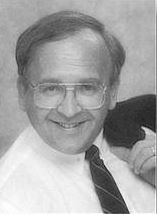
John W. Robbins
The following sermon was preached by John Robbins at Reformation Chapel in Unicoi Tennessee. Please click here to read part two. The transcription is my own.
-Steve Matthews
And now Luke moves on in his narrative to the resurrection. Then he begins by saying it happened on the first day of the week. And there’s a Jewish idiom here, it’s the first of the Sabbaths. And it’s a phrase that appears in the Matthew 28:1, Mark 16:1 and Luke 24:1, it’s called the first day of the Sabbaths or the first of the Sabbaths. From now on this will be the important day. This is what John calls the Lord’s Day. This is why we meet on Sunday and not on Saturday, because this has taken on the characteristics of the most important day of the week. This is the day that Jesus rises from the dead.
“Now on the first day of the week, very early in the morning,” Luke says, “they, and certain other women with them, came to the tomb brining the spices which they had prepared. But they found the stone rolled away from the tomb.” Christ had dies on the sixth day of the week, on Friday, he was in paradise that day and the entire next day, and then early in the morning on the first day of the week he rises from the dead.
Luke says these women, and they’re named in the previous chapter, they go very early in the morning. John says in John 20 verse 1 that they leave when it is still dark, yet dark. And some people have, again, tried to make contradictions in the Bible by saying the various evangelists say well it was at dawn, and John says it was while it was still dark, and another Gospel says it was when the sun was rising. Well, these women had to travel. And they left when it was still dark and when they got there the sun had risen. And it’s very easy. If people would just think about what’s going on in these narratives, all these so-called contradictions and problems would disappear. The women can’t transport themselves like they do on Star Trek from one place to another instantaneously. It takes a while for them to travel, to get together, to pack up their spices and to arrive at the tomb. And so you would expect a variation between the time they leave to the time they arrive there. Which is what the four narratives say.
The Bible and Birthright Citizenship
Posted in Immigration, tagged Anchor Babies, Birthright Citizenship, Politics, Scripturalism on February 18, 2018| 2 Comments »
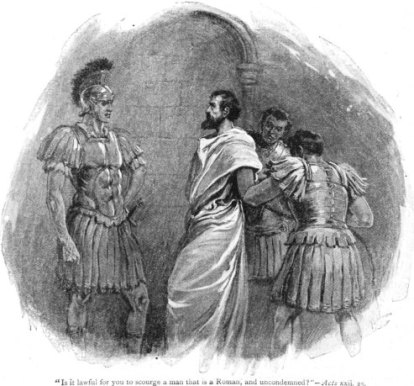
The Apostle Paul declares his Roman citizenship, anon. 2008.
Then the commander came and said to him, “Tell me, are you a Roman?”
He said, “Yes.”
The commander answered, “With a large sum I obtained this citizenship.”
And Paul said, “But I was born a citizen” (Acts 22:27-28).
Hamartano is a Greek verb, which is rendered in English translations of the New Testament as “sin.” But in classical Greek usage it more commonly meant “miss the mark.”
For example, one classical Greek writer gave an account of a hunting party that went out to slay a wild boar. Among the hunters were the king’s son and a rather ambitious courtier. The hunters finally cornered the boar, and the courtier, apparently eager to get credit for the kill, threw his spear and missed, instead striking the king’s son and killing him.
That, as they say, was a bad career move.
Immigration, Citizenship and the Bible, Part 21: Concluding Thoughts
Posted in Immigration, tagged Donald Trump, Economics, Immigration, Immigration Citizensip and the Bible, John Robbins, Scripturalism on February 4, 2018| Leave a Comment »

Ruth and Naomi Leave Moab, 1860, by Julius Schnorr von Carolsfeld (1794-1872).
When I began writing this series of posts on immigration in September 2016, my original plan was for five to seven posts and to wrap things up by early 2017. Obviously, the series grew well beyond these plans, and I find myself nearly a year and a half later sitting down to bring the work to a close.
At this point, it may be worth asking and answering the questions 1) Why I started this series in the first place, and 2) Why did it grow in length far beyond my original intent?
There are two reasons I chose to write on the topic of immigration. In the first place, it’s important, for the effects of a nation’s immigration policy cannot be reversed easily if at all.
Most other political decisions can be reversed. For example, the US passed the Eighteenth Amendment to the Constitution prohibiting the production, importation, transportation and sale of alcohol. This amendment went into effect in 1920 and was repealed by the Twenty-first Amendment in 1933.
Immigration, on the other hand, is forever. Once immigrants are welcomed into the national family, there’s no going back. Their acceptance permanently alters the makeup of a nation. For this reason alone, it is important for legislators and citizen both to have a clear idea in mind about what constitutes proper immigration policy.
Second, for all the ink that has been spilt on the subject, I have yet to read a fully satisfactory treatment of immigration. In Immigration, Citizenship and the Bible (ICB) I review immigration commentary from across the political and religious spectrum, including secular and religious right and left. I have reviewed the works of proponents of mass, taxpayer subsidized immigration and the works of immigration restrictionists. None of the writers I have read get it right for the simple reason that none of them begin their thinking with the Scriptures.
Some writers do use Scripture when formulating their ideas about immigration, but either apply it inconsistently or misunderstand what the Bible has to say on the topic.
And because I was dissatisfied with the work that has been done up until now that I decided that what is needed is a Scripturalist take on immigration. That is, I wanted to approach immigration systematically as someone who believes the Bible has a monopoly on truth, not as someone who seeks to combine the truths of Scripture on immigration with “truths” discovered elsewhere.
Concerning the second question, Why did this series grow much larger than I had originally intended?, the answer lies in the fact that immigration is a large topic and more space was needed than I thought at first.
Apart from immigration – immigration is the act of someone coming to a new country for the purpose of taking up permanent residence – there are two other major related subject: migration and refugee resettlement.
Migration – more specifically, international migration – is the is simply the temporary movement of people from one country to another. Migrants do not intend to settle permanently, but come for various reasons, for example seasonal economic opportunity.
Refugee resettlement involves the accommodation of people fleeing their native countries. A refugee is defined as someone who, “Demonstrates that they (sic) were (sic) persecuted or fear persecution due to race, religion, nationality, political opinion, or membership in a particular social group” (USCIS).
Both migration and refugee resettlement issues are closely related to, but separate from, immigration proper. And because of the close relationship all three topics have to on another, to discuss one generally involves at some point discussing the others. This was a major reason for the growth of this series beyond the original five to seven posts that I originally thought would be the case.
Video #7: Bitcoin vs. The Regulatory State
Posted in Videos, tagged Bitcoin, Economics, John Robbins, Politics, Scripturalism on December 31, 2017| Leave a Comment »
John Robbins On The Incarnation
Posted in Theology, Uncategorized, tagged Gordon Clark, John Robbins, Scripturalism, The Incarnation on December 24, 2017| 27 Comments »

The Annunciation, Fra Angelico, 15th cen.
One of the many reasons I have long admired the work of John Robbins was his insistence on holding, and skill at handling, question and answer sessions after his talks.
As brilliant as his lectures were, some of his best recorded comments came in the discussions that he had with audience members after he was finished speaking.
A few years ago, Tom Juodaitis was kind enough to send me recordings of a number of sermons preached by Dr. Robbins at Reformation Chapel in Unicoi, TN.
Among the sermons was a two part series on John 3:1-17. At the end of part 2, there is a discussion among Dr. Robbins, an individual whose identity I don’t know, and Tom Juodaitis concerning the incarnation.
In this discussion, Dr. Robbins explains Gordon Clark’s teaching on the incarnation. Clarks mature thinking on this subject is found in the final book he wrote just before his death in 1985, The Incarnation. Clark’s work was at the time, and continues to be, controversial. For at its heart is the idea that Jesus of Nazareth is not, as is commonly taught, one person in two natures, but two persons in one individual, one a divine person and the other a human person.
This really shouldn’t be controversial. Just recently I heard a preacher say, correctly I would add, that Jesus is 100 percent God and 100 percent man. If this is the case, and it is, then we are logically driven to the same conclusion Clark reached.
Yet many people are offended at Clark’s thought, dismissing it as Nestorianism while ignoring the logical force of his argument.
John Robbins was one theologian was persuaded by Clark’s argument and had no problem saying so. In the discussion below, Dr. Robbins is at his best, brilliantly, simply and persuasively summarizing Clark’s argument.
The Butcher, The Baker, the Candlestick Maker, And Property Rights
Posted in Politics, Uncategorized, tagged Gay Marriage, Homosexual Rights, Libertarianism, Non Aggression Principle, Scripturalism on December 10, 2017| Leave a Comment »

Mary Torres holds up a rolling in in support of cake artist jack Phillips outside the Supreme Court n Washington on Dec. 5. (Jacquelyn Martin / Associated Press)
In perhaps the biggest story of this past week, the Supreme Court began hearing arguments in the case Masterpiece Cake Shop v. Colorado Civil Rights Commission.
The case involves the Jack Phillips, owner of Masterpiece Cake Shop, who in 2012 refused to make a custom wedding cake for a same sex married couple, Charlie Craig and David Mullins. This set in motion a legal battle that saw Mr. Phillips, a Christian, dragged before the Colorado Civil Rights Commission, which did not look kindly on his appeals to free speech and the free exercise of his faith.
“I can believe anything I want,” said Commissioner Raju Jaram, “but if I’m going to do business here, I’d ought to not discriminate against people.” According to this same article, Phillips was ordered to stop discriminating against gay people, document any customers he refuses to service, provide antidiscrimination training for his staff, and report quarterly for two years.
One commissioner likened Phillips’ actions to those of the Nazis.
The Alliance Defending Freedom, the Christian legal organization representing Jack Phillips, argued this week before the Supreme Court that the baker’s First Amendment rights were violated by the Commission’s ruling. According to her, the Commission also violated Phillip’s religious liberty by attempting to force him, “to sketch, sculpt, and hand-paint cakes that celebrate a view of marriage in violation of his religious convictions.”
Interview with Tom Juodaitis, President of the Trinity Foundation – The Reformation at 500: Is It Over Or Is It Needed Now More Than Ever?
Posted in Radio Lux Lucet, tagged Protestant Reformation, Scripturalism on October 16, 2017| 2 Comments »

The Reformation at 500 conference will be held in Johnson City, TN on Friday, October 27 and Saturday, October 28, 2017. For conference registration details, click this link: http://trinityfoundation.org/PDF/TheReformationAt500Flyer.pdf
Unbelievable: A Quick Look at Bill Nye’s Views on Evolution, Science and Creation, Part 5
Posted in Creationism, tagged Apologetics, Bill Nye, Ken Ham, Science, Scripturalism on July 9, 2017| Leave a Comment »
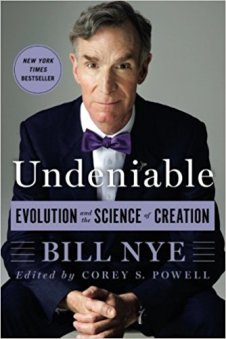 This week’s installment o f our series on Bill Nye continues our review of Chapter 2 of his book Undeniable: Evolution and the Science of Creation.
Bill Nye Asserts The Consequent
Suppose for a moment we were having a conversation about my car and I said to you, “If my battery’s dead, my car won’t start.” “Okay,” you replied, “that makes sense.”
So we go out to my driveway; I hop in and try to crank the engine. Nothing happens.
“Alright,” I say, “obviously this is scientific proof that my battery’s dead!”
What would you say about my logic? Well, if you had any sort of mechanical background, or had just a little bit of training in logic, you’d probably point out to me that I was jumping to conclusions. You might say something like, “Not so fast there, Steve. Sure, your battery may be dead, but there are many other explanations why your car won’t start. Maybe you didn’t check your oil and your engine’s locked up (I had this happen once), or maybe your ignition switch is broken. You could have a bad battery cable. In fact, there are probably dozens of reason why your car won’t start that have nothing do with a dead battery. Don’t you think you’re getting ahead of yourself by claiming you know your battery’s dead?”
This little story illustrates a common logical fallacy called asserting the consequent. This fallacy is the result of the misuse of a form of argument called the hypothetical argument. In my illustration above, you can easily spot where I go wrong in my thinking. I conclude that my battery is dead, even though there are many other reasons that can just as easily explain why my car won’t start.
But here’s the shocking part: the logical fallacy of asserting the consequent is foundational to the scientific method. That’s right. All the supposed great “truths” discovered by science, the very ones that Bill Nye and others like to use to try to intimidate Christians, are built, as it were, on the logical equivalent of quicksand.
On pages 14 and 15, Nye attempts to solidify the invincible logical rigor of science by providing the reader with an example of a successful prediction made by science. In Nye’s mind, this example illustrates the validity of science, but all it really does is underscore his own poor reasoning skills.
Nye relates the story of a University of Chicago scientists who, reasoning that there must exist the fossil of an animal showing the transition between fish and land animals, led a an expedition to an area in northeastern Canada where he thought he would find what he was looking for. As it turned out, the expected fossil was found leading Nye to claim that this is sound science, because the scientist’s prediction of the fossil turned out to be true.
The hypothesis the scientist used to make his prediction is left unstated by Nye, but it probably ran something like this: If land animals evolved from fish, then I should be able to find the fossil of an animal in such and such a place that has features of both fish and land animals. Eureka! I did, in fact, find the fossil of such an animal in the place where I expected, therefore it is true that land animals evolved from fish.
This argument is in the same form as my example above about my car and the dead battery. There could be any number of reasons why the fossil – the name of the fossil in question is the Tiktaalik – was found where it was that have nothing to do with the professor’s particular hypothesis or even, more generally, evolution.
It’s remarkable how smart people like Bill Nye can be so easily misled that they mistaken obvious logical fallacies for the truth. Worth noting is that the Bible itself predicts Nye’s fallacious thinking, giving as the reason for it the fact that men, in their unrighteousness, suppress their innate knowledge of God. And refusing to acknowledge God, they will move heaven and earth to drive him from their conscience by erecting their own intellectual constructs, however full or logical errors they may be. The world calls this sort of humanistic reasoning wisdom. But God calls it foolishness.
Radio Lux Lucet
Radio Lux Lucet

A Scripturalist (Clarkian) podcast about Christian theology, politics and economics.
- Follow Lux Lucet on WordPress.com
Archives
- January 2026
- December 2025
- November 2025
- September 2025
- July 2025
- May 2025
- April 2025
- February 2025
- January 2025
- December 2024
- November 2024
- October 2024
- September 2024
- August 2024
- July 2024
- June 2024
- May 2024
- April 2024
- March 2024
- February 2024
- January 2024
- December 2023
- November 2023
- October 2023
- September 2023
- August 2023
- July 2023
- June 2023
- May 2023
- April 2023
- March 2023
- February 2023
- January 2023
- December 2022
- November 2022
- October 2022
- September 2022
- August 2022
- July 2022
- June 2022
- May 2022
- April 2022
- March 2022
- February 2022
- January 2022
- December 2021
- November 2021
- October 2021
- September 2021
- August 2021
- July 2021
- June 2021
- May 2021
- April 2021
- March 2021
- February 2021
- January 2021
- December 2020
- November 2020
- October 2020
- September 2020
- August 2020
- July 2020
- June 2020
- May 2020
- April 2020
- March 2020
- February 2020
- January 2020
- December 2019
- November 2019
- October 2019
- September 2019
- August 2019
- July 2019
- June 2019
- May 2019
- April 2019
- March 2019
- February 2019
- January 2019
- December 2018
- November 2018
- October 2018
- September 2018
- August 2018
- July 2018
- June 2018
- May 2018
- April 2018
- March 2018
- February 2018
- January 2018
- December 2017
- November 2017
- October 2017
- September 2017
- August 2017
- July 2017
- June 2017
- May 2017
- April 2017
- March 2017
- February 2017
- January 2017
- December 2016
- November 2016
- October 2016
- September 2016
- August 2016
- July 2016
- June 2016
- May 2016
- April 2016
- March 2016
- February 2016
- January 2016
- December 2015
- November 2015
- October 2015
- September 2015
- August 2015
- July 2015
- June 2015
- May 2015
- April 2015
- March 2015
- February 2015
- January 2015
- December 2014
- November 2014
- August 2014
- June 2014
- March 2014
- February 2014
- January 2014
- December 2013
- November 2013
- September 2013
- August 2013
- July 2013
- March 2012
- February 2012
- January 2012
- December 2011
- November 2011
- October 2011
- September 2011
- July 2011
- June 2011
- April 2011
- February 2011
- January 2011
- December 2010
- November 2010
- June 2010
- May 2010
- April 2010
- March 2010
- December 2009
- November 2009
- October 2009
- September 2009
- August 2009
- July 2009
- May 2009
- April 2009
- March 2009
Categories
- A Christian View of Men and Things
- Abortion
- Antichrist
- Antichrist
- Book Review
- Central Banking
- Collapse of the West
- Covid
- Creationism
- Critical Race Theory
- Culture
- Donald Trump
- Economics
- Environmentalism
- Eschatology
- Fed Watch
- Feminism
- Financial Markets
- Financial News
- Foreign Policy
- General Commentary
- Globalism
- Health
- Immigration
- Israel
- Jesuits
- Jesus Christ
- Knox Seminary
- Leo XIV
- LGBT
- New Perspective/Federal Vision
- Philosophy
- Politics
- Prepper
- Presidential Campaign 2020
- Presidential Campaign 2024
- Radio Lux Lucet
- Reformation, The
- Roman Catholic Social Teaching
- Roman Catholicism
- Romanism and Politics
- Rome and Immigration
- Rome Watch
- Rum Romanism and Rebellion
- Russian-Ukrainian War
- Scripturalism
- Scripturalist Short Takes
- Social Media
- Socialism
- The Reformation
- The Week In Review
- Theology
- This 'n That
- Uncategorized
- Videos
- Woke
- World Government
- Zionism
 Lux Lucet