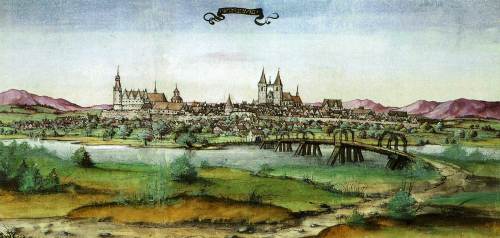
Wittenberg as seen from the Elbe, 1536.
October 31 is known to much of the world as the pagan holiday of Halloween. But for Christians, October 31 represents something quite different. It’s what we call Reformation Day.
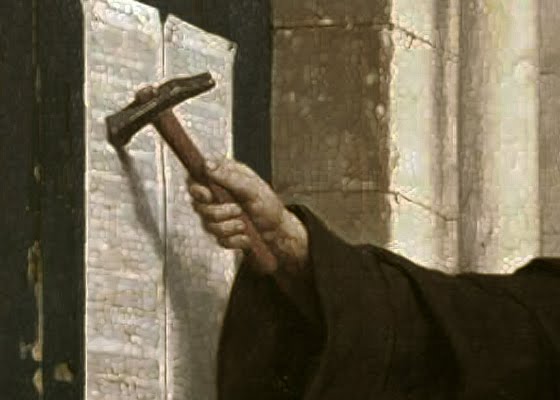
For it was on that date in 1517 that Martin Luther’s nailed his 95 theses to the Wittenberg church door and forever changed the world for the better.
The Gospel of Justification By Faith Alone – the idea that sinful men are saved, not by doing good works, but solely by faith in Christ Jesus – once again shone forth in all its brilliance after a millennium of suppression by the Roman Church-State and millions were saved as a result.
But Luther’s rejection of church tradition in favor of the objective, written Word of God did not revolutionize the church only. It resulted in a whole new civilization, what we now call the West, coming into existence.
Ideas such as the sanctity of private property, honesty in exchange, the rule of law, capitalism, written constitutions, secular work as pleasing to God all found their origin in the Protestant Reformation that began with Luther.
Though it is not commonly understood by Americans, our nation owes its very existence to the Biblical ideas recovered at the time of the Reformation.
Most of us are taught to trace the foundations of our republic to Greece and Rome. But limited, constitutional government did not begin with Greco-Roman civilization. It began with the Hebrew Republic as recorded for us in the Old Testament. Thus the Bible is foundational to our political system.
In like manner, our economic system of capitalism or free enterprise finds its origins, not in the writings of pagan philosophers, nor in the thought of medieval scholastics, nor in the principles of the Renaissance, but in the propositions of the Word of God, the 66 books of the Bible.
To put it another way: No Protestant Reformation, no United States of America. To quote John Robbins,
One of Luther’s most brilliant followers, John Calvin, systematized the theology of the Reformation. The seventeenth-century Calvinists laid the foundations for both English and American civil rights and liberties: freedom of speech, pres, and religion, the privilege against self-incrimination, the independence of juries, and right of habeas corpus, the right not to be imprisoned without cause. The nineteenth-century German historian Leopold von Ranke referred to Calvin as the “virtual founder of America” (Civilization and the Protestant Reformation).

 Lux Lucet