Feeds:
Posts
Comments

Posts Tagged ‘Money and Banking’

Elisha Prophesies the End of Samaria's Siege

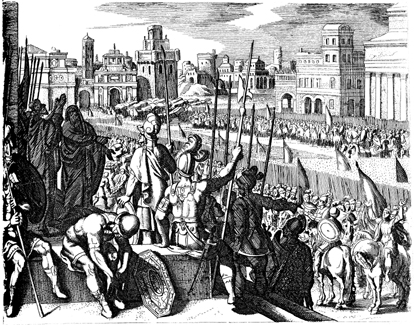
Elisha Prophesies the End of Samaria’s Siege by Nicolas Fontaine, 1625-1709.

In our last installment, we discussed opportunity cost using the example of the four lepers at the gate of Samaria (2 Kings 7:3-5).


The prospects facing of these gentlemen were all seemingly poor. They could remain where they were and die, they could enter the city of Samaria and die, or they could defect to the Syrians and maybe die or maybe live. Choosing any one of the three options meant forgoing the other two opportunities.

Quite rationally, the lepers elected to forgo the opportunity of dying in Samaria, either outside its gates or within the city itself, for the outside chance that they might survive among the Syrians. The two options of dying in Samaria, we concluded, represented the opportunity cost to the lepers of their decision to go over to the Syrians.

The Samaritan Consumer Price Index

At the same time the lepers were reasoning among themselves about their opportunity cost, inside the city walls of Samaria another discussion was taking place.

By this point, King Jehoram of Israel had had quite enough of the whole siege business and was ready to take it out on someone. The most obvious scapegoat in his mind was the prophet Elisha. Such was the king’s anger with Elisha that he had dispatched one of his high ranking officers to take off the prophet’s head.

This came as no surprise to the prophet, who, apparently forewarned by God that a plot had been hatched against him, told those with whom he was sitting, “Do you see this son of a murderer has sent someone to take away my head? Look, when the messenger comes, shut the door, and hold him fast at the door. Is not the sound of his master’s feet behind him?” (2 Kings 6:32).

When the king’s messenger arrived, Elisha had a message for him. Said Elisha, “Hear the word of the LORD. Thus says the LORD: ‘Tomorrow about this time a seah of fine flour shall be sold for a shekel, and two seahs of barley for a shekel, at the gate of Samaria’ ” (7:1).

Incredulous, the officer responded, “Look, if the LORD would make windows in heaven, could this thing be?” To which Elisha answered, “In fact, you shall see it with your eyes, but you shall not eat of it” (7:2).

(more…)

Read Full Post »

meltdown-620Today we may apply the Apostle’s words first to those (rulers) who without cogent cause inflict exorbitant taxes upon the people, or by changing and devaluating the currency, rob them, while at the same time they accuse their subjects of being greedy and avaricious.

    – Martin Luther, Commentary on Romans 2:2, 3

Now, if the laws of buying and selling are corrupted, human society is in a manner dissolved; so that he who cheats by false weights and measures, differs little from him who utters false coin.

    – John Calvin, Commentary on Leviticus 19:35

But if life is an equal value to all, there is something strange, when war comes and large military expenditures are necessary, in requiring the person who has saved for a life insurance policy to lose half its buying power by inflation, while the spendthrift loses nothing and enjoys high wages to boot.

    – Gordon H. Clark, A Christian View of Men and Things, pp. 101-102

Read Full Post »

Elisha Prophesies the End of Samaria's Siege

Elisha Prophesies the End of Samaria’s Siege by Nicolas Fontaine, 1625-1709.

In the first installment in this series, we looked at some of the economic concepts taught in the Bible’s account of the siege of Samaria recorded for us in 2 Kings 6:24-7:20. In particular we looked at 2 Kings 6:25 and found that quite a bit of economics is packed in just that one verse. Today, we’ll continue the discussion of economic implications of Syria’s attack on the capital of the Northern Kingdom.

Politics, Economics and the Blame Game

As a kid, one of my favorite Saturday morning cartoons was Scooby Doo. The episodes were pretty formulaic, especially the ending where, as the bad guys were being hauled off to the paddy wagon, they inevitably would blurt out, “And I would have gotten away with it if it weren’t for you meddling kids!” They never blamed their downfall on their own criminality. It was all the fault of the interlopers.

Well, politicians are a lot like this. While being separate disciplines, politics and economics are closely related such that to talk about one often means brining up the other. This is especially common when a nation is struggling with economic difficulties.

And when economic troubles begin, so too does the blame game shuffle. Suppose the citizens experience a sharp upward spike in the cost of living, or wages stagnate or wave after wave of layoffs take place. Do the powers-that-be blame themselves? Of course not! Economic difficulty is NEVER related to the policies of the current president or Congress. No, not one bit.

The political class, and the academics whose ideas the politicians implement make it all very clear that they had nothing to do with the mess. We’re made to understand that our economic pain is always the fault of the intransigence of opposing party, or greedy market speculators, or bond vigilantes, or budget cuts, or lack of sufficient federal regulatory oversight, or not enough government spending, or cheap imports from China.

This blame game, this shifting of responsibility, is nothing new. In fact, we can say with confidence that it started six thousand years ago with Adam himself. As he put it in his own words, “The woman whom You gave to be with me, she gave me of the tree, and I ate” (Genesis 3:12). “It’s your fault, not mine!” That’s the gist of Adam’s argument to God.

(more…)

Read Full Post »

ready for oligarchyWell, there were no gorilla shootings in Cincinnati this week. Or for that matter, giraffe, hippopotamus or hyena shootings either. And we can all be thankful for this. I know for my part I just really can’t take another week of listening to animal rights activists talking nonsense. Perhaps the most egregious offender in this regard was a gentleman from Cincinnati, who was quoted in the local paper referring to the departed gorilla as, “a fellow Cincinnatian” and a “400-pound person.”

Nope and nope. Animals are not people. People are not animals. See Genesis 1 for details.

Now then, let’s move onto the scintillating stories from this week.

Oligarchy and the American Jezebel

As the old saying goes, I was shocked but not surprised Monday night, a night when not a single Democratic primary vote was cast, to hear that Hillary Clinton had achieved the necessary delegates to seal the Democratic nomination for president.

It just so happened that scheduled the following day were primaries in California primary and New Jersey, and several other states. In the week leading up to the vote, polls in California indicated that Bernie Sanders and Hilary were neck and neck. And a loss there would have been a YUUUGE embarrassment both to Hillary and her supporters in the Deep State. In fact, a loss in California may very well have been the end of Clinton’s hopes to take the White House. And such things simply cannot be allowed to happen.

And they weren’t.

After Monday’s surprise announcement, Hillary went on to win California by a margin of 55% to 43% over Sanders.

No sooner had the polls closed but the MSM began its hagiography of Mrs. Clinton. And among the worst offenders in this regard, predictably, was CNBC. Their business and financial reporting, the networks raison d’être, is a pathetic mix of stock market cheerleading, Keynesian propaganda, and Federal Reserve worship. I stopped watching years ago. And given the networks ratings in recent years, so has nearly everyone else.

Nevertheless, I do admit to visiting CNBC online several times a day to check the markets. And what did I see there on Wednesday but the headline, “Trump’s going to get demolished by Clinton; Here’s why he needs to drop out now.” Yep. The Donald’s on the wrong side of history, according to the sages at CNBC. Just give up. Go home. It’s over.

I’m not here to flack for Trump, but the man just set a record for the highest vote total EVER in the Republican primaries. Somehow I doubt he’s going to listen to the advice of incompetent journalists at a dying cable network.

But back to Clinton. One thing that is almost never discussed regarding her campaign, even among Christians, is whether it would be Biblical to elect a woman as president. Questions of this sort are never asked by the MSM. Even a survey of blogs, podcasts and YouTube channels will show that almost no one, Christian or not, questions whether a woman could properly fill the role of Commander in Chief of the armed forces. The only question is whether she is qualified intellectually and ideologically to take the helm in the Oval Office.

But at least one Christian author has undertaken to answer that question. Paul Elliott wrote a piece a few years back titled Deborah & Esther: Are They Precedents for a Female President? And his answer to this question would likely shock and offend many, even many in the evangelical community. Elliott concludes,

The Bible tells us clearly that God has ordained male headship, and female submission to that headship, in the home, in the church, and in government…Because this is God’s ordained order, Christians must not seek to put a woman in the place of national rulership, no matter how much we may agree with her ideologically. To do so is, in fact, sin in the eyes of God.

Yes, Hillary is an appalling individual and will make a horrible president if elected. She was a disaster as Secretary of State. She’s an obvious felon. And she will continue Obama’s full-court press to further push the immoral LGBT agenda. In short, she will prove to be an American Jezebel.

But the answer is not for Christians to seek a better qualified woman to run against her. As with all areas of life, we must reason and act according to what Scripture teaches, and not according to the wisdom of this world.

(more…)

Read Full Post »

Elisha Prophesies the End of Samaria's Siege.jpg

Elisha Prophesies the End of Samaria’s Siege by Nicolas Fontaine, 1625-1709.

The Bible has a monopoly on truth. This simple idea is basic to the entire Scripturalist enterprise. Yet while the idea itself is simple and ought to be taught and understood by every Christian, it’s one that often is denied.


Speaking for myself, many times I’ve fallen into the trap of thinking that the Bible is good for learning about God and salvation, but it’s not a textbook on economics, or politics or history. Revelation alone is the source of all knowledge, but my belief that Bible is not a textbook on fill-in-the-blank was a sinful denial of this premise.

I mention this by way of introduction to today’s post on Biblical economics. and for today’s lesson, I’d like to look at the siege of Samaria as related in 2 Kings 6:24-7:20.

The Siege of Samaria

Samaria was the capital of the Northern Kingdom and had come under attack by Ben-Hadad, king of Syria. Sieges in the ancient world were horrific events, and doubtless left survivors deeply scarred both physically and emotionally. For example, when the Assyrians were threatening to besiege Jerusalem, the commander of their army told Hezekiah’s representatives and all the people who were assembled on the city wall, “Has my master sent me to your master and to you to speak these words, and not to the men who sit on the wall, who will eat and drink their own waste [during the coming siege of Jerusalem] with you” (Isaiah 36:12). And this leaves unsaid the lack of sanitation, disease, stench and death that would all be part of the package deal.

Regarding the siege of Samaria, the Bible tells us, “And there was a great famine in Samaria; and indeed they [the Syrians] besieged it until a donkey’s head was sold for eighty shekels of silver, and one-fourth of a kab of dove droppings for five shekels of silver” (2 Kings 6:25).

There are a number of important economic ideas packed into this verse. Let’s take a look at them.

(more…)

Read Full Post »

Harambe

Harambe the gorilla with the four year old boy who fell into the gorilla exhibit at the Cincinnati Zoo, 5/28/16. 

Stories of interest for scripturalists can pop up anywhere. They can be on the other side of the world, or right in our backyard. And it just so happens that this week there were two noteworthy items right here in river city. Let’s kick off this week’s This ‘n That with…


The Shot Heard ‘Round the World

Unless you spent this whole last week in a cave or out protesting Donald Trump, you’ve probably heard a little bit about the shooting of Harambe the gorilla at the Cincinnati Zoo.

Just to recap, last Saturday a four year old boy climbed into the Zoo’s gorilla exhibit, fell ten feet into a moat, and quickly found himself a person of interest to Harambe, the Zoo’s 450 pound, alpha-male lowland gorilla.

While the boy’s mother frantically watched, the animal grabbed the boy and dragged him about. When things appeared to become life-threatening, the Zoo have the go-ahead for a sharpshooter to put an end to the standoff.

The episode ended with a dead gorilla and a living boy.

Only it really didn’t end there.

As news spread, it didn’t take long for the animal rights crowd to start up with an irrational two minutes hate directed at the Zoo and the mother of the boy. Check these sample tweets from the compassionate man-haters on Twitter,

It didn’t take me long to find these, so doubtless there’s plenty more nonsense out there. And from these comments it is abundantly clear that not a few members of my own species lack the discernment to understand the vast difference in value between a brute beast and a person made in the image of God.

The Scriptures tell us that God made man a little lower than the angels and set him over the works of his hands. It was God himself who gave man dominion over the earth.

We could wish that things had turned out better for the gorilla. But when it comes to the life of a person or the life of an animal, it’s the animal that goes every time.

The Bible tells us that no man yet ever hated his own flesh. With that in mind, I can’t help but wonder how the social media shriekers would react if it were their lives that were on the line and not that of another. Not that I can prove it, but I rather suspect they’d be singing a different tune.

(more…)

Read Full Post »

Angry Voter

The angry voter.

The angry 2016 voter. Anyone who’s followed presidential politics even a little this year has heard all about it. The establishment seems puzzled by it. Jeb Bush, the early odds on favorite to win the Republican nomination, never connected with voters. His campaign is over, an object lesson that all the money in the world cannot buy public support. Hillary Clinton began the campaign with an aura of inevitability about her. Everyone knew the White House was hers for the taking. Instead she finds herself in a political dogfight with an elderly socialist Vermont. And with a possible FBI indictment hanging over her head, her problems on the campaign trail may be the least of her worries.


When it comes to voter anger, my first reaction is wonder what took them so long. Theft, lies and double standards have infected the whole of society, and it is amazing to this author just how much nonsense people have been willing to tolerate from the so-called masters of the universe who rule us. But on second thought, is voter anger really a positive development? The apostle Paul tells us it’s good to be zealous in a good thing always. And anger, if it’s focused on the proper object and seeks redress in the proper way, can be good. But anger can easily be channeled in the wrong direction, scapegoating the wrong party or going about things in such a way as to actually make a bad situation worse.

Ever since Soren Kierkegaard famously praised the pagan for worshipping his false god with infinite passion, men have carried about in their minds the false notion that sincerity is more important than truth. But the Bible knows nothing of this notion. Truth is everything. How one feels about it makes no difference. It was the same apostle Paul who praised zeal when focused on good ends, who rebuked the Jews, his countrymen, for having a zeal for God, but not according to knowledge. Zeal without knowledge is not a good thing. In fact, it is downright dangerous.

(more…)

Read Full Post »

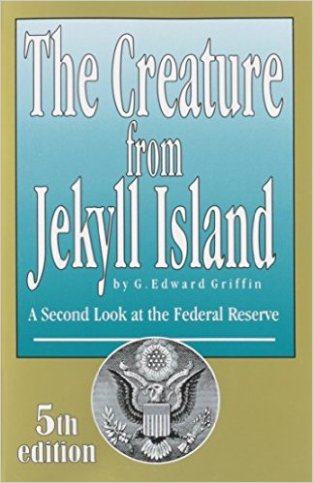
Creature from JekyllThe Creature from Jekyll Island: A Second Look at the Federal Reserve, 5th Edition by G. Edward Griffin (Westlake Village, California, 608 pages, 2010), $19.44.

“The most boring question in the world,” announced the accounting professor to my B-School class, “is whether the government should have bailed out the financial system in 2008.” In his eyes, the answer was an obvious yes. End of story. But that struck me as a rather odd stance. For the question, to bailout, or not to bailout? seemed to me to be among the most fascinating topics imaginable in the field of finance and accounting. And in truth, any answer one could give would have to go well beyond finance and accounting, touching upon the basic philosophical disciplines of politics, ethics, and ultimately epistemology. Further, any answer given would go a long way to telling you something about the man himself. So no, it was not a boring question at all. That is, unless you’re interest is in perpetuating the status quo, in which case you would prefer that it not be asked at all.

I have elected to introduce my review of G. Edward Griffin’s The Creature from Jekyll Island [hereafter, the Creature] by way of this personal account, because it illustrates perfectly the sort of close-minded contempt that emanates from the financial mainstream toward anyone who dares question its reigning orthodoxies. Examples of these nostrums are: Central bank issued fiat currency is good, but the gold standard is a barbarous relic, the money supply cannot be left to the free market, it must be a function of a government appointed central bank; banks are not like other businesses, they must be chartered, regulated, and, if needed, bailed out by the government using taxpayer funds. None of these orthodoxies is true, for none can be supported from Scripture. Yet they are accepted by politicians, academics and ordinary folks alike almost without question.

G. Edward Griffin, on the other hand, is a man who does question these orthodoxies, concluding at the very beginning of his book that the Federal Reserve must be abolished. He provides seven reasons for this, namely:

  • It is incapable of accomplishing its stated objectives.
  • It is a cartel operating against the public interest.
  • It is the supreme instrument of usury.
  • It generates our most unfair tax.
  • It encourages war.
  • It destabilizes the economy.
  • It is an instrument of totalitarianism.

The remainder of the book is used to flesh out why these things are so. In Griffin’s words, the book is a who-dunit, which, in the words of USA Daily, “documents an organized and successful attempt to seize control over the U.S. monetary system by powerful American and European families.”

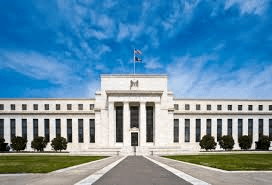
Eccles Building

The Eccles Building, the Washington D.C. headquarters of the Federal Reserve.


At this point one may by asking himself, why is it that Christians should care about the obscure workings of the Federal Reserve System [hereafter, the Fed]? Why not just leave banking to the bankers and get on with more important matters? After all, talking about money doesn’t seem very spiritual. And doesn’t the Bible say that money is the root of all evil? Wouldn’t it be best simply to leave the whole matter alone and focus on the Great Commission instead?

Taking these objections in reverse order, let us consider what Christ commanded in the Great Commission. What did Jesus say to his followers? Go into all the world and teach the five fundamentals? No. Christ called his disciples to go into all the nations and to teach, “them to observe all things that I have commanded you.” The Great Commission includes all of Christ’s teachings. And since there is no field of endeavor not covered by Christ’s teachings,, all statements of all men in all areas of study, including banking, finance, and accounting, must be brought back to Scripture and judged by it. Therefore banking is a proper field of Christian study.

(more…)

Read Full Post »

100 dollar bills.jpgWhen Harvard Economics professor and wannbe Fed Chairman Lawrence Summers speaks, it’s usually a good idea to pay him heed. Mind you, not because pearls of wisdom fall from his lips as manna from heaven, but because what he says carries weight. He is among the very elite of the intellectual and financial elite. A true master of the universe, if you will. And if Summers writes in the Washington Post that he wants to grab your cash, you’d best be paying attention. Because if he’s saying it in the mainstream media, you can take it to the bank (bad pun intended) that the rest of the elite is thinking along those same lines.
Of course, he wasn’t so crude as to suggest he was just going to take your money. People of his ilk never do. They’re far too genteel for such talk. No, what they do is make the case for some small, seemingly innocuous move. The sort of thing that, not only seems downright reasonable, but actually appears to be the very essence of patriotism and upright thinking. I’m speaking here of Summers’ recent call to “kill the $100 bill.”

Now why would this economics professor think that killing a perfectly good Federal Reserve Note is so important that he would take the time to write a newspaper column on the subject? The better to fight crime and terrorism, he tells us. Besides, he adds, we don’t need that silly old $100 bill anyway.

Citing Peter Sands, a senior fellow at Harvard’s Mossavar Rahmani Center for Business and Government, whose recent paper on the subject of banning large denomination bills was the inspiration for his article, Summers writes,

The fact that – as Sands points out – in certain circles the 500 euro note is known as the “Bin Laden” confirms the arguments against it.

Cash, you see, means terrorism. But it’s not just terrorism that we can stop by banning large bills. Crime of the more ordinary sort can be reduced as well. Summers continues,

I confess to not being surprised that resistance within the ECB [European Central Bank, the issuer of the euro] is coming out of Luxembourg, with its long and unsavory tradition of giving comfort to tax evaders, money launderers, and other proponents of bank secrecy…

So, banning the big bills helps us catch crooks too. And on top of that, “technology is obviating whatever need there may ever have been for high denomination notes in legal commerce.”

If we take Summers’ at his word, there simply is no legitimate reason for large denomination notes to even exist at all. And if you think otherwise, you must be a terrorist or tax evader. And you wouldn’t want people to think that about you, now would you?

(more…)

Read Full Post »

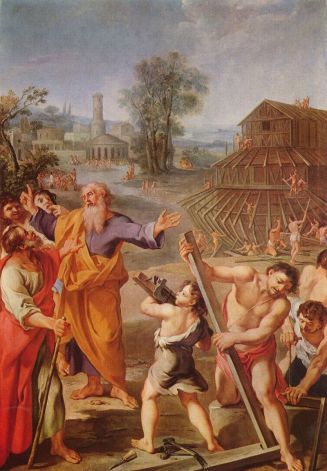
The Building of Noah's Ark_1675

The Building of Noah’s Ark, c. 1675.

Prepping has interested me for several years, but it has been only recently that I felt compelled to write on the subject. Prepping – I would define prepping as, in light of God’s Word, foreseeing possible political, economic and social crises and taking precautions to protect oneself against them – is seen by some as a bit negative, a bit antisocial. After all, if you’re building an ark, you must be rooting for a flood. Because if nothing happens, you’re just going to look foolish.

But while it may be common for people to look down on prepping and those who practice it, preppers actually have a good Biblical basis for doing what they do. As Proverbs tells us, “A prudent man foresees evil and hides himself, but the simple pass on and are punished” (22:3). When one considers the massive and unpayable debts of the Western nations, the geopolitical tensions that seem to be growing all the time, and the spiritual and moral decline seen all around us, it is hard to believe that the current decrepit system can long continue. It has been the position of this author in this series 1) that serious shocks to the West’s political and economic systems are coming in the near future, 2) that most people – and even most Christians – are unprepared materially, physically and spiritually to deal with them, and 3) that the Bible provides an almost embarrassment of riches on the subject of how to get ready for and endure extreme economic, social and political crises.

This series on prepping is not about finding the best type of food to store or how to protect your savings in the event of large scale bank runs. These are important subjects. I do not deny that. But there are other who are better positioned to talk about them. It has been my aim in writing these posts to make the Biblical case for prepping. To show from the pages of Scripture that not only is prepping consistent with the Christian faith, but that it is actually a Biblical imperative.

In particular, this study has looked at the case of Noah, a man faced with a quite literal end-of-the-world-as-he-knew-it scenario. Last week, we looked at the basis of Noah’s salvation from destruction: God’s grace. Noah was not a perfect man. He was a sinner, just like all the others on the earth in his day. But God purposed to save him. Not for anything in Noah or because God was under any obligation to save him, but because the Lord freely, sovereignly elected to do so. This week, I would like to take a closer look at Noah and consider just what sort of man he was.

(more…)

Read Full Post »

« Newer Posts - Older Posts »