Feeds:
Posts
Comments

Posts Tagged ‘Jesus Christ’

Resurrection and the Life

On this Lord’s Day with its special emphasis on the bodily resurrection of our Lord and Savior Christ Jesus, it seemed good to present without comment what others have said concerning this miracle, foretold by the prophets, witnessed by the apostles, and preached by believers ever since.

Scriptural witnesses

  • For I know that my Redeemer liveth, and that he shall stand at the latter day upon the earth (Job 19:25).
  • For You will not leave my soul in Sheol, nor will You allow Your Holy One to see corruption (Psalm 16:10).
  • Yet it pleased the LORD to bruise him; he hath put him to grief: when thou shalt make his soul an offering for sin, he shall see his seed, he shall prolong his days, and the pleasure of the LORD shall prosper in his hand (Isaiah 53:10).
  • And Jonah was in the belly of the fish three days and three nights (Jonah 1:17).
  • He is not here; for He is risen, as He said. Come, see the place where the Lord lay (Matthew 28:6).
  • “Handle Me and see, for a spirit does not have flesh and bones as you see I have” (Luke 24:39).
  • I am the resurrection and the life. He who believes in Me, though he may die, he shall live (John 11:25).
  • Now when she [Mary Magdalene] had said this, she turned around and saw Jesus standing there, and did not know that it was Jesus. Jesus said to her, “Woman, why are you weeping? Whom are you seeking?” She, supposing Him to be the gardener, said to Him, “Sir, if You have carried Him away, tell me where You have laid Him, and I will take Him away.” Jesus said to her, “Mary!” She turned and said to him Rabboni!” (John 20:14-16).
  • [B]eginning from the baptism of John to that day when He was taken up from us, one of these must become a witness with us of His resurrection (Acts 1:22).
  • And with great power the apostles gave witness to the resurrection of the Lord Jesus (Acts 4:33).
  • Concerning his Son Jesus Christ our Lord, which was made of the seed of David according to the flesh; And declared to be the Son or God with power, according to the spirit of holiness, by the resurrection from the dead (Romans 1:3).
  • It [righteousness] shall be imputed to us who believe in Him who raised up Jesus our Lord from the dead, who was delivered up because of our offenses, and was raised because of our justification (Romans 4:24-25).
  • For is we have been united together in the likeness of His death, certainly we also shall be in the likeness of His resurrection (Romans 6:5).
  • He rose again the third day according to the Scriptures (1 Corinthians 15:4).
  • For since by man came death, by man came also the resurrection of the dead (1 Corinthians 15:21).
  • Blessed be the God and Father of our Lord Jesus Christ, who according to His abundant mercy has begotten us again to a living hope through the resurrection of Jesus Christ from the dead (1 Peter 1:3).
(more…)

Read Full Post »

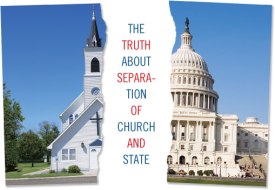
separation-church-and-state

“We have the same vocabulary, but a different dictionary,” was a saying coined a hundred years or so back. It was used by Bible believing Christians to describe liberals who were surreptitiously working to undermine the churches of the day.

The liberals didn’t like a fair fight. Instead of openly declaring their unbelief in the Bible, liberal ministers and scholars were wont to cloak their liberalism in the language of Scripture. The social gospelers would speak of the “divinity of Christ” and for all the world appear to be sound Christians. But instead meaning that Jesus was fully God, they meant only that Jesus, as do all men, had a spark of divinity within him. This is not Christianity. It is a humanist lie.

But old-school social gospelers are not the only people to redefine words to suit their agenda. One prominent example of this is what some atheists and liberals have done to the term “separation of church and state.”

If you’re like me, you probably grew up thinking that 1) these words are found in the Constitution and 2) they mean Christian ideas are legally prohibited from having even the smallest influence in matters of government. Both ideas are false.

But their falsity doesn’t stop many people from passionately believing them. Take a look at this video of a recent Town Hall held by Senator Bill Cassidy of Louisiana.


When minister steps up to pray, some in the audience scream “Prayer? Prayer?” A man can be heard loudly repeating “separation of church and state, separation of church and state.” Another says, “He’s [the minister] not supposed to be up there [at the lectern].”

When the minister ends the prayer in Jesus’ name, the crowd again explodes.

Now for all I know, the loud mouthed protesters may have been dupes paid by George Soros. Perhaps they were expressing an honest, albeit mistaken, opinion. At any rate, they would be better served taking time to learn a thing or two about the Constitution before getting so worked up a minister doing his job.

(more…)

Read Full Post »

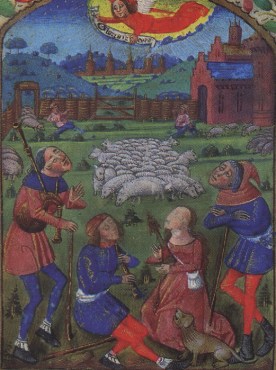
shepherds_illuminationFor the law was given through Moses, but grace and truth came through Jesus Christ (John 1:17).

“I have no idea why justification is by faith alone,” said the hapless minister in story related to my class by Dr. Robert Reymond. The minister, it would seem, was a well intentioned but rather confused fellow.

“Good grief!,” Dr. Reymond continued, “the Bible tells right in Romans chapter 4 the reason why we’re justified by faith alone. ‘Therefore it is of faith that it might be according to grace, so that the promise might be sure to all the seed…’ ”

The saints of God of justified – that is, they are declared righteous by God – not on the basis of their works, but on the basis of faith alone in the finished work of Christ alone, so that their salvation may be on the basis of God’s grace – that is, his unmerited favor – alone.

The redeemed have nothing to boast in except their great Savior. As the old hymn puts it, “Noting in my hand I bring, Simply to the cross I cling.”

Grace is God’s giving his people, not what they deserve, but the blessings he has purposed for them out of the mere good pleasure of his will.

And nowhere is God’s grace more evident than in the birth of Christ Jesus, who, as Paul tells us, was “born of a woman, born under the law, to redeem those who were under the law, that we might receive the adoption as sons.”

In Christ, God has made a way to save his people. The law was given through Moses. And the law condemns us, for we all are guilty of violating it. In it, we have no hope. But Christ fulfilled the law perfectly. And those who believe in him are credited with his righteousness, that they may live for God.

And while it’s important to understand the graciousness of God’s grace, it is also important to remember that his grace is never apart from the truth.

Unlike what some modern day theologians would tell you, God does not speak to us through myth or falsehood. Those who say such things impugn the character of God by their words and bring condemnation upon themselves.

God speaks to us through his Word, and his Word is truth. Always.

Jesus declared that he himself was truth, “I am the way, the truth and the life. No one comes to the Father except through Me.”

How is it that Christ could say “I am the truth”? Doesn’t that seem to be a rather strange way to speak? We might say that so-and-so spoke the truth. But we don’t say of him “he is the truth.” Yet Jesus described himself, not as speaking the truth, but as truth itself.

The answer, I believe, lies in what Gordon Clark taught about truth and persons. Truth, as Clark insisted, is a characteristic of propositions only. A proposition is the meaning of a declarative sentence.

For example, “The ball is red,” is a propositional statement, because it states that a certain property, in this case “red”, attaches to a certain subject, “the ball”. Now if we perceive that the ball is in fact red, we would say the proposition “The ball is red” is true. If, on the other hand, the ball appears green to us, we would say the statement is false.

But what do propositions have to do with the person of Christ? It has to do with how one defines a person. A person, in Clark’s definition, is a complex of propositions. Or to put it a little less philosophically, a person is the thoughts he thinks.

Christ could say of himself “I am the truth” because all his thoughts were true. And since a person is defined by his thoughts, it is proper for Jesus to speak of himself as “the truth.”

When Christ was born in Bethlehem all those years ago, it was the birth, not of one who merely spoke the truth, but of truth itself.


Read Full Post »

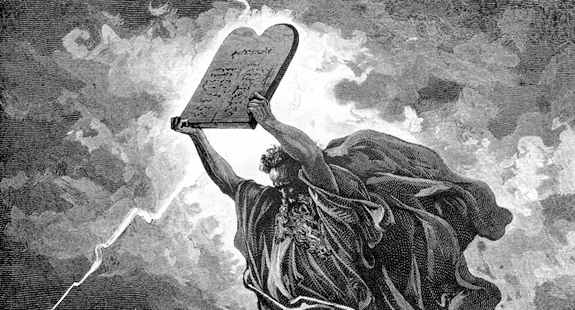
moses

For the law was given through Moses, but grace and truth came through Jesus Christ (John 1:17).

The first chapter of John is a gold mine of theological insight. To paraphrase the apostle himself, if all that could be written on the chapter actually were written, one supposes that the whole earth could not contain the books.

And while it is not the intention of this writer to attempt anything like a comprehensive review of all that John has to tell us, it seems that a look at one small portion of the chapter is not too daunting a task.

In verse 17, John draws an important distinction for us, namely the distinction between Moses and Jesus Christ. The law, John tells us, was given through Moses, but grace and truth came through Jesus Christ.

This brief statement is loaded with implications, a few of which, Lord willing, I will endeavor to point out over the next two weeks.

(more…)

Read Full Post »

you-are-what-you-thinkMost of us have probably hear, and maybe even used, the saying “you are what you eat.” From a strictly physical standpoint, it would seem hard to argue with this. Our bodies are composed of nutrients we take in.
But there is another, more profound way of defining our identity. One that goes beyond the physical, touching on who we really are. And on the authority of the Word of God it is this: You are what you think. Proverbs 23:7 puts it this way, “For as [a man] thinks in his heart, so is he.”

And it is for this reason that God is supremely concerned with the thoughts of our heart, the things we believe, the things we say.

(more…)

Read Full Post »


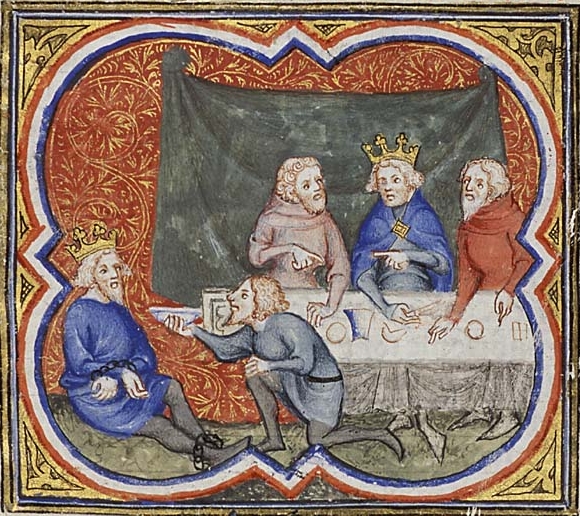
zedekiah_is_chained_and_brought_before_nebuchadnezzar

Zedekiah is chained and brought before Nebuchadnezzar, from Petrus Comestor’s “Bible Historiale.”  

Traditionally attributed to the prophet Jeremiah, Lamentations recounts the author’s reflections on the ruins of Jerusalem in the aftermath of the city’s fall to the Babylonians.


When a city, when a nation, falls, it is natural for people to ask why it happened. Chapter One of Lamentations provides the following succinct summary of the sorry state of Jerusalem.

Her uncleanness is in her skirts;

She did not consider her destiny;

Therefore her collapse was awesome.

Now that’s what I call getting right to the point. Jerusalem, which was really a part standing for the whole of Judah, had become morally unclean. God sent prophets to warn the people, but they did not heed, they, they did not consider their end, therefore judgment befell them.

Now I’ve always been a history buff. And, in particular, I’ve always been fascinated by the notion of civilizational collapse. That sounds pretty depressing, I know. But I don’t say that, because I’m rooting to see a contemporary collapse myself.

(more…)

Read Full Post »


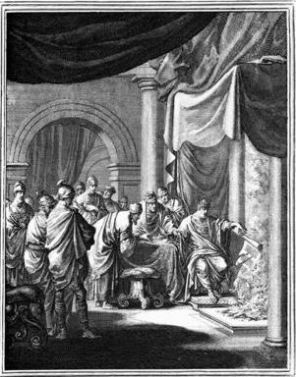
jehoiakim-burns-the-scroll

Jehoiakim Burns the Scroll, Caspar Luiken 1672-1708.

What to write?  That’s the question all bloggers must face.  Sometimes the answer comes quickly.  Sometimes it doesn’t. 

With campaign season hitting its big crescendo last week, my mind’s been focused on the election. But now that it has passed, where do I go from here? There’s the series on immigration I’ve been writing. I haven’t forgotten about it. Lord willing, I plan to finish it sometime later this month. But today didn’t strike me as a day to write about immigration.

So back to the question of what to write about. Perhaps due in part to the recently concluded election, the specter of national and civilizational decline is often at the forefront of my thoughts.

Perhaps another reason for this is my Scripture reading. Recently, I’ve been focused on the prophets, Jeremiah in particular. And I never get very far in the prophets before I find myself saying “This could have been written yesterday about America!”

And it’s true, too. Edward Gibbons’ masterpiece of history The Decline and Fall of the Roman Empire is often cited by writers who want to advance some reason or another for the obvious, ongoing collapse of Western Civilization in our own time.

But there is a far better text to use if we want to gain insight on the problems we face in 21st century America. Of course, I’m referring to the Bible. And in particular the historical books of I and II Samuel,
I and II Kings,
I and II Chronicles and the prophets. Taken together, they could almost be subtitled The Decline and Fall of the Hebrew Republic.

Samuel was the last of the judges and the anointer of the first two kings of Israel, Saul and David. It was during Samuel’s judgeship that Israel made the critical error in asking for a king (big government) in place of the limited, constitutional republic set up by God in the law of Moses.

If we were to summarize the history of Israel under the kings, we could say that the kingdom rapidly grew in power under the rule of David, hit its peak under his son Solomon, then split in two – the northern and southern kingdoms – under Solomon’s son Rehoboam. From there, the two kingdoms followed a centuries long trajectory of decline with the northern kingdom falling to Assyrian in 722 BC, and the southern kingdom to Babylon in 586 BC.

What makes the history of this decline and fall so relevant today is that the reader is not, as he is with secular history, left to decide for himself the reasons behind the disasters that befell Israel and Judah. The Word of God tells him explicitly: the people of Israel refused to heed the Lord and suffered the covenant curses pronounced in Deuteronomy 28.

(more…)

Read Full Post »


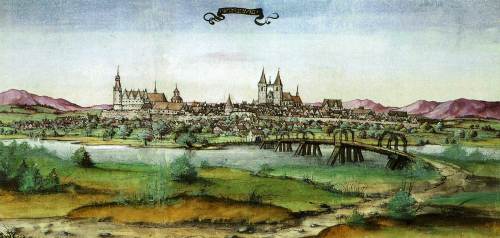
Wittenberg-1536.jpg

Wittenberg as seen from the Elbe, 1536.

October 31 is known to much of the world as the pagan holiday of Halloween. But for Christians, October 31 represents something quite different. It’s what we call Reformation Day.


For it was on that date in 1517 that Martin Luther’s nailed his 95 theses to the Wittenberg church door and forever changed the world for the better.

The Gospel of Justification By Faith Alone – the idea that sinful men are saved, not by doing good works, but solely by faith in Christ Jesus – once again shone forth in all its brilliance after a millennium of suppression by the Roman Church-State and millions were saved as a result.

But Luther’s rejection of church tradition in favor of the objective, written Word of God did not revolutionize the church only. It resulted in a whole new civilization, what we now call the West, coming into existence.

Ideas such as the sanctity of private property, honesty in exchange, the rule of law, capitalism, written constitutions, secular work as pleasing to God all found their origin in the Protestant Reformation that began with Luther.

Though it is not commonly understood by Americans, our nation owes its very existence to the Biblical ideas recovered at the time of the Reformation.

Most of us are taught to trace the foundations of our republic to Greece and Rome. But limited, constitutional government did not begin with Greco-Roman civilization. It began with the Hebrew Republic as recorded for us in the Old Testament. Thus the Bible is foundational to our political system.

In like manner, our economic system of capitalism or free enterprise finds its origins, not in the writings of pagan philosophers, nor in the thought of medieval scholastics, nor in the principles of the Renaissance, but in the propositions of the Word of God, the 66 books of the Bible.

To put it another way: No Protestant Reformation, no United States of America. To quote John Robbins,

One of Luther’s most brilliant followers, John Calvin, systematized the theology of the Reformation. The seventeenth-century Calvinists laid the foundations for both English and American civil rights and liberties: freedom of speech, pres, and religion, the privilege against self-incrimination, the independence of juries, and right of habeas corpus, the right not to be imprisoned without cause. The nineteenth-century German historian Leopold von Ranke referred to Calvin as the “virtual founder of America” (Civilization and the Protestant Reformation).

(more…)

Read Full Post »

What Sweeter Music


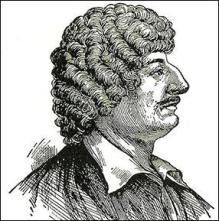
herrick

Robert Herrick, English poet and cleric, 1591-1674.


A Christmas Carol

by Robert Herrick


What sweeter music can we bring

Than a carol for to sing

The birth of this our Heavenly King?

Awake the voice! awake the string!

Heart, ear, and eye, and everything

Awake! the while the active finger

Runs division with the singer.


Dark and dull night fly hence away!

And give the honour to this day

Than sees December turn’d to May.


If we may ask the reason, say

The why and wherefore all things here

Seem like the spring-time of the year.


Why does the chilling winter’s morn

Smile like a field beset with corn?

Or smell like to a mead new shorn,

Thus on a sudden?


Come and see

The cause why things thus fragrant be:

‘Tis He is born, whose quickening birth

Gives life and lustre, public mirth,

To heaven and the under-earth.


We see Him come, and know Him ours,

Who with his sunshine and his showers

Turns all the patient ground to flowers.


The darling of the world is come,

And fit it is we find a room

To welcome Him.


The nobler part

Of all the house here is the heart,


Which we will give Him; and bequeath

This holly and this ivy wreath

To do Him honour, who’s our King

And Lord of all this revelling.

Read Full Post »

300

Thermopylae inscription

Memorial at Thermopylae bearing Simonides famous epitaph: Tell them in Lacedaimon, passer-by / That here, obedient to their word, we lie.   


“Come and take them,” retorted king Leonidas to the Persian envoy who had asked him to surrender his arms. Brave words those. Especially in light of the overwhelming odds facing the Spartans. The Persians had an army numbering in the hundreds of thousands. One ancient source puts it at over two million. In any event, the Persian forces vastly outnumbered the small Greek army of about 7,000 men. After two days of heroic fighting, Leonidas and the 300 other Spartan soldiers who were with him were surrounded and killed by the Persians.


Those familiar with ancient history immediately will recognize this as a reference to the Battle of Thermopylae, fought in 480 B.C. The Spartans’ stand against the Persians was the stuff of legend, even in ancient times. Simonides, a Greek poet from about the same time, composed a famous epitaph for the slain that reads,

Tell them in Lacedaimon [Sparta], passer-by,

That here, obedient to their word, we lie.

Today, these words are inscribed on a memorial plaque at the site of the battle. In more recent times, interest in the Battle of Thermopylae has been inspired by a graphic novel titled 300 and a movie by the same name.

From the account of their actions at Battle of Thermopylae, it is clear that the Spartans were a remarkable people. What can we say about them? First, they were great warriors. It was often commented that Sparta, unlike most other ancient cities, lacked defensive walls. Spartan lawgiver Lycurgus reportedly explained this by saying, “A city is well-fortified which has a wall of men instead of brick.”

Second, they had a strong sense of honor. Not all the Greek forces at Thermopylae fought to the death. Some surrendered. Others retreated. But Leonidas and his men went down fighting. In ancient warfare, it was considered shameful for a man to drop his weapons and flee. Such was the Spartan love of honor that Plutarch, an ancient Greek writer, quoted Spartan mothers as telling their sons as they went off to battle, “Come back with your shield, or on it.”

Third, they lost. Doubtless they were very brave. And doubtless they were heroic. But in the end, they were all dead. The Greeks went on the win the war, perhaps in part due to the efforts of the Spartans at Thermopylae. But it was the Persians who held the field at the end of the day.

(more…)

Read Full Post »

« Newer Posts