Feeds:
Posts
Comments


ark-encounter_lights

Ark Encounter rainbow lights.


We’re down to the last day of 2016. To say the least, it’s been an interesting year. One which, Lord willing, I’ll review in a little more depth later this weekend. But for now, here’s a few thoughts on the news from this past week.

The Ark and the Rainbow

Since the Ark Encounter theme park is located just a little south of Cincinnati, from time to time articles about it appear in the local paper. For those who may not be familiar with Ark Encounter, it’s a park built around a full sized replica of Noah’s Ark. Having opened in the summer of 2016, the attraction is part of Ken Ham’s Answers in Genesis ministry, which runs the Creation Museum, located in the Cincinnati area.

The main message of both Ark Encounter and the Creation Museum is that the history presented in the early chapters of Genesis is just that, actual, literal history. Adam and Eve were actual people. There really was a Noah who built an actual ark of a certain size and shape. God really did end the world as it was know by means of a cataclysmic flood that wiped out all human and most animal life except what was on the ark, etc.

This is sound Bible teaching, but definitely not the sort of thing that plays well in some quarters. In some cases, opposition comes from within the Evangelical community. In others, it comes from without.

LGBTQ activists are the latest group to be put off by Ark Encounter, this time by a light display that baths the replica ark in rainbow colored lights at night.

As Ham puts it, the rainbow is not a symbol of “freedom, love, pride or the LGBTQ movement.” It is the sign of the Noahic covenant, God’s promise to never again destroy the earth by water.

Naturally, LGBTQ activists reacted with scorn to Ham’s comments, with one expressing concern for the effect Ham’s message will have on younger people.

But who has the real compassion for young people wrestling with the sin of homosexuality? A man who presents the truth of what God says in his Word, or a man who peddles the lie that homosexuality is merely a lifestyle choice with all the ethical weight of a decision on what color carpet to install in the family room.

Continue Reading »

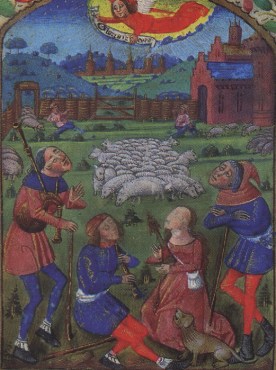
shepherds_illuminationFor the law was given through Moses, but grace and truth came through Jesus Christ (John 1:17).

“I have no idea why justification is by faith alone,” said the hapless minister in story related to my class by Dr. Robert Reymond. The minister, it would seem, was a well intentioned but rather confused fellow.

“Good grief!,” Dr. Reymond continued, “the Bible tells right in Romans chapter 4 the reason why we’re justified by faith alone. ‘Therefore it is of faith that it might be according to grace, so that the promise might be sure to all the seed…’ ”

The saints of God of justified – that is, they are declared righteous by God – not on the basis of their works, but on the basis of faith alone in the finished work of Christ alone, so that their salvation may be on the basis of God’s grace – that is, his unmerited favor – alone.

The redeemed have nothing to boast in except their great Savior. As the old hymn puts it, “Noting in my hand I bring, Simply to the cross I cling.”

Grace is God’s giving his people, not what they deserve, but the blessings he has purposed for them out of the mere good pleasure of his will.

And nowhere is God’s grace more evident than in the birth of Christ Jesus, who, as Paul tells us, was “born of a woman, born under the law, to redeem those who were under the law, that we might receive the adoption as sons.”

In Christ, God has made a way to save his people. The law was given through Moses. And the law condemns us, for we all are guilty of violating it. In it, we have no hope. But Christ fulfilled the law perfectly. And those who believe in him are credited with his righteousness, that they may live for God.

And while it’s important to understand the graciousness of God’s grace, it is also important to remember that his grace is never apart from the truth.

Unlike what some modern day theologians would tell you, God does not speak to us through myth or falsehood. Those who say such things impugn the character of God by their words and bring condemnation upon themselves.

God speaks to us through his Word, and his Word is truth. Always.

Jesus declared that he himself was truth, “I am the way, the truth and the life. No one comes to the Father except through Me.”

How is it that Christ could say “I am the truth”? Doesn’t that seem to be a rather strange way to speak? We might say that so-and-so spoke the truth. But we don’t say of him “he is the truth.” Yet Jesus described himself, not as speaking the truth, but as truth itself.

The answer, I believe, lies in what Gordon Clark taught about truth and persons. Truth, as Clark insisted, is a characteristic of propositions only. A proposition is the meaning of a declarative sentence.

For example, “The ball is red,” is a propositional statement, because it states that a certain property, in this case “red”, attaches to a certain subject, “the ball”. Now if we perceive that the ball is in fact red, we would say the proposition “The ball is red” is true. If, on the other hand, the ball appears green to us, we would say the statement is false.

But what do propositions have to do with the person of Christ? It has to do with how one defines a person. A person, in Clark’s definition, is a complex of propositions. Or to put it a little less philosophically, a person is the thoughts he thinks.

Christ could say of himself “I am the truth” because all his thoughts were true. And since a person is defined by his thoughts, it is proper for Jesus to speak of himself as “the truth.”

When Christ was born in Bethlehem all those years ago, it was the birth, not of one who merely spoke the truth, but of truth itself.


fake-news

It’s been a while since I’ve written a Week In Review. Too long for my taste. I’ve been a political/economic/world events junkie for as long as I can remember, and I really do enjoy reading and writing about the events of the day.

So, let’s get on with the business at hand…

Continue Reading »

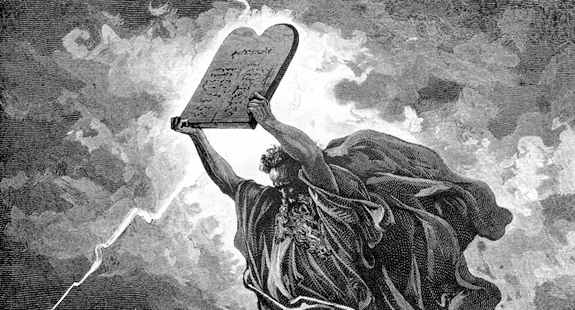
moses

For the law was given through Moses, but grace and truth came through Jesus Christ (John 1:17).

The first chapter of John is a gold mine of theological insight. To paraphrase the apostle himself, if all that could be written on the chapter actually were written, one supposes that the whole earth could not contain the books.

And while it is not the intention of this writer to attempt anything like a comprehensive review of all that John has to tell us, it seems that a look at one small portion of the chapter is not too daunting a task.

In verse 17, John draws an important distinction for us, namely the distinction between Moses and Jesus Christ. The law, John tells us, was given through Moses, but grace and truth came through Jesus Christ.

This brief statement is loaded with implications, a few of which, Lord willing, I will endeavor to point out over the next two weeks.

Continue Reading »


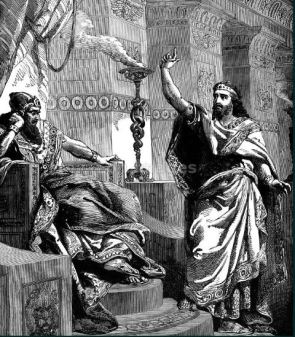
daniel-and-neb

Daniel interprets Nebuchadnezzar’s dream.

One of the key points of Gordon Clark’s Scripturalism is that we are just as dependent on God for knowledge as we are for salvation.


Those in the Reformed community, at least those who are actually Christians, will readily admit that salvation is by grace alone, through belief alone, in Christ alone.

But oddly, many of the same people are sound on the doctrine of salvation at the same time hold to a theory of knowledge (epistemology) that is at odds with their view of salvation.

It is not uncommon to hear some Christians talk as though there are two sources of knowledge, revelation in the 66 books of the Bible and sense experience (empiricism).

This admixture of revelation and sense experience in Christian thought can be traced back to Thomas Aquinas. John Robbins explains,

Thomas Aquinas, the great thirteenth-century Roman Catholic theologian, tried to combine two axioms in his system: the secular axiom of sense experience, which he obtained from Aristotle, and the Christian axiom of revelation, which he obtained from the Bible. His synthesis was unsuccessful. The subsequent career of western philosophy is the story of the collapse of Thomas’ unstable Aristotelian-Christian condominium (An Introduction to Gordon H. Clark)

One of the problems with Protestantism over the centuries is that it never produced a philosopher who challenged Aquinas’ theory of knowledge. As a result, Aquinas’ erroneous synthesis of “the secular axiom of sense experience…and the Christian axiom of revelation” was accepted by large segments of the Christian church.

Continue Reading »

egyptAmong the besetting sins of Old Testament Israel was an unfortunate tendency do what seemed right in their own eyes. When faced with a difficult situation, many times the Israelites, both the common people and the leadership, chose to wing it rather than to seek God’s face.

Speaking through the prophet Isaiah, God condemned this way of thinking in no uncertain terms.

“Woe to the rebellious children,” says the LORD,

“Who take counsel, but not of Me,

And who devise plans, but not of My Spirit,

That they may add sin to sin;

Who walk to go down to Egypt,

And have not asked My advice,

To strengthen themselves in the strength of Pharaoh,

And to trust in the shadow of Egypt!” (Isaiah 30:1, 2)

Some commentators believe that the likely targets of these words originally were King Hezekiah’s counselors. Assuming that is the case, how can we apply these words to what is going on in our own day? To do this, a little history is in order.

Continue Reading »

you-are-what-you-thinkMost of us have probably hear, and maybe even used, the saying “you are what you eat.” From a strictly physical standpoint, it would seem hard to argue with this. Our bodies are composed of nutrients we take in.

But there is another, more profound way of defining our identity. One that goes beyond the physical, touching on who we really are. And on the authority of the Word of God it is this: You are what you think. Proverbs 23:7 puts it this way, “For as [a man] thinks in his heart, so is he.”

And it is for this reason that God is supremely concerned with the thoughts of our heart, the things we believe, the things we say.

Continue Reading »


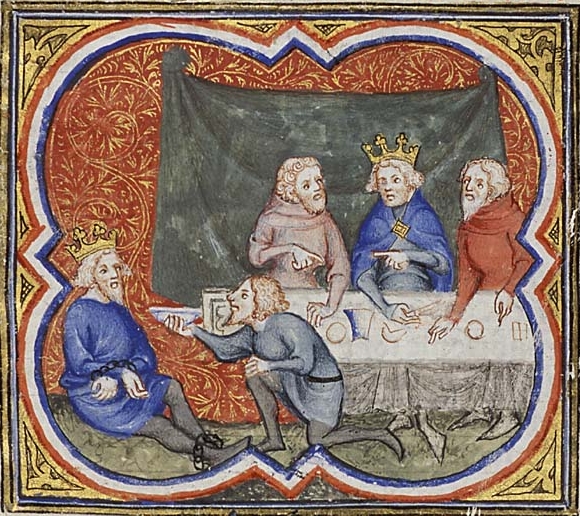
zedekiah_is_chained_and_brought_before_nebuchadnezzar

Zedekiah is chained and brought before Nebuchadnezzar, from Petrus Comestor’s “Bible Historiale.”  

Traditionally attributed to the prophet Jeremiah, Lamentations recounts the author’s reflections on the ruins of Jerusalem in the aftermath of the city’s fall to the Babylonians.


When a city, when a nation, falls, it is natural for people to ask why it happened. Chapter One of Lamentations provides the following succinct summary of the sorry state of Jerusalem.

Her uncleanness is in her skirts;

She did not consider her destiny;

Therefore her collapse was awesome.

Now that’s what I call getting right to the point. Jerusalem, which was really a part standing for the whole of Judah, had become morally unclean. God sent prophets to warn the people, but they did not heed, they, they did not consider their end, therefore judgment befell them.

Now I’ve always been a history buff. And, in particular, I’ve always been fascinated by the notion of civilizational collapse. That sounds pretty depressing, I know. But I don’t say that, because I’m rooting to see a contemporary collapse myself.

Continue Reading »


jehoiakim-burns-the-scroll

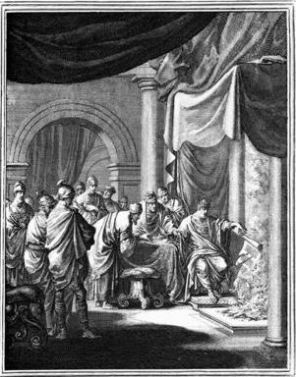
Jehoiakim Burns the Scroll, Caspar Luiken 1672-1708.

What to write?  That’s the question all bloggers must face.  Sometimes the answer comes quickly.  Sometimes it doesn’t. 

With campaign season hitting its big crescendo last week, my mind’s been focused on the election. But now that it has passed, where do I go from here? There’s the series on immigration I’ve been writing. I haven’t forgotten about it. Lord willing, I plan to finish it sometime later this month. But today didn’t strike me as a day to write about immigration.

So back to the question of what to write about. Perhaps due in part to the recently concluded election, the specter of national and civilizational decline is often at the forefront of my thoughts.

Perhaps another reason for this is my Scripture reading. Recently, I’ve been focused on the prophets, Jeremiah in particular. And I never get very far in the prophets before I find myself saying “This could have been written yesterday about America!”

And it’s true, too. Edward Gibbons’ masterpiece of history The Decline and Fall of the Roman Empire is often cited by writers who want to advance some reason or another for the obvious, ongoing collapse of Western Civilization in our own time.

But there is a far better text to use if we want to gain insight on the problems we face in 21st century America. Of course, I’m referring to the Bible. And in particular the historical books of I and II Samuel,
I and II Kings,
I and II Chronicles and the prophets. Taken together, they could almost be subtitled The Decline and Fall of the Hebrew Republic.

Samuel was the last of the judges and the anointer of the first two kings of Israel, Saul and David. It was during Samuel’s judgeship that Israel made the critical error in asking for a king (big government) in place of the limited, constitutional republic set up by God in the law of Moses.

If we were to summarize the history of Israel under the kings, we could say that the kingdom rapidly grew in power under the rule of David, hit its peak under his son Solomon, then split in two – the northern and southern kingdoms – under Solomon’s son Rehoboam. From there, the two kingdoms followed a centuries long trajectory of decline with the northern kingdom falling to Assyrian in 722 BC, and the southern kingdom to Babylon in 586 BC.

What makes the history of this decline and fall so relevant today is that the reader is not, as he is with secular history, left to decide for himself the reasons behind the disasters that befell Israel and Judah. The Word of God tells him explicitly: the people of Israel refused to heed the Lord and suffered the covenant curses pronounced in Deuteronomy 28.

Continue Reading »

election-2016Alright all you Social Justice Warrior snowflakes, listen up! I’m about to discuss a certain election that was recently held in the US, and you’re probably not going to like what I have to say. So consider this your trigger warning. Proceed at your own risk

For the rest of you, I trust you’re all adults who can hear the name Donald Trump without breaking into a cold sweat and the sudden urge to flee to the nearest safe space.

To all of you, congratulations on surviving the 2016 presidential election. As has been noted by many others, this was an election unlike any we’ve ever seen. For my part, I tried to avoid writing about it.

Some of my reticence was the result of not quite knowing what to think. As a constitutionalist out of the Ron Paul mold, I had significant differences with all of the candidates. It was tempting at times to pronounce a plague on all their houses and try my best to ignore the whole thing.

But since one of the main purposes of this blog is to bring the light of Clarkian Scripturalism to bear on contemporary issues, keeping silent on the election was not really a viable option.

Neutrality was an option as well. But the obvious establishment propaganda campaign on behalf of Hillary coupled with a remarkably vicious elite jihad on Trump and his supporters – most of Trump’s backers were regular, hard-working Americans, people like me who had had it with the arrogant, lying, globalist oligarchy that had by means of bogus trade deals, unconstitutional foreign wars, Federal Reserve money printing, bail-outs, etc. run the nation into the ground – went a long way to pushing me, even if somewhat reluctantly, into the Trump camp.

In the end, I wrote far move about the election than I had ever intended. And in retrospect, I’m glad that I did. The 2016 campaign challenged me to think carefully about issues – for example, in light of all Donald Trump’s obvious moral shortcomings, could a Christian in good conscience still vote for him? (in case you’re wondering, I came down on the “yes” side of that question) – that I otherwise would have preferred to leave alone. For that I am thankful.

All that said, here are a few items that strike me as key takeaways.

Continue Reading »