The Religious Wars of the 21st Century by John W. Robbins – http://www.sermonaudio.com/sermoninfo.asp?SID=53101448594
Conservatism, An Autopsy by John W. Robbins – http://www.trinityfoundation.org/journal.php?id=115
Posted in Politics, Radio Lux Lucet, Scripturalism, Theology, tagged Donald Trump, Economics, John Robbins on July 22, 2016| Leave a Comment »
The Religious Wars of the 21st Century by John W. Robbins – http://www.sermonaudio.com/sermoninfo.asp?SID=53101448594
Conservatism, An Autopsy by John W. Robbins – http://www.trinityfoundation.org/journal.php?id=115
Posted in Economics, Scripturalism, tagged Economics, Gordon Clark, Investing, John Robbins, Philosophy, Pope Francis, The Fed on July 10, 2016| 2 Comments »
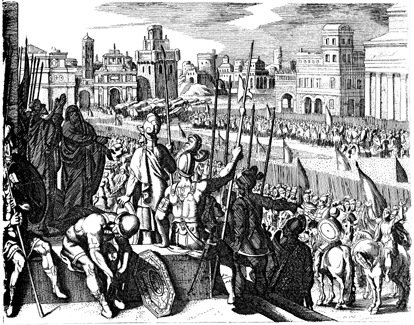
Elisha Prophesies the End of Samaria’s Siege by Nicolas Fontaine, 1625-1709.
When beginning the Siege of Samaria series on Biblical economics, I never intended it to go on for more than two or perhaps three posts. Due to an embarrassment of material and positive response from the readers of this blog, the series stretched into five posts. In no small part the success of this series has been due to the generous support of Sean Gerety over at the God’s Hammer blog, who has been kind enough to republish my posts.
It’s certainly been an encouragement to me to see so many people interested in what the Bible has to teach us about economics. Most of the economic talk one hears in the mainstream media is misleading, and, I suspect, it’s designed to be that way. After all, if too many folks were to get wise to the economic evil troika of central banking, fiat currency and demand-side Keynesian economics, it would be a lot harder for the financial masters of the universe to loot the poor and middle class of the world for their benefit.
The lies of the statists enslave, but the truth of God’s Word makes men free. And it is to the end of furthering this truth that I have presented the series on Biblical economics.
And because Biblical economics is both a fascinating and worthwhile study, it seemed good to me to take this opportunity to share with others the intellectual ammunition I’ve found helpful in developing my understanding of the subject. Below is a list of resources along with my comments.
Posted in Scripturalism, Theology, tagged Gordon Clark on May 1, 2016| 2 Comments »
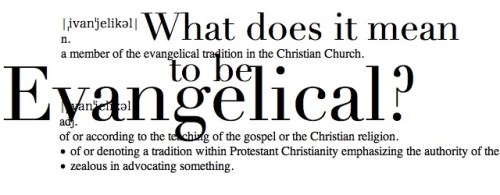 So what is an evangelical anyway? It’s common term, and not just in church circles either. Now that the US presidential elections are well underway, one often hears the word evangelical in connection with politics, as in such and such a candidate is attempting to garner the evangelical vote. But who are these people whose votes the politicians want?
From stories that appear in the media, one gets the distinct sense that evangelical has come to anyone who’s a non-Roman Catholic, non- mainline liberal Protestant church goer. The popular image of which could be described as a mega-church attending, TBN watching, pre-trib rapture awaiting Christian Zionist.
In his 2007 study concerning who qualifies as an Evangelical, George Barna found that 38% of the US population described themselves as such.
As part of the same survey, Barna used a nine-point definition of Evangelical to identify individuals who belonged to this group. Judged by Barna’s criteria, only about 8% of the US population can be described as Evangelical.
Historically speaking, the definition of Evangelical has encompassed two criteria: justification by faith alone (JBFA) and the authority of Scripture alone. Gordon Clark makes this point in Chapter 4 of God’s Hammer, writing, “The term evangelical, an inheritance from the Reformation, reminds us of the so-called material principle of the origin of Protestantism. Justification by faith alone was the material principle…”
Clark continues, “[T]he so-called formal principle of the Reformation [is] the Scripture itself. No one can rightly appropriate the term evangelical who rejects the one or the other.”
Belief in the twin towers of the Reformation, Scripture alone and Justification by Faith alone, is required of anyone who wishes to be considered an evangelical, at least in the historical sense of the term.
Posted in Economics, Politics, Scripturalism, tagged John Robbins on March 30, 2016| 2 Comments »

President Barak Obama addresses the Young Leaders of the Americas Town Hall in Buenos Aires, Argentina, March 23, 2016.
“So often in the past,” said president Barak Obama to a group of Argentinian youth, “there has been a division between left and right, between capitalists and communists or socialists, and especially in the Americas, that’s been a big debate.” The president continued, “Those are interesting intellectual arguments, but I think for your generation, you should be practical and just choose from what works. You don’t have to worry about whether it really fits into socialist theory or capitalist theory. You should just decide what works.”
Obama’s remarks have drawn a good deal of fire from conservatives, and rightly so. To downplay the division between communism and capitalism betrays a profound ignorance of economics and of history. Capitalism, the economic system of the Bible with its emphasis on private property, has lifted millions out of poverty and produced relatively free and just societies in the nations where it has been practiced; communism, the collectivist economic system of Karl Marx that places ownership of the means production with the state, has produced untold suffering and death for millions.
Posted in Book Review, Scripturalism, Theology, tagged Gordon Clark, John Robbins on March 27, 2016| Leave a Comment »
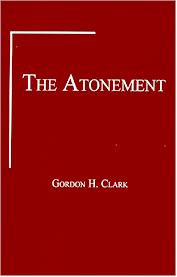 The Atonement by Gordon H. Clark (Jefferson, MD: The Trinity Foundation, 1987, 163 pages), $8.95.
Chapters Include: Introduction on Method; The Doctrine in its Simplicity; The Covenant of Redemption; The Covenant of Grace; The Incarnation; The Virgin Birth; The Human Nature of Christ; The Purpose of the Incarnation; Active Obedience; The Covenant of Works; The Vicarious Sacrifice; Expiation; Propitiation; Satisfaction; Federal Headship; Absolute Necessity; Traducianism; The Sovereignty of God; The Extent of the Atonement.
A few years back, American Express ran a television advertisement that featured the story of a man who visited Norway thinking he was going to see the land of his ancestors only to find upon arrival that he actually was of Swedish descent. Or perhaps it was the other way around. At any rate, he wasn’t who he thought he was.
I had a similar experience when I first began to study theology. As I worked through a book on systematic theology with a very generous and learned reformed Baptist pastor, I found, much to my surprise, I was an Arminian. This was particularly shocking to me, as I had never so much as heard the word before, let alone realized I was one. In truth, my experience wasn’t so unusual. Such is the dominance of Arminian theology in American Evangelical churches that Arminians generally are unaware of their Arminianism. It’s taken for granted that Christ died for all men, and little or no serious thought is given to an alternative. When the doctrines of grace, what we would call Calvinism, are discussed, many folks raised in the broad evangelical church are shocked and offended that someone actually could believe that God does not love all men, that some are in fact reprobate and fitted for destruction, and that this is the historic teaching of the Reformation.
Posted in Economics, Scripturalism, tagged John Robbins, Money and Banking, Obamacare, The Fed on January 17, 2016| 4 Comments »
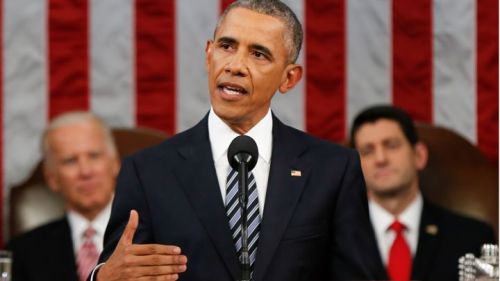
President Barak Obama delivers his State of the Union address to Congress, January 12, 2016.
“Anyone claiming that America’s economy is in decline is peddling fiction,” or at least that’s what President Obama would have Americans believe based on his remarks in his State of the Union address last week. Yes, according to the president, everything is awesome. And anyone who thinks otherwise is simply, to quote a Vice President from a few decades back, a nattering nabob of negativism.
But is everything as rosy as Obama would have us believe? The following points would suggest otherwise:
Considering only the bullet points above, it would appear that precarious is about the kindest word one could use to describe the economic condition of the US. To say we’re headed off an economic cliff likely would be closer to the mark.
So how did we get here? How did a nation founded by the Puritans and committed to the principles of civil and economic liberty end up a bloated, socialist over extended empire suffocating under the largest debt edifice in the history of mankind? Although a full answer to that question is beyond the scope of a single blog post, the short answer is that the American people have, to borrow what Isaiah said about the people of Judah, turned away backwards from God and from his law. We have rejected the truth and embraced the lie, and now the chickens are coming how to roost.
In this post, I would like to look specifically at three economic lies that are held by nearly all academic economists, politicians and their enablers in the media: central banking, fiat currency and Keynesian economics. Any one of these by itself is dangerous to the health of a nation. Taken together, they are a sort of perfect storm, guaranteed to bring economic destruction to any nation whose leaders embrace them.
Posted in Book Review, Scripturalism, Theology, tagged Apologetics, Gordon Clark, John Robbins on January 10, 2016| 5 Comments »
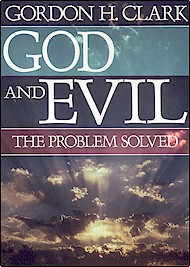
God and Evil: The Problem Solved by Gordon H. Clark (Unicoi, Tennessee: The Trinity Foundation, 91 pages, 2004) $5.00.
Responding to president Bush’s proposal to allow public schools to teach intelligent design along with Darwinism, veteran political commentator Daniel Schorr remarked, “[Bush] might well have reflected that, if this [Hurricane Katrina] was the result of intelligent design, then the designer has something to answer for.” From a Christian perspective, this comment is a bit off the mark. For Christians do no not, or at least ought not, argue for intelligent design. Creationism – the doctrine that God created all things of nothing, by the Word or his power, in the space of six literal days, and all very good – is the proper Biblical stance. Nevertheless, Schorr’s statement certainly does apply to creationism. In fact, Schorr’s argument is really more of a problem of the creationist than it is for the proponent of intelligent design.
Writing in his 2006 book Letter to a Christian Nation, atheist evangelist Sam Harris was even more pointed in his criticism of Christians than was Schorr.
Examples of God’s failure to protect humanity are everywhere to be seen. The city of New Orleans, for instance, was recently destroyed by a hurricane. More than a thousand people dies; tens of thousands lost all their earthly possessions; and nearly a million were displaced. It is safe to say that almost every person living in New Orleans at the moment Hurricane Katrina struck shared your belief in an omnipotent, omniscient, and compassionate God. But what was God doing while Katrina laid waste to their city? Surely He heard the prayers of those elderly men and women who fled the rising waters for the safety of their attics, only to be slowly drowned there. These were people of faith. These were good men and women who had prayed throughout their lives. Do you have the courage to admit the obvious? These poor people died talking to an imaginary friend (52).
From the start, Christians have found themselves confronted with arguments similar to those above and have handled them with various degrees of success. Far too often they have come off as the proverbial fellow who made the mistake of brining a knife to a gun fight. They are unprepared and overmatched. In the opinion of this reviewer, a Christian who and understands and believes Clark’s argument in God and Evil: The Problem Solved (hereafter God and Evil)
will find himself in the happier position of the man who brought a gun to a knife fight. The opposition won’t have a chance.
Posted in Book Review, Scripturalism, Theology, tagged Gordon Clark, John Robbins on December 6, 2015| 3 Comments »
The Incarnation by Gordon H. Clark (Jefferson, Maryland: The Trinity Foundation, 91 pages, 1988), $8.95.
For several reasons, The Incarnation
is a noteworthy book. First, it is Gordon Clark’s final publication, written at the very end of his life and published posthumously. Second, it is a masterpiece of logical reasoning and clear writing. As if to prove correct the psalmist’s comment about the righteous, that they “still shall bear fruit in old age,” Clark’s thinking is just as acute in this book as at any time in his long and distinguished career. Third, it is brief. At 91 pages, it makes for a short it can be read in a single sitting. and yet for all its brevity, it is also quite profound. Fourth, it is perhaps Clark’s most controversial writing, in which he weighs the Creed of Chalcedon in the balance and finds it, if not entirely wanting, certainly in dire need of renovation.
 Although Gordon Clark (1902-1985) died before completing The Incarnation, he left it in a state such that, practically speaking, it was a complete work at the time of his decease. As John Robbins commented in the book’s Foreward,
At the time he [Clark] was stricken mortally ill in February 1985, he was writing the present volume, which he titled Concerning the Incarnation. He did not quite finish the book, intending to add a few more paragraphs summarizing his hundred pages of analysis and argumentation, so he asked this writer to complete it for him…I have added only two paragraphs to his words (ix).
The additional summary paragraphs written by Robbins fall at the very end of the book and are clearly marked.
As for the book’s analysis and argumentation, it is first rate start to finish. Clark brings a logician’s eye to the Creed of Chalcedon and finds much that is lacking. This likely comes as a surprise to many readers. For since its formulation in A.D. 451, Chalcedon has been held up as the final word on the incarnation. But Clark makes a compelling case that the Creed, although helpful in some places, also is beset with serious shortcomings, chief among them being the lack of clear definitions for its principle terms.
Posted in Book Review, Philosophy, Scripturalism, Theology, tagged God's Hammer, Gordon Clark on November 16, 2015| Leave a Comment »
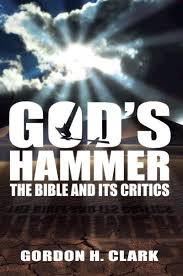 God’s Hammer: The Bible and its Critics by Gordon H. Clark (Unicoi, Tennessee: The Trinity Foundation, 304 pages, 4th Ed., 2011), $5.18. Also available in E-Book format.
Chapters include: How May I Know the Bible is Inspired?; The Bible as Truth; Verbal Inspiration: Yesterday and Today; The Evangelical Theological Society Tomorrow; Special Divine Revelation as Rational; Revealed Religion; Holy Scripture; The Concept of Biblical Authority; Hamilton’s Theory of Language and Inspiration; What is Truth?; The Reformed Faith and the Westminster Confession.
According to the back cover of the fourth edition, “God’s Hammer is a collection of essays on the inspiration, authority, and infallibility of the Bible by one of the greatest defenders of the Christian faith in modern times.” These words, in the opinion of this reviewer, are an accurate summary of the book.
The title God’s Hammer comes from Jeremiah 23:29, “Is not My word like a fire?” says the LORD, “and like a hammer that breaks the rock in pieces?,” Here, Jeremiah contrasts the lying words of the false prophets of Judah with those of the Lord delivered through his true prophets. And what was true for the words spoken by God through Jeremiah are true for those set forth in the rest of Scripture
It may come as a surprise to some, the doctrine of Scripture is the most important of all Christian
doctrines. For the 66 books of the Bible are the very word of God and the only means by which man can come to a saving knowledge of Jesus Christ. Apart from God’s gracious written revelation, we would have no knowledge of creation, the fall, or the atonement. We could never deduce the Trinity or man’s ultimate destination in heaven or hell from our own experiences or by using logic alone.
Posted in Politics, Scripturalism, tagged Foreign Policy on November 13, 2015| Leave a Comment »

Republican Sen. Marco Rubio at the Republican debate, November 10, 2015.
There is no bigger swear word in the neo-conservative vocabulary than “isolationist,” and Marco Rubio showed his true neo-con colors by employing it against Rand Paul during Tuesday’s Republican presidential debate. Said Rubio of Paul, “I know that Rand is a committed isolationist; I’m not.” When a neo-conservative uses the “I” word, his intention is not to have a discussion, but to smear his opponent’s foreign policy views as beyond acceptable and shut down the debate.
In truth, the term “isolationist” is simply a caricature of the historic foreign policy of the United States: non-interventionism. As proof, consider the following statements on foreign policy from the founding fathers;
To put it another way, the foreign policy of the United States originally was based on Christ’s Golden Rule, “Therefore, whatever you want men to do to you, do also to them, for this is the Law and the Prophets” (Matthew 7:12). From the response Ron Paul received in South Carolina four years ago, apparently Jesus would not be welcomed in today’s Republican party.
But a neo-conservative of Rubio’s ilk isn’t happy unless the US is bombing, strafing or droning some hapless third world country, all the while uttering self-congratulatory platitudes about the world’s need for a strong America. But neo-conservative boilerplate aside, is it too much to ask Rubio and other militarists to provide even one coherent reason why, after 14 years, US forces are still in Afghanistan? Can he give us even a single coherent purpose behind America’s current attempt to overthrow the government of Syria? Why is it he wants to increase Pentagon funding at a time when US defense outlays are greater than those of the next ten biggest military spenders combined?
The United States is going bankrupt, in part due to the out of out of control militarism espoused by neo-conservatives such as Senator Rubio. He would do well to stop with the name calling and consider what the Bible, the only source of knowledge about foreign policy, has to say on the subject.

A Scripturalist (Clarkian) podcast about Christian theology, politics and economics.
 Lux Lucet