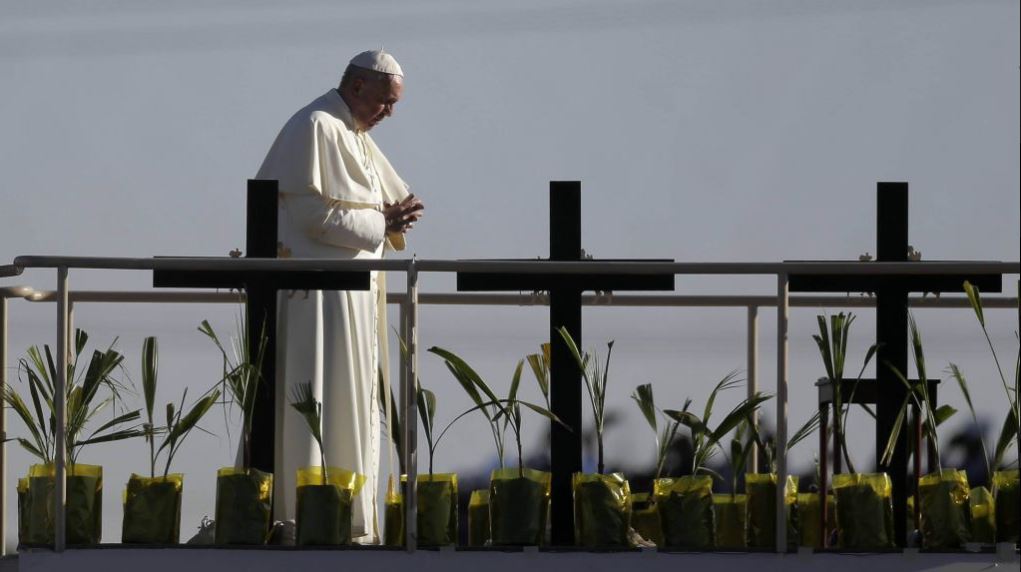
In his book Ecclesiastical Megalomania, John Robbins quoted Roman Catholic historian Brian Tierney’s comment on Rome’s doctrine of the of the two swords. This doctrine, which asserts that God had delegated both spiritual and temporal power to the bishop of Rome, is based on Luke 22:38 “And they said, Lord, behold here are two swords. And he said unto them, It is enough.” Wrote Tierney, “A whole inverted pyramid of political fantasy was erected on the basis of this one verse.”[1]
In much the same way as with the doctrine of the two swords, Rome likewise has erected a whole inverted pyramid of immigration fantasy on the basis of three verses in the second chapter of Matthew that record the flight into Egypt.
Now when they had departed, behold, an angel of the Lord appeared to Joseph in a dream, saying, “Arise, take the young Child and His mother, flee to Egypt, and stay there until I bring you word; for Herod will seek the young Child to destroy Him.”
When he arose, he took the young Child and His mother by night and departed for Egypt, and was there until the death of Herod, that it might be fulfilled which was spoken by the Lord through the prophet, saying, “Out of Egypt I called My Son” (Matthew 2:13-15).
This flight, according to Pope Pius XII’s[2] 1952 Apostolic Constitution Exsul Familia Nazarethana,[3] the Émigré Family of Nazareth, hereafter EFN, is the “archetype of every refugee family.” In the words of Pius XII,
The émigré Holy Family of Nazareth, fleeing into Egypt, is the archetype of every refugee family. Jesus, Mary and Joseph, living in exile in Egypt to escape the fury of an evil king, are, for all times and all places, the models and protectors of every migrant, alien and refugee of whatever kind who, whether compelled by fear of persecution or by want, is forced to leave his native land, his beloved parents and relatives, his close friends, and to seek a foreign soil.[4]
Clearly, Joseph and his family were refugees under any reasonable definition of the term. Had they remained in Bethlehem, it is certain that Jesus would have been executed by King Herod, who “sent forth and put to death all the male children who were in Bethlehem and in all its districts, from two years old and under, according to the time which he had determined from the wise men” (Matthew 2:16) in his attempt to kill the newborn King of the Jews. Webster’s Seventh New Collegiate Dictionary gives the definition of refugee as, “one who flees to a foreign country or power to escape danger or persecution.” According to the 1951 UN Convention and Protocol Relating to the Status of Refugees, the term refugee applies to “any person who…owing to well-founded fear of being persecuted for reasons of race, religion, nationality, membership of a particular social group or political opinion, is outside the country of his nationality and is unable or, owing to such fear, is unwilling to avail himself of the protection of that country; or who, not having a nationality and being outside the country of his former habitual residence as a result of such events, is unable or, owing to such fear, is unwilling to return to it.” [5] The definition of “refugee” in US law is essentially the same as that of the 1951 UN Convention.



 Lux Lucet