The Religious Wars of the 21st Century by John W. Robbins – http://www.sermonaudio.com/sermoninfo.asp?SID=53101448594
Conservatism, An Autopsy by John W. Robbins – http://www.trinityfoundation.org/journal.php?id=115
Posted in Politics, Radio Lux Lucet, Scripturalism, Theology, tagged Donald Trump, Economics, John Robbins on July 22, 2016| Leave a Comment »
The Religious Wars of the 21st Century by John W. Robbins – http://www.sermonaudio.com/sermoninfo.asp?SID=53101448594
Conservatism, An Autopsy by John W. Robbins – http://www.trinityfoundation.org/journal.php?id=115
Posted in Book Review, tagged Economics, Environmentalism, Gordon Clark, John Robbins, Money and Banking, Scripturalism on July 17, 2016| 3 Comments »
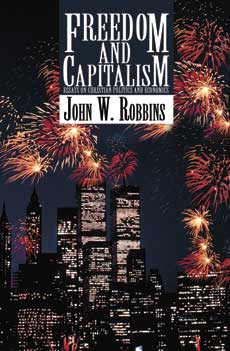 Freedom and Capitalism: Essays on Christian Politics and Economics by John W. Robbins (The Trinity Foundation, Unicoi Tennessee, 650 pages, 2006), $29.95 (E-Book $10.00).
“Brevity, clarity, and profundity are three virtues missing from the modern world,” wrote John Robbins in the introduction to his commentary on Philemon, (Christianity & Slavery, 7). But while these admirable qualities are missing from the works of most contemporary writers, such is not the case with Robbins’ work.
This reviewer has long been of the opinion that one can get more sound theology and philosophy from reading a single short essay by the late Dr John Robbins that he can get from entire shelves full of books by other authors. In Freedom and Capitalism, Robbins once again displays his remarkable talent for presenting profound ideas in a compact and readable package.
Robbins, who is likely well known to followers of this blog as the founder and former president of The Trinity Foundation, held a Ph.D. in Political Philosophy from The Johns Hopkins University and worked on the staff of Congressman Ron Paul of Texas, serving as Paul’s Chief of Staff from 1981-1985.
He was also an active lecturer and writer. Concerning the latter, Robbins commented in his introduction to Capitalism and Freedom that, “Over the past 40 years, as a student (high shcool, college, and graduate) and adult, I have written hundreds of essays, articles, and letters-to-the-editor” (9). This book represents a collection of thirty-one of articles, all but four by Robbins, on the subjects of politics and economics.
The essays presented in Freedom and Capitalism concern a variety of topics within the broad fields of politics and economics and were written over a period of thirty-four years. But for all that, there is a common theme that runs through them, the Scripturalism of Gordon Clark. Robbins nicely summarizes Clark’s Christian system of thought as follows:
Epistemology: The Bible tells me so.
Soteriology: Justification is by belief alone.
Metaphysics: In Him we live and move and have our being.
Ethics: We ought to obey God rather than men.
Politics: Proclaim liberty throughout the land, unto all the inhabitants thereof.
Economics: Laissez-faire capitalism: Have I not the right to do what I will with my own? (9)
Posted in Radio Lux Lucet, tagged Gordon Clark, John Robbins, Scripturalism on July 15, 2016| 4 Comments »
Posted in Economics, Scripturalism, tagged Economics, Gordon Clark, Investing, John Robbins, Philosophy, Pope Francis, The Fed on July 10, 2016| 2 Comments »
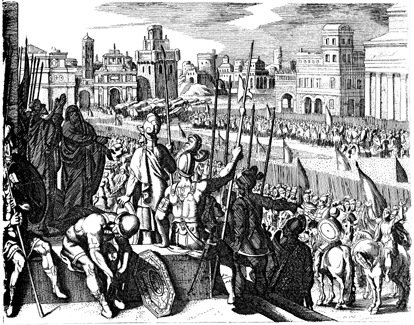
Elisha Prophesies the End of Samaria’s Siege by Nicolas Fontaine, 1625-1709.
When beginning the Siege of Samaria series on Biblical economics, I never intended it to go on for more than two or perhaps three posts. Due to an embarrassment of material and positive response from the readers of this blog, the series stretched into five posts. In no small part the success of this series has been due to the generous support of Sean Gerety over at the God’s Hammer blog, who has been kind enough to republish my posts.
It’s certainly been an encouragement to me to see so many people interested in what the Bible has to teach us about economics. Most of the economic talk one hears in the mainstream media is misleading, and, I suspect, it’s designed to be that way. After all, if too many folks were to get wise to the economic evil troika of central banking, fiat currency and demand-side Keynesian economics, it would be a lot harder for the financial masters of the universe to loot the poor and middle class of the world for their benefit.
The lies of the statists enslave, but the truth of God’s Word makes men free. And it is to the end of furthering this truth that I have presented the series on Biblical economics.
And because Biblical economics is both a fascinating and worthwhile study, it seemed good to me to take this opportunity to share with others the intellectual ammunition I’ve found helpful in developing my understanding of the subject. Below is a list of resources along with my comments.
Posted in Politics, tagged Hillary Clinton, John Robbins, Presidential Campaign 2016 on July 7, 2016| Leave a Comment »

I was shocked but not surprised. Shocked, because it’s so patently ridiculous. Not surprised, because it fits the same pattern we’ve seen time and again. I’m referring, of course, to the decision of FBI Director James Comey not to recommend charges be brought against Hillary Clinton over her mishandling of classified emails.
In a case such as this, it’s tempting to launch into writing some doom and gloom post proclaiming the end of the republic and, for that matter, the world as we know it too.
Ten years ago, John Robbins wrote a must read essay he titled The Religious Wars of the 21st Century, the basic thrust of which was that the ongoing civilizational collapse West, a collapse brought on by its rejection of the Gospel of Justification by Belief Alone, would lead to a terrible century of religious wars. Wars that would be all the more terrible because they would be fought with modern weapons in the name of the false medieval religions Islam, Judaism and Roman Catholicism.
Robbins had this to say about the collapse of the West,
The West has been in collapse for more than a century. The Biblical theology that created the Western civilization five hundred years ago has all be disappeared in the West. The rejection of Christianity in North America and Europe, and the rise of several false religions – including Arminianism, Romanism, Pentecostalism, atheism, and mysticism – have led to the collapse of the West. That collapse is marked by, or, more accurately, is the dissolution of the Biblical family (husband, wife, and children), the economic and political regimentation of the individual and business enterprises; government ownership and control of most educational institutions; the growth of crime; the waning of civility; the acceptance of public profanity, obscenity, and homosexuality; and the resurgence of brutality.
Robbins’ citation of the growth in crime is particularly apropos here. The sheer audacity of Hillary Clinton’s fraud – not just what Andrew Napolitano termed “her grossly negligent failure to keep state secrets in a secure venue,” but also the obvious manipulation of the justice system and the news media effected by her and her supporters – is breathtaking. I’ve never seen anything quite like it.
Woodward and Bernstein? Deep Throat? Forget ’em. Nobody needs those guys. Not when the Deep State oligarchy and its minions have gotten so brazen with their criminality that they hardly even both to hide it anymore.
According to Comey, he elected not to indict Clinton because there was no sign that Clinton meant to break the law. “We did not find evidence sufficient to establish that she knew she was sending classified information, beyond a reasonable doubt, to meet the intent standard,” Comey is quoted as saying.
But as Andrew Napolitano points out, “The espionage statue that criminalizes the knowing or grossly negligent failure to keep states secrets in a secure venue is the rare federal statute that can be violated and upon which a conviction may be based without the need of the government to prove intent.”
But beyond that, what part of setting up an unsecured server in her bathroom fails to rise to the level of intent? As former CIA Operations Officer Scott Uehlinger put it, “The fact that she set up a private server, in and of itself, means she is guilty of a felony right there. Obviously, by having a private server, she was conspiring to evade her signed sworn statements that she would uphold secrecy agreements. The fact that she simply established that (private server) regardless of what was on it, she intended to go around and circumvent the law.”
The FBI’s failure to recommend charges against Clinton is a travesty. One is reminded of Isaiah’s lament over Judah’s collapsing civilization. Wrote the prophet, “How the faithful city has become a harlot! It was full of justice; Righteousness lodged in it, But now murderers” (Isaiah 1:21).
So, is this the end of the republic? It’s tempting to say yes. But the truth is, none of us knows the future. When Isaiah wrote his lament, things looked pretty bleak for Judah. But not long after those words were penned, Hezekiah, one of the best kings ever to sit on the throne of David, would lead the nation to spiritual renewal. Has God’s arm been shorted that he cannot do the same in our time?
While we cannot say for certain that Hillary Clinton’s preternatural ability to dodge indictment represents the end of the republic, it is clear that the failure to charge her is a severe blow to the rule of law in this nation. If she’s allowed to get away with these crimes while a candidate, what she will attempt once in the Oval Office I care not to think about.
Posted in Economics, tagged Economics, John Robbins, Keynesianism, Money and Banking on July 3, 2016| 5 Comments »
Elisha Prophesies the End of Samaria’s Siege by Nicolas Fontaine, 1625-1709.
Inflation – What it is and what it isn’t (continued)
In the last installment of this series, I mentioned that the big takeaway point was the definition of inflation. As you may recall, we defined inflation a bit differently than is commonly understood. Most people, when they talk about inflation, mean to say that prices – the amount we pay for items such as gas or bread or rent – have gone up.
The most common statistic used to report rising prices is the Consumer Price Index (CPI). The CPI measures the cost of a representative basket of goods and services, comparing the average price of these items in one period with their average price in the following period.
When the CPI shows average prices going up from one reporting period to the next, the rising prices are reported in the news as inflation. Occasionally, average prices fall. When this happens, we are told that deflation has occurred.
But the definition of inflation that was presented in Part 4 of this series did not rely on measuring the average cost of goods. Instead, inflation was defined as the increase in the supply of money. Conversely, deflation was not defined as decreasing prices, but rather the decrease in the supply of money.
But even though inflation and deflation are not the same thing as rising and falling prices, there is a relationship among them. When the money supply increases, assuming the amount of goods and services in the economy remain the same, prices go up. Conversely, when the money supply falls, prices go down. As Peter Schiff puts it, “The money supply expands and contracts. Prices go up and down. Inflation and price increases are not the same thing. One is cause. The other is effect” (Crash Proof, 69).
Now you may be asking yourself why I bother to define inflation as I do. Isn’t the common definition of inflation good enough as long as we all agree that inflation is rising prices? Why confuse things be bringing in the concept of money supply?
The best argument for defining inflation as the increase in the supply of money is that it clearly identifies the cause of rising prices: central banks creating too much money, usually in response to governments spending too much money.
If we are satisfied with the usual definition of inflation, government officials can easily fool us into thinking that prices are going up for reasons that have nothing to do with their own policies. Bad weather, profiteering by greedy speculators and lack of sufficient governmental regulations are common scapegoats for rising prices, even though prodigal politicians and the central bankers that fund their wasteful spending are the real culprits.
Posted in Politics, This 'n That, tagged Economics, Foreign Policy, Homosexual Rights, John Robbins on June 24, 2016| Leave a Comment »

In 1940, newly elected Prime Minister Winston Churchill rallied his countrymen to the looming Battle of Britain with the words, “Let us therefore brace ourselves to our duties, and so bear ourselves, that if the British Empire and it Commonwealth last for a thousand years, men will still say, This was their finest hour.”
I’m certainly not here to argue with Churchill’s assessment of his country’s finest hour. But if yesterday’s vote by the British to leave the European Union didn’t quite rise to the level of their stand against the Nazi war machine, it was, nevertheless, a most impressive feat. One I never thought I would see.
The globalists and oligarchs threw everything they could at the Brexit partisans, including their usual tired mix of fear mongering, dire warnings of economic catastrophe, and bogus charges of racism.
And it failed. All of it.
Likely, this won’t be the end of the issue. Globalists aren’t the sort to go quietly into that good night.
But for those who love liberty, this was a sweet victory. It proves that ordinary people can see the corrupt establishment demagoguery – the constant siren song wooing them trade their precious freedoms for a mirage of bureaucratic security – for the lie that it is. And it gives hope to others who seek to do likewise.
Posted in Economics, Uncategorized, tagged Economics, John Robbins on June 19, 2016| 2 Comments »
Elisha Prophesies the End of Samaria’s Siege by Nicolas Fontaine, 1625-1709.
My goal in this series is to demonstrate that many of key concepts of economics are either explicitly or implicitly taught in Bible’s account of the siege of Samaria as found in 2 Kings 6:24-7:20.
In Part One, we looked at 2 Kings 6:25 and what we could learn from the exorbitant prices people were paying for undesirable food under siege conditions. In Part 2, we looked at the relationship between two economics and politics. Especially, we considered how economic hardship is frequently brought on by the ill-conceived policies of politicians, who, being loath to take the blame themselves, often will attempt to find a scapegoat to divert public dissatisfaction away from themselves.
Today, I would like us to look at another important economic concept demonstrated in 2 Kings: opportunity cost. But before diving into that, perhaps it would be advisable to offer a definition of economics.
Economics, What is it?
In his lecture series on economics, John Robbins offered the following definition of economics: it is the study of the logic of choice.
That may sound a bit surprising to many people. It is common to think of economics as news about what the stock market did today, but that is history. Some may think of economics as mathematics. Still others, when they consider the subject at all, hold very negative views about economics. For example, 19th century Scottish thinker Thomas Carlyle famously dubbed economics “the dismal science.”
But starting with the axiom of Scripture, the idea that the Bible has a monopoly on truth, Robbins makes a strong case for his definition. He starts with four principle statements about man taken from Scripture:
From these concepts, Robbins provides us with the following chain of reasoning: To be human is to be rational > To be rational is to have purposes > To have purposes is to plan > To plan is to arrange ends and means (in other words, to choose). And economics, as Robbins defines it, is the study of the logic behind the choices we make.
Posted in Economics, tagged John Robbins, Money and Banking, The Fed on June 12, 2016| 7 Comments »
Elisha Prophesies the End of Samaria’s Siege by Nicolas Fontaine, 1625-1709.
In the first installment in this series, we looked at some of the economic concepts taught in the Bible’s account of the siege of Samaria recorded for us in 2 Kings 6:24-7:20. In particular we looked at 2 Kings 6:25 and found that quite a bit of economics is packed in just that one verse. Today, we’ll continue the discussion of economic implications of Syria’s attack on the capital of the Northern Kingdom.
Politics, Economics and the Blame Game
As a kid, one of my favorite Saturday morning cartoons was Scooby Doo. The episodes were pretty formulaic, especially the ending where, as the bad guys were being hauled off to the paddy wagon, they inevitably would blurt out, “And I would have gotten away with it if it weren’t for you meddling kids!” They never blamed their downfall on their own criminality. It was all the fault of the interlopers.
Well, politicians are a lot like this. While being separate disciplines, politics and economics are closely related such that to talk about one often means brining up the other. This is especially common when a nation is struggling with economic difficulties.
And when economic troubles begin, so too does the blame game shuffle. Suppose the citizens experience a sharp upward spike in the cost of living, or wages stagnate or wave after wave of layoffs take place. Do the powers-that-be blame themselves? Of course not! Economic difficulty is NEVER related to the policies of the current president or Congress. No, not one bit.
The political class, and the academics whose ideas the politicians implement make it all very clear that they had nothing to do with the mess. We’re made to understand that our economic pain is always the fault of the intransigence of opposing party, or greedy market speculators, or bond vigilantes, or budget cuts, or lack of sufficient federal regulatory oversight, or not enough government spending, or cheap imports from China.
This blame game, this shifting of responsibility, is nothing new. In fact, we can say with confidence that it started six thousand years ago with Adam himself. As he put it in his own words, “The woman whom You gave to be with me, she gave me of the tree, and I ate” (Genesis 3:12). “It’s your fault, not mine!” That’s the gist of Adam’s argument to God.
Posted in This 'n That, tagged Antichrist, Climate Change, Donald Trump, Ecumenism, Immigration, John Robbins, Money and Banking, Pope Francis, Roman Catholicism on June 3, 2016| Leave a Comment »

Harambe the gorilla with the four year old boy who fell into the gorilla exhibit at the Cincinnati Zoo, 5/28/16.
Stories of interest for scripturalists can pop up anywhere. They can be on the other side of the world, or right in our backyard. And it just so happens that this week there were two noteworthy items right here in river city. Let’s kick off this week’s This ‘n That with…
The Shot Heard ‘Round the World
Unless you spent this whole last week in a cave or out protesting Donald Trump, you’ve probably heard a little bit about the shooting of Harambe the gorilla at the Cincinnati Zoo.
Just to recap, last Saturday a four year old boy climbed into the Zoo’s gorilla exhibit, fell ten feet into a moat, and quickly found himself a person of interest to Harambe, the Zoo’s 450 pound, alpha-male lowland gorilla.
While the boy’s mother frantically watched, the animal grabbed the boy and dragged him about. When things appeared to become life-threatening, the Zoo have the go-ahead for a sharpshooter to put an end to the standoff.
The episode ended with a dead gorilla and a living boy.
Only it really didn’t end there.
As news spread, it didn’t take long for the animal rights crowd to start up with an irrational two minutes hate directed at the Zoo and the mother of the boy. Check these sample tweets from the compassionate man-haters on Twitter,
It didn’t take me long to find these, so doubtless there’s plenty more nonsense out there. And from these comments it is abundantly clear that not a few members of my own species lack the discernment to understand the vast difference in value between a brute beast and a person made in the image of God.
The Scriptures tell us that God made man a little lower than the angels and set him over the works of his hands. It was God himself who gave man dominion over the earth.
We could wish that things had turned out better for the gorilla. But when it comes to the life of a person or the life of an animal, it’s the animal that goes every time.
The Bible tells us that no man yet ever hated his own flesh. With that in mind, I can’t help but wonder how the social media shriekers would react if it were their lives that were on the line and not that of another. Not that I can prove it, but I rather suspect they’d be singing a different tune.

A Scripturalist (Clarkian) podcast about Christian theology, politics and economics.
 Lux Lucet