Feeds:
Posts
Comments

Posts Tagged ‘Gordon Clark’

Jeffrey Tayler does not like religion in general or Christianity in particular. He makes his stance quite clear. Writing

2016 US presidential candidates.  From left to right:  Ted Cruz, Rand Paul, Hillary Clinton, Marco Rubio, and Jeb Bush. REUTERS/Kevin Lamarque.

2016 US presidential candidates. From left to right: Ted Cruz, Rand Paul, Hillary Clinton, Marco Rubio, and Jeb Bush.
REUTERS/Kevin Lamarque.

in an article in Salon.com, the contributing editor at The Atlantic made manifest his intense dislike for Christianity and its adherents when he wrote,

Aspirants to the White House, both Democratic and Republican, have, as we all know, begun “announcing,” thus initiating from a rationalists point of view, a media carnival featuring on both sides, an array of supposedly God-fearing clowns and faith-mongering nitwits groveling before Evangelicals and nattering on about their belief in the Almighty and their certainty that if we just looked, we could find answers to many of our ills in the Good Book (Marco Rubio’s deranged religion, Ted Cruz’s bizarre faith: Our would-be presidents are God-fearing clowns).

Tayler, who we learn from the article is both a rationalist and, apparently, an atheist, is all kinds of upset at even the slightest suggestion that God may have something to do with politics. Tayler’s fulmination continues,

The candidates will cloak their true agenda – serving the Lords of Wall Street far more zealously than Our Father who art (or really, art not) in heaven – in pious patter about “values,” about the need to “restore America” and return us to the state of divinely granted exceptionalism President Obama has so gravely squandered. This Season of Unreason will end with the elections of November 2016, but its consequences – validation of the idea taht belief without evidence is a virtue, that religion, and especially Christianity, deserves a place in our politics, our Constitutionally enshrined secularism notwithstanding – will live on an damage the progressive cause…

Professing belief in a fictitious celestial deity says a lot about the content of a person’s character…

With the dapper Florida Sen. Marco Rubio we move into the more disturbing category of Republicans we might charitably diagnose as “faith-deranged” – in other words, as likely to do fine among the unwashed “crazies” in the red-state primaries, but whose religious beliefs would (or should) render them unfit for civilized company anywhere else…

Among the faith-deranged, Rubio stands out. He briefly dumped on magic book [apparently the Bible] for another, converting from Roman Catholicism to Mormonism and then back again…

Yet even as a re-minted Catholic, Rubio cheats on the Pope with a megachurch in Miami called Christ Fellowship. As religion and politics blogger Bruce Wilson points out, Christ Fellowship is a hotbed of “demonology and exorcism, Young Earth creationism and denial of evolution,” as is so intolerant it demands its prospective employees certify they are not “practicing homosexuals” and don’t cheat on their spouses…

It’s a safe bet, in fact, that most scientists have a better grasp on the vital verities than anyone rummaging around in Rubio’s beloved “sacred” tome [again, apparently a reference to the Bible] of far-fetched fiction and foolish figments. Yet of the Republicans, the most flagrant irrationalist is clearly Texas junior Sen. Ted Cruz. For starters, Cruz pandered fulsomely to the faith-deranged by choosing to announce at Liberty University, that bastion of darkness located in Lynchburg, Virginia. Once administered by the late Jerry Falwell, Liberty promises a “World Class Christian education: and boasts that it has been “training champions for Christ since 1971” – grounds enough, in my view, to revoke the institution’s charter and subject it to immediate quarantine until sanity breaks out.

Tayler goes on to suggest that reporters should challenge the religious beliefs of the candidates, rightly asserting that, “After all, they [religious convictions] are essentially wide-ranging assertion about the nature of reality and supernatural phenomena.” He then proceeds to propose a line of questioning that, at least in his mind, will catch Christian candidates on the horns of an unanswerable dilemma.

We will examine Tayler’s questions in a moment. But before doing so, a couple of clarifications are in order. First, many of those attacked by Tayler for their Christianity are themselves likely not Christian, and it is not my intention to defend them as though they were. Marco Rubio, for example, is a practicing Roman Catholic, and thus part of an organization that, not only expressly denies the essential Biblical doctrines of sola scriptura and justification by belief alone, but whose head is the great papal Antichrist of Revelation. Of course, one cannot be too hard on the atheist Tayler for confusing Roman Catholicism with Biblical Christianity. Most professing Evangelicals in the US, and this goes double prominent Evangelical leaders, don’t know the difference either. If Evangelicals can’t get their own story straight, it’s unreasonable to expect an atheist outsider to know perceive there’s a difference. That Rubio suffers no intellectual qualms about combining his Catholicism with attendance at an Evangelical megachurch simply underscores this point.

Second, because Tayler uses the term “Christian” in his article to refer generally to anyone who names the name of Christ, I shall follow him in this. To distinguish Bible believing Christians from those who name the name of Christ, I shall use the terms Evangelical, Bible believers, and Protestants.  In like fashion, I shall distinguish Christianity generally from the religion as taught in the Word of God by referring to the latter as Biblical Christianity.

Third, many of the proposals put forth by presidential candidates under the aegis of Christianity in fact have nothing to do with it. Rather, by their very nature they are actually anti-Christian. The “compassionate conservatism” and “faith-based initiatives” advanced by George W. Bush during the 2000 presidential election cycle are good cases in point. Evangelicals and atheists – some atheists inconsistently hold to the Evangelical principle of limited government – can both denounce such ideas for the fascist claptrap that they are.

That said, let’s look at Tayler’s supposedly unanswerable line of questioning.

(more…)

Read Full Post »

Animals are not ours to eat, wear, experiment on, use for entertainment, or abuse in any other way. – People for the Ethical Treatment of Animals

PETAFounded in 1980, Norfolk Virginia based People for the Ethical Treatment of Animals (PETA) has long had a reputation as one of the more aggressive animal rights groups. PETA’s slogan, quoted above, describes as abuse actions that most people would consider quite normal. Such a radical criticism of normal everyday activities calls for close scrutiny. For if PETA is correct in what it says, then it is incumbent on people to rethink their relationship to the animal kingdom.

Not surprisingly from a group that has the word “ethical” in its name, PETA’s slogan is an ethical statement. Ethics is one of the four main disciplines of philosophy and answers the question, What ought we to do? It is the theory of right conduct. In the case of PETA, their ethical statement is put in the negative, telling us what we ought not to do, namely: use animals for food, clothing, laboratory experiments, entertainment or otherwise subject them to abuse.

On the PETA website, if one click’s on the slogan, he will taken to a page that explains in more detail what the PETA stands for and the reasons for the group’s position on animal rights. From a review of this page, it quickly becomes obvious that PETA is serious about what it says and is quite sincere in its ethical pronouncements.

But truth, unlike what so many people seem to think in this anti-intellectual age, is not a matter sincerity. One can be completely sincere in his beliefs and at the same time be totally wrong. What is the Christian to make of PETA’s ethics?

(more…)

Read Full Post »

Richard Weaver

Richard Weaver

Ideas Have Consequences is title of well know philosophical work by Richard Weaver. First published in 1948, the book argues that the decline of the West began with the rejection of absolute truth by the medieval scholastics, and that this decline has continued into modern times.

While we do not share the author’s analysis of origin of the decline of the West, his prescription for curing it, or even what constitutes Western Civilization, we can appreciate his insight about the importance of ideas. All practice – the actions we take, the words we use – are the result of some prior theory. John Robbins put it this way,

Not only do ideas have consequences, but only ideas have consequences: Human actions are not independent of ideas but the results of ideas (The Religious Wars of the 21st Century).

Given the practical mindset that dominates in the US and throughout the West, the notion that ideas are logically prior to, and more important than, actions may seem strange to many. One 20th century theologian who well understood the importance of ideas was Gordon Clark. For Clark, ideas were not merely the thoughts that a man thinks, they were the very definition of the man himself. Clark wrote,

the definition [of a person] must be a composite of propositions. As a man thinketh in his (figurative) heart, so is he. A man is what he thinks…a person is the propositions he thinks (The Incarnation, 54, 55).

It is not true that we are what we eat. We are defined, not by what we consume at the dinner table, but by the thoughts we think. And the thoughts we think have consequences for all eternity. Our very salvation depends upon our understanding of, and accepting as true, the propositions of the 66 books of the Bible, especially the Gospel of Jesus Christ.

(more…)

Read Full Post »

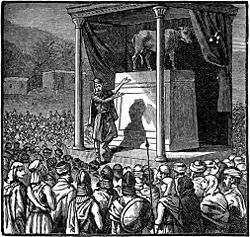
Jeroboam sets up a golden calf.

Jeroboam sets up a golden calf.

Among other things, the Bible is a book of examples. As God’s people, we can be thankful for this. Had he wished, God could have given his bare commandments and left it to us to draw our own lessons. But that’s not what he did. After providing very clear instructions to his covenant people in the Law of Moses, God inspired the writers of the Old Testament to record a detailed and fascinating history of his people. Some of this history was recorded as a warning to future generations. In his letter to the Corinthians, the apostle Paul highlighted several negative examples from the history of Israel and made the point, “Now all these things happened to them as examples, and they were written for our admonition, upon whom the ends of the ages have come” (I Corinthians 10:11).

In a previous post, we looked at two bad examples from the Old Testament, specifically the actions of kings Rehoboam and Jeroboam. In the case of Rehoboam, his was a political failure. Instead of being a servant to his people, he instead chose to lord it over them, answering a reasonable request for lower taxes with a churlish threat to increase them. His arrogance was the proximate cause of the division of the twelve tribes into the Northern and Southern Kingdoms. On the other hand the failure of Jeroboam, the first ruler of the Northern Kingdom, was of an ethical nature. He was charged by the prophet Ahijah to walk in the commandments of God. But Jeroboam, doing what he ought not, was quick to set up an idolatrous religion in the Northern Kingdom, which corrupted the people for generations. At bottom, the failures of both kings were epistemological, for both men rejected the clear commands of God and followed the dictates of their own hearts.

As a follow up to the bad examples, over the next two weeks we will look at two good examples from the Old Testament, one of them a prophet, the other a king. Both of had this in common: they trusted in God, not themselves.

(more…)

Read Full Post »

philosophy_dictionaryMy previous posts in this series were intended as a survey of what the Bible has to say about the four main disciplines of philosophy: epistemology (the theory of knowledge, metaphysics (the theory of reality), ethics (the theory of conduct), and politics (the theory of government). The structure and ideas contained in this series are taken from the tract What is Christian Philosophy? written by John Robbins and published by The Trinity Foundation.

These posts were written with three goals in mind. First, to lay my philosophical cards on the table. Since my purpose in writing this blog has always been to articulate the Scripturalism of Gordon Clark and John Robbins, it seemed good to set forth the basic assumptions of this system as clearly as I possibly could.

Second, it has been my hope to show the importance of systematic thinking. Systematic thinking is not popular today. That the world should passionately embrace irrationalism is not surprising. But the hostility toward logical thought in the professing church is alarming. Christ is the logos, the logic, of God. And those who bear his name, those who have the mind of Christ, of all people should have respect for sound thinking.

My third goal with this series has been to make philosophy accessible. Often people are turned off from philosophy, because they think they cannot understand it. Much of this is the fault of the philosophers themselves. If you are in that camp, I understand. In spite of my best efforts, I never understood philosophy until I started reading John Robbins. He was possessed of remarkable ability to take ideas that in the hands of other authors were all but impenetrable and make them clear. It has been my goal to do the same for others.

To close out this series, I have summarized my previous posts on Christian philosophy below.

(more…)

Read Full Post »

PoliticsSo far in this series on Christian philosophy, we have looked at three of the four major philosophic disciplines. First was epistemology, the theory of knowledge. It answers the question, How do you know? Second came metaphysics, the theory of reality. For those who have not previously studied philosophy, these terms may seem a bit strange or intimidating. Ethics, the theory of conduct, was third. Ethics is a more familiar term for us. It answers the question, What ought we to do ?

This post will address the disciple on politics. Politics is the theory of government. As you may suppose, there are many different views on government. Men differ on the origin of government – is it a natural institution?; does it arise from the consent of the governed? – the proper scope of government – should government be minimal or involve itself in every area of one’s life? – and what form of government – democracy, republic, or monarchy – is ideal.

The Origin of Government

In his book A Christian View of Men and Things, Gordon Clark raised the question, “How does a government get, not the power, but the right to coerce its people?” This may seem like a strange question to many people. For the most part, folks accept the existence of government in much the same way they accept the fact that the sun rises in the east, or the grass is green, or the sky is blue. But this is an important question. For if government cannot be justified in any form, there is no use in discussing its proper scope or form.

Historically, there have been several answers to Clark’s question. Aristotle, for example, believed that government was a natural institution. In one of his lectures on philosophy, John Robbins described Aristotle’s view thus, “People grow into states the way that acorns grow into oak trees.” Another view is the social compact theory: governments derive their coercive authority form the consent of the governed. Still another view is that government is power. This was the view of historian Oswald Spengler, who held that, “Great statesmen like Caesar or Napoleon act immediately on the basis of a flair for facts. Their action is not sicklied o’er by the pale cast of thought. If indeed ther ar any general principles of politics, they never enter the heads of great men” (Clark, A Christian View of Men and Things, 95). These views of government, diverse as they are, all have one important element in common: God, the God of the Bible, does not matter in any of them.

Christian political theory rejects all these answers to the origin of government. The Bible teaches us, in the words of Gordon Clark, that, “The existence of the state is a partial punishment and cure for sin” (A Christian View of Men and Things, 100). Government bears the power of the sword, the power of coercion, in response to man’s sin. Proof of this can be seen in Genesis 3:24, which reads, “So He drove out the man; and He placed cherubim at the east of the garden of Eden, and a flaming sword which turned every way, to guard the way to the tree of life.”
Civil government was not a natural institution, it was not part of the original created order, it came about after the fall of Adam. Writing in Romans 13 about the civil magistrate, Paul makes this same point where he tells us, “[H]e does not bear the sword in vain; for he is God’s minister, an avenger to execute wrath on him who practices evil.”

(more…)

Read Full Post »

Dictionary definition of the word

Throughout this series on Christian philosophy, it has been my argument that Christianity is a system of ideas thought out together. Christianity is not the only system of thought, it is not the only worldview. Marxism, for example, is a systematic attempt to provide a comprehensive worldview. On the other hand, Christianity is unique in that it is God’s revealed system of thought. it is truth itself. Paul’s statement, “Eye has not seen, nor ear heard, not have entered into the heart of man the things which God has prepared for those who love him” (I Corinthians 2:9), is a denial that man can discover truth on his own.

Throughout the course of history, men, brilliant men such as Plato and Aristotle, have argued that man can too discover truth by his own efforts. Secular epistemology – epistemology is logically the first discipline of philosophy, it is the theory of knowledge answering the question “How do you know?” – comes in one of two forms. Rationalism (Plato) tells us that men can know truth from ideas they come up with in their own minds. Empiricism (Aristotle) argues that man can know truth by observing things. Our senses, say the empiricists, furnish us with knowledge. Christianity, on the other hand, argues that truth, all truth, is graciously revealed by God to men, that men do not discover truth on their own, that the so-called wisdom men claim to have found by their own efforts is, in reality, foolishness.

One’s view of metaphysics – metaphysics is the theory of reality – depends upon his epistemology. Since we live in an age in which empirical epistemology is dominant, it is not surprising that people believe that matter, physical stuff, is the ultimate reality. Carl Sagan gave voice to this idea when he wrote, “The cosmos is all that is or was or ever will be.” But as John Robbins wrote in his tract What is Christian Philosophy?, Christian metaphysics, which is based upon a Christian theory of knowledge, speaks in this way, “in God, not matter, we live and move and have our being.” The universe is not eternal, but created Not independent, but upheld by God. Not evolving to perfection, but advancing in its decay.

(more…)

Read Full Post »

« Newer Posts