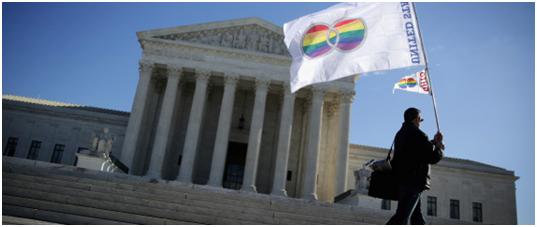
WASHINGTON, DC – JANUARY 09: Pete Prete of Equality Beyond Gender holds a ‘marriage pride flag’ outside the U.S. Supreme Court January 9, 2015 in Washington, DC. The justices of the Supreme Court were scheduled to meet to determine whether the court will take up any of the five pending state-banned same-sex marriage cases in Ohio, Tennessee, Michigan, Kentucky and Louisiana. (Photo by Alex Wong/Getty Images) | Alex Wong via Getty Images
The latest shot in the battle over same-sex marriage has fired in Bexley, Ohio. According to an article in the Columbus Dispatch,
A florist in Washington state, a baker in Oregon and a photographer in New Mexico are all among the small-business people who have received nationwide pushback for declining to provide services for the weddings of same-sex couples.
Now a videographer in the Columbus area has joined their ranks.
Next Door Stories in Bexley has become the subject of a boycott campaign, after a Facebook post detailed an email in which a company founder said she doesn’t provide services for same-sex weddings.
As of this writing, there has been no public statement from the owners of Next Door Stories providing details as to why they do not provide services to same-sex couples. The original response from the company to Jerra Knicely, the individual who solicited Next Door Stories to film her same-sex wedding, reads,
Hello,
Thank you for reaching out about wedding videography. How did you hear about Next Door Stories? Unfortunately at this time I do not offer services for same-sex weddings, but thank you for your inquiry!
Peace,
(name withheld)
Founding Storyographer
According to a Pew Research Center survey cited in the article, the American public is about evenly split when it comes to same-sex couples and wedding businesses, with 49 percent agreeing that businesses should be required to provide wedding services to same-sex couples and 47 percent supporting the right of businesses to refuse their services for religious reasons. What does the Bible have to say about this issue?
Property Rights and the 1964 Civil Rights Act
The principle reason for the debate over whether bakers, florists, and videographers have the right to refuse service to same-sex couples is that a prior question about property rights was answered incorrectly. The American Civil Rights Movement in 1950s and 1960s did a great deal to strike down laws prejudicial to blacks in the United States. To the extent that the movement focused on removing legal barriers to equality, it was in the right. But the Civil Rights Movement did not keep this focus, but instead attacked private property rights by seeking to legally prohibit owners of private businesses from deciding whom they will and will not serve. This attack on private property was written into Title II of the 1964 Civil Rights Act, which reads in part,
TITLE II – INJUNCTIVE RELIEF AGAINST DESCRIMINATION IN PLACES OF PUBLIC ACCOMODATION
SEC. 201. (a) All persons shall be entitled to the full and equal enjoyment of the goods, services, facilities, and privileges, advantages, and accommodations of any place of public accommodation, as defined in this section, without discrimination or segregation on the ground of race, color, religion, or national origin.
(b) Each of the following establishments which serves the public is a place of public accommodation within the meaning of this title if its operations affect commerce, or if discrimination or segregation by it is supported by State action:
(1) any inn, hotel, motel, or other establishment which provides lodging to transient guests…
(2) any restaurant, cafeteria, lunchroom lunch counter, soda fountain, or other facility principally engaged in selling food for consumption on the premise…
(3) any motion picture house, theater, concert hall, sports arena, stadium or other place of exhibition or entertainment.
The antidiscrimination provisions of Title II are directed against what are called “place[s] of public accommodation” in contradistinction to other types of private property. For example, Title II specifically exempts, “private club[s] or other establishment[s] not in fact open to the public,” from having to comply with its provisions. This creates a two-tier system of private property. One which is called a place of public accommodation, and another which is termed a private club.
It is worth noting that Title II provides protection against discrimination on the grounds of race, color, religion, or national origin. There is no language in the Title II that disallows discrimination on the ground of sexual orientation. Those business owners who have run afoul of the law for refusing their services to same-sex couples have been charged with violating state or local antidiscrimination laws, not federal law. At this time, there is no federal law against refusing service to someone on the basis of sexual orientation.
Property Rights and the Law of God
Unlike the 1964 Civil Rights Act, the Scriptures know only one class of private property. There is no distinction between a private club and a place of public accommodation. Private property is private property, and the owner of that property – it is immaterial whether the private property in question is a dwelling or a business, or a club – is permitted to do with it as he pleases. Perhaps the clearest statement of this in all of Scripture is found in Matthew 20 in the parable of the Workers in the Vineyard. When the workers complain about their wages, the vineyard owner replies to one of them, “Is it not lawful for me to do what I wish with my own things?” The Biblical answer is, of course, yes. And doing what one wishes with his own things includes deciding, not only how much he will pay his employees, but also the people whom he will serve or elect not to serve.
An objection may be raised against this conclusion by those who would argue that it gives aid and comfort to racists. Doubtless there are business owners who, if given the opportunity, would choose not to serve customers due to their race. But a business owner’s decision to consider the race of a person as the basis for whether to provide service, though it is a sin – it is a failure to love our neighbor as ourselves – should not be a crime. This is the case, because of what the Bible teaches about property rights, which rights flow from the 10 Commandments, specifically, the Eighth Commandment’s prohibition against theft. Laws that force a business owner to serve another are stealing that businessman’s property by diminishing his right to dispose of his property as he sees fit.
Worth noting too is that in a capitalist system which protects the rights of private property, discrimination can be costly. In his article Rosa Parks and History, economist Thomas Sowell provides some important, little known background information on how Jim Crow laws came to be in the South. Writes Sowell,
Far from existing from time immemorial, as many have assumed, racially segregated seating in public transportation began in the South in the late 19th and early 20th centuries.
Those who see government as the solution to social problems may be surprised to learn that it was government which created this problem. Many, if not most, municipal transit systems were privately owned in the 19th century and the private owners of these systems had no incentive to segregate the races.
These owners may have been racists themselves but they were in business to make a profit – and you don’t make a profit by alienating a lot of your customers. There was not enough market demand for Jim Crow seating on municipal transit to bring it about.
It was politics that segregated the races because the incentives of the political process are different from the incentive of the economic process. Both blacks and whites spent money to ride the buses but, after the disenfranchisement of black voters in the late 19th and early 20th century, only whites counted in the political process.
Far from being the bastion of discrimination many take it to be, capitalism, the economic system of the Bible, has within itself built-in sanctions against racist behavior. Unfortunately the Civil Rights Movement, not being satisfied with overturning Jim Crow laws requiring racial segregation, attacked private property by passing laws that prohibited business owners from making their own decisions about what customers they were willing to serve. While we can applaud the end of Jim Crow, the destruction of property rights that came with the 1964 Civil Rights Act severely weakened private property rights in the US. But not only that, it set the stage for the stunning success of the Gay Rights Movement over the past decade.
Errors of the Civil Rights Movement Rear Their Head
It is a commonplace in conservative political circles to talk about the Law of Unintended Consequences. This is the notion that big-government initiatives often produce results that are precisely the opposite of what was intended by their proponents. Once such example would be gun buyback programs that result in more, not fewer guns.
Examples of the Law of Unintended Consequences can be found in the Bible as well. Joseph’s brother sold him into slavery. Although they intended evil against him, God used their sin to bring Joseph to Egypt and save them and their whole family from starvation. King Jehoshaphat of Judah made peace with Ahab king of Israel and took Ahab’s daughter as wife for his son. Although Jehoshaphat apparently undertook the alliance to strengthen his kingdom, he unwittingly set off a series of events that nearly resulted in the extinction of the Davidic dynasty (2 Kings 11). Caiaphas the high priest sought to have Jesus executed, so that the whole of Israel would not perish. He achieved his end, but not in the way he intended.
While it is doubtful that the leaders of the Civil Rights Movement had any intention of providing legal cover for the Gay Rights Movement, the damage they inflicted on private property rights with the antidiscrimination language in Title II of the 1964 Civil Rights Act did just that. Many of those who championed the Civil Rights Movement have been shocked and offended at the way Gay Rights activists have attached themselves to their legacy, using many of the same arguments to attack private property as were used by Civil Rights activists a generation before. In his article Are Gay Rights Civil Rights?, Steve Osunsami writing for ABC News says,
In Boston, Bishop Gilbert Thompson does not like it one bit. “I resent the fact,” he says, “that homosexuals are trying to piggy back on the civil rights struggles of the ’60s.”
In Los Angeles, the Rev. Jesse Lee Peterson says it’s “offensive” and that the civil rights movement “is not about sex.”
In Chicago, Detroit, and Raleigh, N.C., the black ministers are beginning to preach on an uncomfortable subject in African-American circles. Gay marriage, they argue, has no place in a movement defined by Jim Crow laws and the right to vote.
“I was born black,” said Thompson. “I was born male. Homosexuals are not born, they’re made. They don’t qualify.”
It is a question of legitimacy. Civil rights protection, many argue, is meant for people, not behavior. Pastor Garland Hunt of Atlanta says that generally means race, gender and disability only. “It doesn’t protect behavior patterns.”
For many African Americans, who began the civil rights movement in the black churches of the conservative South, gay and lesbian Americans are people of poor behavior.
“Same-sex marriage has nothing to do with civil rights, this is an issue of morality,” said Hunt.
Although we have much sympathy for those who claim homosexuality is a behavior – the Apostle Paul proved that homosexuality is a behavior when writing to the Corinthians he commented on homosexuals and sodomites, saying to them “and such were some of you” (I Cor. 6:11) – the Gay Rights movement has successfully persuaded a large segment of the population that being gay is, in fact, not a behavior, but an inherent part of who they are. In other words, they were born that way and cannot change. When one adds to this idea the proposition that privately owned businesses may not discriminate whom they serve on the basis of race, we arrive at the point where we are today, with Christian business owners being persecuted for not providing service to same-sex weddings. After all, so goes the argument, a gay or lesbian is no more in control of his homosexuality than a black person is of his race.
Big Business Support Gay Rights
If Christian business owners think they will find support for their position on homosexuality from others in the business community, usually considered one of the form conservative sectors of society, they will be sorely disappointed. A recent story in the local Cincinnati paper illustrates this point. The article P&G, others ask court to back gay marriage, informs us,
As the U.S. Supreme Court prepares to rule this summer on gay marriage, Procter & Gamble and hundreds of employers nationwide have signed an amicus brief asking it to strike down statewide bans.
Law firm Morgan Lewis filed the brief Thursday on behalf of 379 employers urging the high court to consider the burdens imposed on both employers and employees by a fractured legal landscape [n.b. what the amicus brief calls a “fractured legal landscape” is simply the result of constitutional right of the individual states to make laws where the Constitution does not explicitly grant power to the Federal government, this is not a problem to be solved, it is what the framers of our republic intended] with no uniform rule on same-sex marriage. The filing comes three months after P&G first publicly supported gay marriage.
And P&G is hardly alone in its support of gay marriage. By my count, the article listed 47 other firms as signers of the amicus brief, the names of which read like a who’s who of the largest, most prestigious companies in America. Click here for a complete list of all 379 corporate signers.
Conclusion
In the opinion of this author, the Gay Rights Movement is and likely will continue to be a major point of conflict between Evangelicals and the world. The groundwork for this conflict was laid during the Civil Rights Movement of the 50’s and 60’s with its attack on private property. Cleaver politics by supporters of the Gay Rights agenda have convinced a large number of Americans that homosexuality is no different than being born of a particular race. And the marriage of these two ideas has propelled the Gay Rights Movement further and faster than almost anyone thought possible.
If Christians are to have any chance of winning this fight, they must fight on Biblical grounds. This means defending not just what the Bible has to say about marriage and sexuality, but also what the Scriptures teach about private property.
Read Full Post »


 Lux Lucet