Feeds:
Posts
Comments

Archive for the ‘Scripturalism’ Category

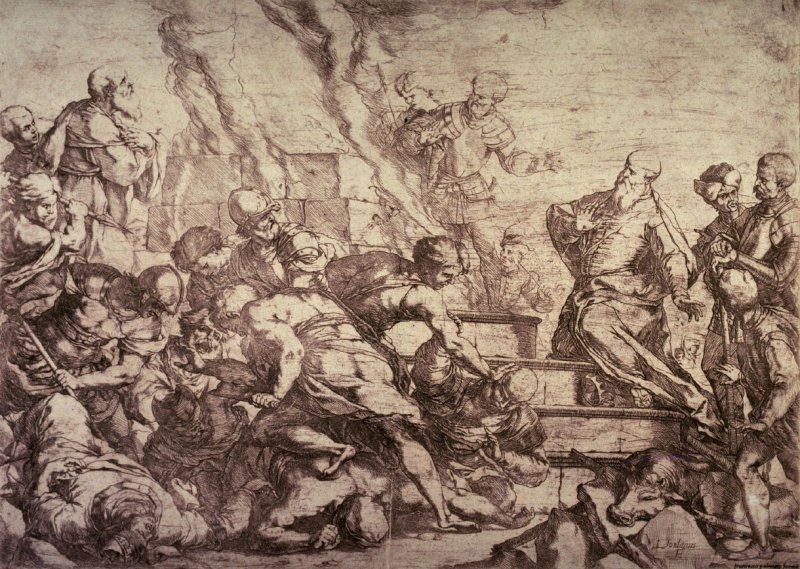
The Sacrifice of Elijah Against the Prophets of Baal.  Luca Giordano ca. 1650 -1660.

The Sacrifice of Elijah Against the Prophets of Baal. Luca Giordano ca. 1650 -1660.

In 1 Kings 18, we read the account of the famous head-to-head between Elijah and the prophets of Baal. Elijah had challenged Baalites to a prophetic version of a pistols-at-noon duel. The supports of Baal would have their opportunity to call upon their god, Elijah would have his opportunity to call upon his. Addressing the people of Israel, Elijah set the terms of the challenge by saying, “I alone am left a prophet of the LORD; but Baal’s prophets are for hundred and fifty men. Therefore let them give us two bulls; and let them choose one bull for themselves, cut it in pieces, and lay it on the wood, but put no fire under it; and I will prepare the other bull, and lay it on the wood, but put no fire under it. Then you call on the name of your gods, and I will call on the name of the LORD; and the God who answers by fire, He is God” (1 Kings 18:22-24).

Could the priests of Baal call fire from the heavens to consume the sacrificial bull? This was a fair challenge, and one the Baalites could hardly refuse. Had they taken a pass, they would have cast doubt on their entire belief system. Elijah had them cornered. Scripture tells us, “So they [the prophets of Baal] took the bull which was given them and they prepared it, and called on the name of Baal from morning even till noon, saying, “O Baal, hear us!” (1 Kings 18:26). But for all their infinite passion, nothing happened.

This had to be enormously embarrassing for both the priests and for their royal patrons, King Ahab and his wife Jezebel. Taking advantage of their obvious failure, Elijah mocked the Baalite prophets, saying, “Cry aloud, for he is a god; either he is meditating , or he is busy, or he is on a journey, or perhaps he is sleeping and must be awakened” (I Kings 18;27). Faced with the prospect of a crushing defeat, Baal’s prophets doubled down on the only trick they had. Unfortunately for them, that trick, which already wasn’t working, was about not to work once again. Scripture tells us that in response to Elijah’s sarcasm, the prophets of Baal, “cried aloud, and cut themselves, as was their custom, with knives and lances, until the blood gushed out on them. And when midday was past, they prophesied until the time of the offering of the evening sacrifice (I Kings 18:28, 29).

What was their reward for all this effort, all this blood-letting? Crickets. The sound of crickets. The Bible tells us, “But there was no voice; no one answered, no one paid attention” (I Kings 18/29).

Those familiar with the account know how it ends. The Lord answered Elijah’s simple prayer and sent fire from heaven that consumed “the burnt sacrifice, and the wood and the stones and the dust, and it licked up the water that was in the trench” (I Kings 18:38). Adding injury to their humiliation, Elijah ordered the execution of the false Baalite prophets.

The problem with the prophets of Baal wasn’t their lack of passion. It wasn’t that they didn’t give it their all. The reason they failed was simple: they had a flawed concept of reality. They had turned their back on the Lord and embraced a lie. Professing to be wise, they had become fools.

(more…)

Read Full Post »

Slavery & Christianity
by John W. Robbins (Unicoi, Tennessee: The Trinity Foundation, 2007, 84 pages).

Slavery & Christianity

Slavery & Christianity

As Christians, we are called to bring every thought into captivity to Christ. That is to say, we are required to judgeallthings by the Word of God. And by doing so, Christians living in the West more and more find themselves at odds with their own societies. To the cheers of just about all the movers and shakers in the US, this summer the Supreme Court of the United States legalized so-called gay marriage in all 50 states.

Many Christian writers have objected to this very clear rejection of the Law of God by citing the Bible. The Bible, they say, condemns homosexuality not only as a sin, but also as a crime. And indeed, they are right in what they say. But arguing from the Bible can be dangerous too. For someone, and it usually doesn’t take very long for this to happen, will be sure to bring up the topic of slavery. “So, you say that the Bible condemns homosexuality,” they will say. “Very well. What about slavery? The Bible support slavery, doesn’t it? After all, Peter tells servants to be submissive to their masters. Even Christian writers have endorsed slavery. The writers of the New Testament were nothing but bigoted, homophobic, misogynist racists. Why should anyone listen to them?” This line of attack is designed to put Christians on the horns of a dilemma. By arguing this way, the opponents of Christianity hope to force Christians into the uncomfortable position either of defending slavery and misogyny, or dropping their Biblical opposition to homosexuality. Too often, this line of questioning reduces Christians to embarrassed silence or incoherence. Chalk up another win for the secularists. Game. Set. Match.

(more…)

Read Full Post »

Jeffrey Tayler does not like religion in general or Christianity in particular. He makes his stance quite clear. Writing

2016 US presidential candidates.  From left to right:  Ted Cruz, Rand Paul, Hillary Clinton, Marco Rubio, and Jeb Bush. REUTERS/Kevin Lamarque.

2016 US presidential candidates. From left to right: Ted Cruz, Rand Paul, Hillary Clinton, Marco Rubio, and Jeb Bush.
REUTERS/Kevin Lamarque.

in an article in Salon.com, the contributing editor at The Atlantic made manifest his intense dislike for Christianity and its adherents when he wrote,

Aspirants to the White House, both Democratic and Republican, have, as we all know, begun “announcing,” thus initiating from a rationalists point of view, a media carnival featuring on both sides, an array of supposedly God-fearing clowns and faith-mongering nitwits groveling before Evangelicals and nattering on about their belief in the Almighty and their certainty that if we just looked, we could find answers to many of our ills in the Good Book (Marco Rubio’s deranged religion, Ted Cruz’s bizarre faith: Our would-be presidents are God-fearing clowns).

Tayler, who we learn from the article is both a rationalist and, apparently, an atheist, is all kinds of upset at even the slightest suggestion that God may have something to do with politics. Tayler’s fulmination continues,

The candidates will cloak their true agenda – serving the Lords of Wall Street far more zealously than Our Father who art (or really, art not) in heaven – in pious patter about “values,” about the need to “restore America” and return us to the state of divinely granted exceptionalism President Obama has so gravely squandered. This Season of Unreason will end with the elections of November 2016, but its consequences – validation of the idea taht belief without evidence is a virtue, that religion, and especially Christianity, deserves a place in our politics, our Constitutionally enshrined secularism notwithstanding – will live on an damage the progressive cause…

Professing belief in a fictitious celestial deity says a lot about the content of a person’s character…

With the dapper Florida Sen. Marco Rubio we move into the more disturbing category of Republicans we might charitably diagnose as “faith-deranged” – in other words, as likely to do fine among the unwashed “crazies” in the red-state primaries, but whose religious beliefs would (or should) render them unfit for civilized company anywhere else…

Among the faith-deranged, Rubio stands out. He briefly dumped on magic book [apparently the Bible] for another, converting from Roman Catholicism to Mormonism and then back again…

Yet even as a re-minted Catholic, Rubio cheats on the Pope with a megachurch in Miami called Christ Fellowship. As religion and politics blogger Bruce Wilson points out, Christ Fellowship is a hotbed of “demonology and exorcism, Young Earth creationism and denial of evolution,” as is so intolerant it demands its prospective employees certify they are not “practicing homosexuals” and don’t cheat on their spouses…

It’s a safe bet, in fact, that most scientists have a better grasp on the vital verities than anyone rummaging around in Rubio’s beloved “sacred” tome [again, apparently a reference to the Bible] of far-fetched fiction and foolish figments. Yet of the Republicans, the most flagrant irrationalist is clearly Texas junior Sen. Ted Cruz. For starters, Cruz pandered fulsomely to the faith-deranged by choosing to announce at Liberty University, that bastion of darkness located in Lynchburg, Virginia. Once administered by the late Jerry Falwell, Liberty promises a “World Class Christian education: and boasts that it has been “training champions for Christ since 1971” – grounds enough, in my view, to revoke the institution’s charter and subject it to immediate quarantine until sanity breaks out.

Tayler goes on to suggest that reporters should challenge the religious beliefs of the candidates, rightly asserting that, “After all, they [religious convictions] are essentially wide-ranging assertion about the nature of reality and supernatural phenomena.” He then proceeds to propose a line of questioning that, at least in his mind, will catch Christian candidates on the horns of an unanswerable dilemma.

We will examine Tayler’s questions in a moment. But before doing so, a couple of clarifications are in order. First, many of those attacked by Tayler for their Christianity are themselves likely not Christian, and it is not my intention to defend them as though they were. Marco Rubio, for example, is a practicing Roman Catholic, and thus part of an organization that, not only expressly denies the essential Biblical doctrines of sola scriptura and justification by belief alone, but whose head is the great papal Antichrist of Revelation. Of course, one cannot be too hard on the atheist Tayler for confusing Roman Catholicism with Biblical Christianity. Most professing Evangelicals in the US, and this goes double prominent Evangelical leaders, don’t know the difference either. If Evangelicals can’t get their own story straight, it’s unreasonable to expect an atheist outsider to know perceive there’s a difference. That Rubio suffers no intellectual qualms about combining his Catholicism with attendance at an Evangelical megachurch simply underscores this point.

Second, because Tayler uses the term “Christian” in his article to refer generally to anyone who names the name of Christ, I shall follow him in this. To distinguish Bible believing Christians from those who name the name of Christ, I shall use the terms Evangelical, Bible believers, and Protestants.  In like fashion, I shall distinguish Christianity generally from the religion as taught in the Word of God by referring to the latter as Biblical Christianity.

Third, many of the proposals put forth by presidential candidates under the aegis of Christianity in fact have nothing to do with it. Rather, by their very nature they are actually anti-Christian. The “compassionate conservatism” and “faith-based initiatives” advanced by George W. Bush during the 2000 presidential election cycle are good cases in point. Evangelicals and atheists – some atheists inconsistently hold to the Evangelical principle of limited government – can both denounce such ideas for the fascist claptrap that they are.

That said, let’s look at Tayler’s supposedly unanswerable line of questioning.

(more…)

Read Full Post »

Animals are not ours to eat, wear, experiment on, use for entertainment, or abuse in any other way. – People for the Ethical Treatment of Animals

PETAFounded in 1980, Norfolk Virginia based People for the Ethical Treatment of Animals (PETA) has long had a reputation as one of the more aggressive animal rights groups. PETA’s slogan, quoted above, describes as abuse actions that most people would consider quite normal. Such a radical criticism of normal everyday activities calls for close scrutiny. For if PETA is correct in what it says, then it is incumbent on people to rethink their relationship to the animal kingdom.

Not surprisingly from a group that has the word “ethical” in its name, PETA’s slogan is an ethical statement. Ethics is one of the four main disciplines of philosophy and answers the question, What ought we to do? It is the theory of right conduct. In the case of PETA, their ethical statement is put in the negative, telling us what we ought not to do, namely: use animals for food, clothing, laboratory experiments, entertainment or otherwise subject them to abuse.

On the PETA website, if one click’s on the slogan, he will taken to a page that explains in more detail what the PETA stands for and the reasons for the group’s position on animal rights. From a review of this page, it quickly becomes obvious that PETA is serious about what it says and is quite sincere in its ethical pronouncements.

But truth, unlike what so many people seem to think in this anti-intellectual age, is not a matter sincerity. One can be completely sincere in his beliefs and at the same time be totally wrong. What is the Christian to make of PETA’s ethics?

(more…)

Read Full Post »

Richard Weaver

Richard Weaver

Ideas Have Consequences is title of well know philosophical work by Richard Weaver. First published in 1948, the book argues that the decline of the West began with the rejection of absolute truth by the medieval scholastics, and that this decline has continued into modern times.

While we do not share the author’s analysis of origin of the decline of the West, his prescription for curing it, or even what constitutes Western Civilization, we can appreciate his insight about the importance of ideas. All practice – the actions we take, the words we use – are the result of some prior theory. John Robbins put it this way,

Not only do ideas have consequences, but only ideas have consequences: Human actions are not independent of ideas but the results of ideas (The Religious Wars of the 21st Century).

Given the practical mindset that dominates in the US and throughout the West, the notion that ideas are logically prior to, and more important than, actions may seem strange to many. One 20th century theologian who well understood the importance of ideas was Gordon Clark. For Clark, ideas were not merely the thoughts that a man thinks, they were the very definition of the man himself. Clark wrote,

the definition [of a person] must be a composite of propositions. As a man thinketh in his (figurative) heart, so is he. A man is what he thinks…a person is the propositions he thinks (The Incarnation, 54, 55).

It is not true that we are what we eat. We are defined, not by what we consume at the dinner table, but by the thoughts we think. And the thoughts we think have consequences for all eternity. Our very salvation depends upon our understanding of, and accepting as true, the propositions of the 66 books of the Bible, especially the Gospel of Jesus Christ.

(more…)

Read Full Post »

Christ And CivilizationChrist and Civilization by John W. Robbins (Unicoi, Tennessee: The Trinity Foundation, 48 pages).

Many in the West have a vague sense that something is seriously wrong with our civilization. Predictions of decline and collapse are not especially new. They go back as least as far as Oswald Spengler’s 1918 Decline of the West. But the years following the 2008 financial crisis have seen anxiety about the long-term viability of Western civilization go mainstream. Government surveillance grows. Individual freedom shrinks. National debt spirals out of control, while politicians and central bankers talk openly about banning the use of cash, the better to control a financial system that threatens to collapse. There seems to be a general loss of trust in the mainstream institutions of society, and the rise of the alternative internet media is one sign of this.

In the opinion of the reviewer, people are right to be concerned about the future of the West. An unstable and unsustainable financial system, increasingly lawless government, and the decline of public morality are all hallmarks of our civilization in the early 21st century. Someone once made the witty observation that things which cannot go on forever, don’t. And from all appearances, the West seems to be on an unsustainable course. The question seems to be when, not if a major systemic shock will occur.

One of the few hopeful signs during this degenerate time has been the rise of the internet, which has provided a forum for commentary which in earlier times never would have seen the light of day. As one with a special interest in finance, this reviewer has been delighted at the remarkable amount of interesting and knowledgeable commentary about the ongoing financial crisis that is to be found on various blogs and You Tube channels.

But while many bloggers pour their heart and soul into documenting the decline of the West and advising people how to protect themselves against it, there is something missing from what they have to say. In this reviewer’s opinion, their biggest problem is that they lack a clear understanding of what made the West great in the first place and what has been the cause of its decline.

Christ and Civilization by John W. Robbins is the antidote to all that. Writing in the lucid, concise style that is characteristic of him, Robbins takes there reader on a tour of history beginning in ancient Greece and Rome, carrying through to the middle ages and the Reformation, and ending in modern times. This would be an impressive feat for any book. But what makes this book all the more remarkable is that Robbins accomplishes all this in the space of a mere 48 pages.

Originally published in The Trinity Review as an essay by the same name, Christ and Civilization posits that the West owes its origin and its success, not to Greece and Rome, but rather to the Protestant Reformation of the 16th century. Form most modern westerners, subject as they are to secularist propaganda, this likely will come as a new thought. And herein lies the importance of Robbins’ work.

(more…)

Read Full Post »

Supreme Court rainbow.

Supreme Court rainbow.

Shocked but not surprised, that was my reaction to the recent Supreme Court ruling that legalized gay marriage in all 50 states. Shocked, because it is difficult for me as a Christian to process how a law so repugnant to the clear teaching of the Word of God could become law. It had been my prayer and my hope that God would intervene and put a stop to the madness. Such was not the case. On the other hand, I’m not surprised at the Supreme Court’s ruling in Obergefell v. Hodges either.
Governments, including the U.S. federal government, sometimes do horrible things. And the zeitgeist, the spirit of the times, in the US is such that a victory for gay marriage seemed almost preordained long before the official ruling was handed down.

But now that the deed is done, now that sodomy is the law of the land, now that our government has called good evil and evil good, what are Christians to think? What are they do? Below are a few of my thoughts on the subject.

(more…)

Read Full Post »

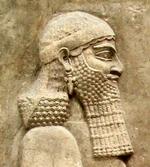
Sennacherib (as crown prince) on a relief from the Khorsabad,  now in the Louvre.

Sennacherib (as crown prince) on a relief from the Khorsabad, now in the Louvre.

Hezekiah had a problem.  And not just any old problem either,  He had a king sized problem.  Literally.  In particular, he had a problem with the king of Assyria, Sennacherib by name.

Hezekiah was a direct descendent of David and reigned as the thirteenth king of Judah from 715 B.C – 686 B.C.  The scriptures paint him in a very positive light, saying of him,

Now it came to pass in the third year of Hoshea the son of Elah, king of Israel, that Hezekiah the son of Ahaz, king of Judah, began to reign.  He was twenty-five years old when he became king, and he reigned twenty-nine years in Jerusalem.  His mother’s name was Abi the daughter of Zechariah.  And he did what was right in the sight of the LORD, according to all that his father David had done (I Kings 18:1-3).

Due to a foreign policy blunder by this father Ahaz, Hezekiah found himself on the receiving end of a blitzkrieg from the Assyrian empire at the zenith of its power.  How he dealt with the attack is a model of faith and courage from which Christians today can draw important lessons.

Hezekiah’s Trusts in the Power Egypt

One of the big takeaways from the Old Testament is this:  If the Lord doesn’t fight your battles, you’re going to lose.  From the time of the fall until the present, man has believed that he knows best.  “Forget what God says; I’m going to do it my way,” is the language of the world.   In the history of God’s covenant people, there are several instances where military defeat was the direct result of this sort of thinking.  The loss suffered by Israel at the hands of the men of Ai (Joshua 7), the Philistines’ victory over Israel recorded in I Samuel 4, and the beat down the Syrians gave the allied armies of Ahab and Jehoshaphat (I Kings 22 and II Chronicles 18) all stand as testament to this principle.

Even a godly man such as Hezekiah was not immune from the temptation of conducting the affairs of state the world’s way.  As the Assyrian threat loomed on the horizon, some in his administration had gone to Egypt to persuade Pharaoh to join in alliance with Judah against the invading Assyrians.  This worldly mindset, the sort of thinking that causes men to look everywhere for help except the one place it can be found, is rebuked by the prophet Isaiah.  He wrote,

“Woe to the rebellious children,” says the LORD, “who take counsel, but not of Me, and who devise plans, but not of My Spirit, that they may add sin to sin; who walk to go down to Egypt, and have not asked My advice, to strengthen themselves in the strength of Pharaoh, and to trust in the shadow of Egypt!  Therefore the strength of Pharaoh shall be your shame, and trust in the shadow of Egypt shall be your humiliation (Isaiah 30:1-3).

Commenting on this passage, Edward J. Young remarked,

To avoid the bondage of this enemy [Assyria], the people now look to another source of human deliverance, namely Egypt.  Indeed, there may have been a pro-Egyptian party in Hezekiah’s court.  The present prophecy, however, relates not so much to one particular act as to an attitude of the mind, which in the face of danger turns to man rather than to God; it is this attitude wherever manifested that the prophet condemns (The Book of Isaiah, A Commentary, Vol.2, 335).

In 701 B.C., Hezekiah was faced with the unfortunate fact that the mighty Assyrian army was on Jerusalem’s doorstep.  From a human standpoint, Judah was a beaten nation.  The Assyrians had overrun Israel 21 years earlier and deported the people.  No help could be expected from the northern tribes.  Further, Sennacherib’s forces had just crushed the Egyptian army sent by Pharaoh to defend Judah at the behest of Hezekiah.

It was at this dark hour for God’s people that Sennacherib sent one of his commanders to threaten Hezekiah at Jerusalem.  The Assyrian commander stood outside the wall of Jerusalem and began what today we might talking trash.  He boasted about the conquests of Assyria, blasphemed the Lord by speaking of him, “as against the gods of the people of the earth – the work of men’s hands” (2 Chronicles 32:19), and even mocked the Egyptians, saying of them, “Now look!  You are trusting in the staff of this broken reed, Egypt, on which if a man leans, it will go into his hand and pierce it.  So is Pharaoh king of Egypt to all who trust in him”  (2 Kings 18:21).  Tiny Judah was all alone and without hope in the world.  Where would its help come from?

(more…)

Read Full Post »

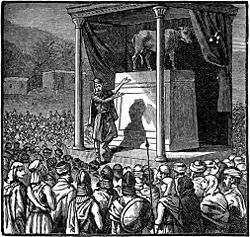
Jeroboam sets up a golden calf.

Jeroboam sets up a golden calf.

Among other things, the Bible is a book of examples. As God’s people, we can be thankful for this. Had he wished, God could have given his bare commandments and left it to us to draw our own lessons. But that’s not what he did. After providing very clear instructions to his covenant people in the Law of Moses, God inspired the writers of the Old Testament to record a detailed and fascinating history of his people. Some of this history was recorded as a warning to future generations. In his letter to the Corinthians, the apostle Paul highlighted several negative examples from the history of Israel and made the point, “Now all these things happened to them as examples, and they were written for our admonition, upon whom the ends of the ages have come” (I Corinthians 10:11).

In a previous post, we looked at two bad examples from the Old Testament, specifically the actions of kings Rehoboam and Jeroboam. In the case of Rehoboam, his was a political failure. Instead of being a servant to his people, he instead chose to lord it over them, answering a reasonable request for lower taxes with a churlish threat to increase them. His arrogance was the proximate cause of the division of the twelve tribes into the Northern and Southern Kingdoms. On the other hand the failure of Jeroboam, the first ruler of the Northern Kingdom, was of an ethical nature. He was charged by the prophet Ahijah to walk in the commandments of God. But Jeroboam, doing what he ought not, was quick to set up an idolatrous religion in the Northern Kingdom, which corrupted the people for generations. At bottom, the failures of both kings were epistemological, for both men rejected the clear commands of God and followed the dictates of their own hearts.

As a follow up to the bad examples, over the next two weeks we will look at two good examples from the Old Testament, one of them a prophet, the other a king. Both of had this in common: they trusted in God, not themselves.

(more…)

Read Full Post »

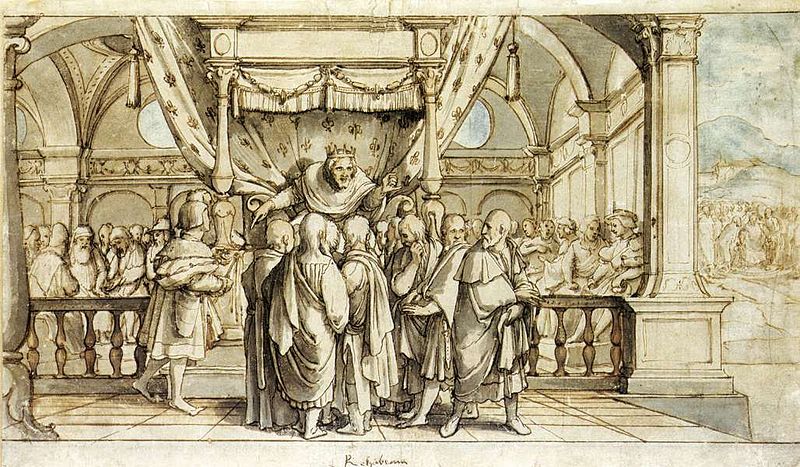
The Arrogance of Rehoboam, circa 1530.  Hans Holbein the Younger.

The Arrogance of Rehoboam, circa 1530. Hans Holbein the Younger.

“Nothing is completely worthless,” or so the saying goes, “it can always serve as a bad example.” I’ve always liked this old saw and have found it oddly comforting. In my own life, God has used my sins and to teach me some painful, negative lessons, which to this day I remember. But negative lessons are not unique to me. In fact, chastening from God is the common experience of Christians, for the author of Hebrews tells us that without chastening, we are illegitimate children and not sons.

But our opportunity to learn negative lessons is not limited to our own experience. God is a gracious God. It would be enough for him to provide us with bare commandments on how we ought to live, or just enough of the Gospel to be saved. But that’s not what he did. He gave us a whole library of 66 books, in which are found, not only his commandments, but example after example of what happens to those who heed his voice as well as to those who disobey.

Today, I’d like to focus on two negative examples found in I Kings 12-14. In particular, I would like to draw the reader’s attention to the examples of Rehoboam king of Judah, Jeroboam king of Israel. Both individuals were in a position of great responsibility, both brought upon themselves the judgment of God by their own poor decision making, which in both cases was the result of their failure to take their ideas from the correct source.

(more…)

Read Full Post »

« Newer Posts - Older Posts »