Feeds:
Posts
Comments

Archive for the ‘Roman Catholicism’ Category

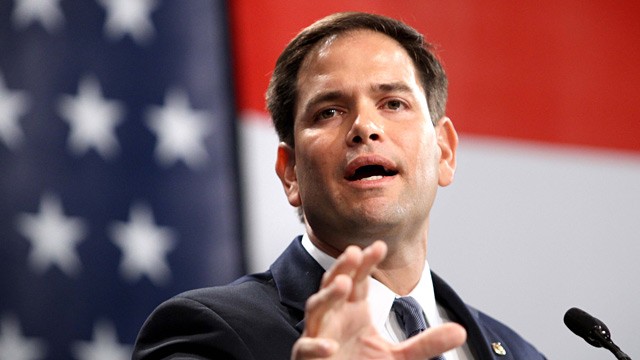
Marco Rubio, neo-evangelical favorite.

Marco Rubio, neo-evangelical favorite.

Have you ever noticed this strange phenomenon, that those at the forefront of a movement or discipline generally are the ones doing the most to undermine it? Take, for example, the legal profession. Among lawyers, there is no more prestigious assignment than to be named to the US Supreme Court. And yet these high-powered legal minds – supposedly the best and brightest the profession has to offer – routinely made a hash of the Constitution, the very document on which they claim expertise. Economists are in the same boat, the majority of whom are intellectual thralls to the economy destroying nonsense taught by John Maynard Keynes. Business leaders are anti-business, favoring programs of crony capitalist government bail-outs over the free market that allowed them to prosper in the first place.

To this list you can add another category of prominent individuals doing their best to undermine the very cause for which they claim to stand: evangelical insiders. According to a poll released by World Magazine, the favorite 2016 presidential candidates of these anointed insiders – World does not tell us what criteria it uses to select these insiders, describing them only as “well-connected evangelicals” – are, drum roll please…Marco Rubio and Carly Fiorina. Somehow, I’m not surprised by this. In fact, given the long-standing Romeward and feminist drift of the neo-evangelical movement. it was almost inevitable that the poll would turn out as it did.

But are these evangelical insiders thinking Biblically? Even posing this question may come as a surprise to some. What may be even more surprising to them is to hear that there are sound arguments against Christians supporting either one for president.

(more…)

Read Full Post »

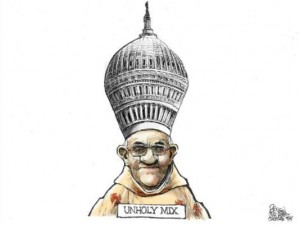
Pope Francis_Unholy MixThe past five days have seen the citizens of the United States subjected to a most extraordinary propaganda campaign. As the result of pope Francis’ visit to Washington D.C., New York and Philadelphia, the airwaves and newspapers of our nation have been filled with countless images of and reports on the pope’s activities, nearly all of which serve to cast Francis and his church in the most positive light possible. If it wasn’t clear before, it should now be abundantly evident to anyone, Catholic or not, that the mainstream media in this country is more than willing to prostitute itself as a megaphone for the Man of Sin. This shouldn’t be surprising. The Roman Catholic religion is designed and built to appeal to the flesh, and papal pomp certainly makes for good television.

But for all its gaudy appeal, Rome lacks that most important mark of a true church of God: the Gospel of Jesus Christ, Justification by Faith Alone. All Rome’s smells, bells, mitres, and masses put together cannot save a single soul. They cannot do so much as remit the guilt of a single sin. It is the righteousness of Christ alone imputed to believers by faith alone that saves sinners from death eternal. But this Rome flatly denies. And not only that, but it actually curses and damns all who believe this simple truth. The Roman Catholic Church-State is a false spiritual harlot of a church, teaching a false faith plus works non-gospel, presided over by the Son of Perdition himself. And yet this Babylonian Harlot-drunk-with-the-blood-of-the-saints institution is lifted up by the American press as representative of the best of Christianity. Watching this spectacle is enough to prompt any thinking Christian to repeat the words of the apostle John, who, when confronted with the vision of the Whore of Babylon, was astonished, declared, “And when I saw her, I marveled with great amazement.”

(more…)

Read Full Post »

“Building a future of freedom requires love of the common good and cooperation in a spirit of subsidiarity and solidarity.” – Pope Francis I

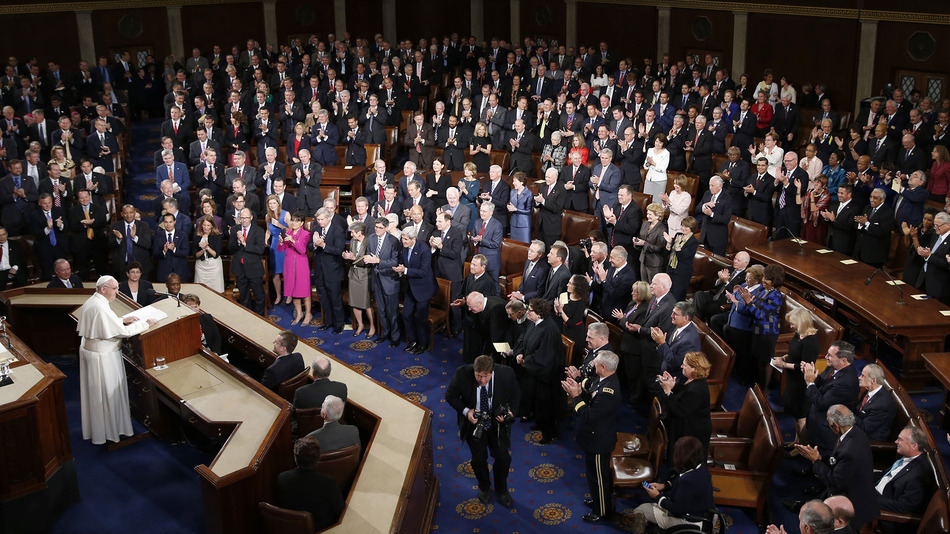
Pope Francis addresses a joint meeting of Congress on Capitol Hill in Washington, Thursday, Sept. 24, 2015, making history as the first pontiff to do so. (AP Photo/Evan Vucci)

Pope Francis addresses a joint meeting of Congress on Capitol Hill in Washington, Thursday, Sept. 24, 2015, making history as the first pontiff to do so. (AP Photo/Evan Vucci)

Antichrist continued his assault on our nation’s capital, breaking new ground as pope Francis became the first pontiff to address a joint session of Congress. The reaction from the members of the House and Senate was as expected, enthusiastic. The same with the press. The headline on Fox News was “Pope Francis delivers message of ‘hope and healing’ in address to Congress.” The New York Times proclaimed “Pope Francis Challenges Congress to Heal World’s ‘Open Wounds.’ ” The truth be known, the pope’s speech was a chock full of the standard collectivist claptrap we have come to expect from the Vatican.

One could spend a great deal of time unpacking all the economic, political, and theological errors in the pope’s address, ideas that are incompatible with the constitutional and capitalist foundation of the United States. But to keep this discussion brief, I shall mention only three: the common good, solidarity and subsidiarity.

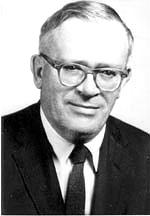
The term “common good” is a buzzword in the social teaching the Roman Catholic Church-State invoked as a call for socialism. By my count, the pope used this term six times in his speech before Congress. In Roman Catholic social teaching, the common good is not merely used as justification for Rome to interfere in the economies of individual nations, but it is the basis for Rome’s long standing call for world government. John Robbins explains it this way,

The “common good” is the great fiction used by the Roman Church-State to justify government control of society and economy. It is also useful in arguing for a world government, as many popes have done. The Catechism of the Catholic Church points out that “Human interdependence is increasing and gradually spreading throughout the world.” The unity of the human family, embracing people who enjoy equal natural dignity, implies a universal common good. This good calls for an organization of the community of nations able to “provide for the different needs of men…food, hygiene, education…” (Ecclesiastical Megalomania, 187, 188).

Yes, the common good sounds so wonderful, Who could possibly be against it? But how many understand that behind such silken language lies the call for world government?

(more…)

Read Full Post »

And then shall that Wicked be revealed, whom the Lord shall consume with the spirit of his mouth, and shall destroy with the brightness of his coming: Even
him, whose coming is after the working of Satan with all power and signs and lying wonders.

2 Thessalonians 2:8, 9

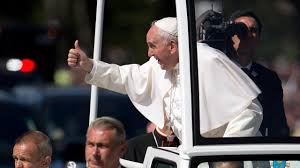
Pope Francis on parade in Washington D.C., 9/23/15.

Pope Francis on parade in Washington D.C., 9/23/15.

“I have no idea who Antichrist is,” said the veteran Presbyterian missionary to the congregation. His words, at once disappointing and unsurprising, could easily be those of nearly the entire Evangelical church at the beginning of the 21st century. No one, it seems, knows who Antichrist is. The dispensationalist Left Behind crowd thinks it’s Nicolae Carpathia. The preterists see Antichrist as some figure from the distant past. Both are dupes of the Jesuits. And neither camp, because of their poor eschatology, is able recognize Antichrist and his works, even while watching him quite literally parade around our nation’s capital on their high definition flat screens. So much for seeing is believing.

(more…)

Read Full Post »

Pope Francis Bobbleheads

Pope Francis Bobbleheads

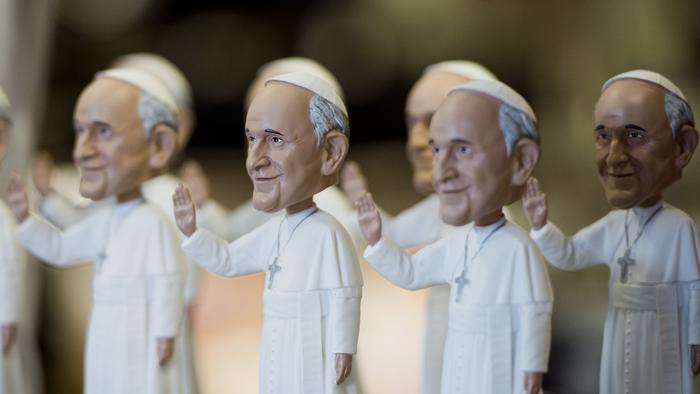
“In America we have a two party system,” explained the Republican congressional staffer to a group of visiting Russian dignitaries, “the stupid party [Republicans] and the evil party [Democrats]. “I’m a proud member of the stupid party.” “From time to time,” the staffer continued, ” the two parties get together and do something that’s both stupid and evil. This is called bi-partisanship.” Although there is some debate as to who actually said this – some attribute it to the late conservative columnist Samuel Francis – it’s a funny quote. And one that rings true as well. And in light of the endless propaganda blitz from the mainstream media about Jorge Bergolio’s (dba Pope Francis I) upcoming visit to the United States, it seems particularly apropos.

The visit, a result of a bi-partisan invitation to the pope by John Boehner (Republican) and Nancy Pelosi (Democrat), is the very definition of stupid and evil. During his stay in the US, the pope will, among other things, meet with President Barak Obama at the White House, parade through the streets of Washington D.C., deliver a speech to Congress, address the United Nations, visit Independence Hall and there deliver a speech using the same lectern used by Abraham Lincoln for the Gettysburg Address, and hold a Papal Mass for the World Meeting of Families.

The invitation is stupid, because politicians representing the people of the United States, supposedly a nation that values constitutional capitalism, have voluntarily brought the Antichrist head of the aggressively globalist, anti-republican Roman Catholic Church-State to our shores. Throughout its long, bloody history, the Babylonian Harlot of Rome has always favored repressive monarchies over against Biblical, representative government. It has always hated capitalism and favored collectivism of one sort or another. The pope is no friend of the Biblical ideas of limited government and laissez faire capitalism on which US was founded. Inviting him to trample three of our greatest cities with his parades, speeches, masses and blasphemies is an act of the crassest stupidity on the part of Congress.

The invitation is evil, because promoting the pope and his agenda is the same as putting light for darkness and darkness for light. While visiting the US, not only will the pope promote the unbiblical politics and economics of the Roman Catholic Church-State, but more importantly, he will be given the biggest possible stage, amplified by all the hype a star-struck media can muster, on which to advance Rome’s soul-destroying false gospel of faith and works, while those who believe the true Gospel of justification by faith alone are cast into the shadows.

(more…)

Read Full Post »

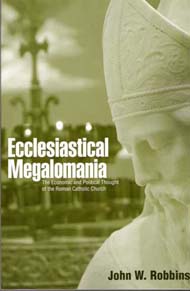
Ecclesiastical Megalomania: The Economic and Political Thought of the Roman Catholic Church by John W. Robbins (Unicoi, Tennessee: The Trinity Foundation, 1999, 326 pages).

Ecclesiastical MegalomaniaAlthough to some this may sound strange, Ecclesiastical Megalomania (EM) by Dr. John W. Robbins ranks among the best books ever read by this reviewer. It is crisply written, hard hitting without compromise, and God exalting. It also manages to be absolutely fascinating.

In a mere nine days citizens of the United States will be greeted with a visit from Antichrist in the person of pope Francis I, yet it is doubtful that even one American in a hundred has the discernment to recognize the pope for what he is. It is a marvelous thing that a nation founded by Protestants a little over 200 years ago could be so confused as the true nature of the papacy as to invite the pope, the absolute head of the Roman Catholic Church-State, to address Congress, visit the White House and tour Independence Hall. It is enough to remind one of Hezekiah giving the emissaries from Babylon the grand tour of his palace. But such is the case is this confused nation of ours.

No doubt, the papal visit will bring with it all the pomp and pubic adulation one would expect to accompany a royal visit. Public officials will clamor the pope’s attention and the media will sing his praises. But if this were not bad enough, what is far worse is the fact that many Evangelicals not only will swallow the mainstream media narrative hook line and sinker, but Evangelical leaders, not content to remain on the sidelines, will join the Antichrist’s chorus themselves and invite their foolish followers to sing along.

To all this nonsense Robbins’ book is the perfect antidote. The Oxford English Dictionary gives the definition of “megalomania” as, “the insanity of self-exultation.” “Ecclesiastical” means of or relating to the church.  Taken together, Ecclesiastical Megalomania mans the insane self-exultation of the Church, the Roman Catholic Church, that is.  Quoting the words of popes and various other Catholic prelates, Robbins does a brilliant job demonstrating that insane self-exultation is the modus operandi of the Roman Catholic Magisterium when it comes to making pronouncements on matters economic and political. But not only that, Robbins also shows that the economic and political thought of Rome is unalterably, radically opposed to constitutional capitalism, the political and economic system of the Bible, and historically of the nations of the West, including the United States. In Robbins’ words,

It might be expected that an institution such as the Roman Church-State, ruled by an absolute emperor, structured in a rigid hierarchy, supranational in scope, aristocratic in character, and none of whose officials is elected – an institution that in more than one way is an anachronism, and intrusion of the ancient world into the modern – would not favor constitutional capitalism. But how deep-seated its hostility to freedom and free enterprise is was a surprise even to this author. The popes have expressed their hatred, not only for Protestantism (a hatred perhaps muted recently, not by a change of mind, but by the relativism of the Church-State influenced by postmodern culture), but also for the political and economic expression of Christianity: capitalism (EM, 24).

With this in mind, the openly socialist and globalist pronouncements of pope Francis can be seen for what they are. Far from representing, as some think, a leftist aberration, the current pope’s obvious socialism is, in fact, a continuation of Rome’s longstanding war against constitutional government and laissez faire capitalism.

(more…)

Read Full Post »

Jeffrey Tayler does not like religion in general or Christianity in particular. He makes his stance quite clear. Writing

2016 US presidential candidates.  From left to right:  Ted Cruz, Rand Paul, Hillary Clinton, Marco Rubio, and Jeb Bush. REUTERS/Kevin Lamarque.

2016 US presidential candidates. From left to right: Ted Cruz, Rand Paul, Hillary Clinton, Marco Rubio, and Jeb Bush.
REUTERS/Kevin Lamarque.

in an article in Salon.com, the contributing editor at The Atlantic made manifest his intense dislike for Christianity and its adherents when he wrote,

Aspirants to the White House, both Democratic and Republican, have, as we all know, begun “announcing,” thus initiating from a rationalists point of view, a media carnival featuring on both sides, an array of supposedly God-fearing clowns and faith-mongering nitwits groveling before Evangelicals and nattering on about their belief in the Almighty and their certainty that if we just looked, we could find answers to many of our ills in the Good Book (Marco Rubio’s deranged religion, Ted Cruz’s bizarre faith: Our would-be presidents are God-fearing clowns).

Tayler, who we learn from the article is both a rationalist and, apparently, an atheist, is all kinds of upset at even the slightest suggestion that God may have something to do with politics. Tayler’s fulmination continues,

The candidates will cloak their true agenda – serving the Lords of Wall Street far more zealously than Our Father who art (or really, art not) in heaven – in pious patter about “values,” about the need to “restore America” and return us to the state of divinely granted exceptionalism President Obama has so gravely squandered. This Season of Unreason will end with the elections of November 2016, but its consequences – validation of the idea taht belief without evidence is a virtue, that religion, and especially Christianity, deserves a place in our politics, our Constitutionally enshrined secularism notwithstanding – will live on an damage the progressive cause…

Professing belief in a fictitious celestial deity says a lot about the content of a person’s character…

With the dapper Florida Sen. Marco Rubio we move into the more disturbing category of Republicans we might charitably diagnose as “faith-deranged” – in other words, as likely to do fine among the unwashed “crazies” in the red-state primaries, but whose religious beliefs would (or should) render them unfit for civilized company anywhere else…

Among the faith-deranged, Rubio stands out. He briefly dumped on magic book [apparently the Bible] for another, converting from Roman Catholicism to Mormonism and then back again…

Yet even as a re-minted Catholic, Rubio cheats on the Pope with a megachurch in Miami called Christ Fellowship. As religion and politics blogger Bruce Wilson points out, Christ Fellowship is a hotbed of “demonology and exorcism, Young Earth creationism and denial of evolution,” as is so intolerant it demands its prospective employees certify they are not “practicing homosexuals” and don’t cheat on their spouses…

It’s a safe bet, in fact, that most scientists have a better grasp on the vital verities than anyone rummaging around in Rubio’s beloved “sacred” tome [again, apparently a reference to the Bible] of far-fetched fiction and foolish figments. Yet of the Republicans, the most flagrant irrationalist is clearly Texas junior Sen. Ted Cruz. For starters, Cruz pandered fulsomely to the faith-deranged by choosing to announce at Liberty University, that bastion of darkness located in Lynchburg, Virginia. Once administered by the late Jerry Falwell, Liberty promises a “World Class Christian education: and boasts that it has been “training champions for Christ since 1971” – grounds enough, in my view, to revoke the institution’s charter and subject it to immediate quarantine until sanity breaks out.

Tayler goes on to suggest that reporters should challenge the religious beliefs of the candidates, rightly asserting that, “After all, they [religious convictions] are essentially wide-ranging assertion about the nature of reality and supernatural phenomena.” He then proceeds to propose a line of questioning that, at least in his mind, will catch Christian candidates on the horns of an unanswerable dilemma.

We will examine Tayler’s questions in a moment. But before doing so, a couple of clarifications are in order. First, many of those attacked by Tayler for their Christianity are themselves likely not Christian, and it is not my intention to defend them as though they were. Marco Rubio, for example, is a practicing Roman Catholic, and thus part of an organization that, not only expressly denies the essential Biblical doctrines of sola scriptura and justification by belief alone, but whose head is the great papal Antichrist of Revelation. Of course, one cannot be too hard on the atheist Tayler for confusing Roman Catholicism with Biblical Christianity. Most professing Evangelicals in the US, and this goes double prominent Evangelical leaders, don’t know the difference either. If Evangelicals can’t get their own story straight, it’s unreasonable to expect an atheist outsider to know perceive there’s a difference. That Rubio suffers no intellectual qualms about combining his Catholicism with attendance at an Evangelical megachurch simply underscores this point.

Second, because Tayler uses the term “Christian” in his article to refer generally to anyone who names the name of Christ, I shall follow him in this. To distinguish Bible believing Christians from those who name the name of Christ, I shall use the terms Evangelical, Bible believers, and Protestants.  In like fashion, I shall distinguish Christianity generally from the religion as taught in the Word of God by referring to the latter as Biblical Christianity.

Third, many of the proposals put forth by presidential candidates under the aegis of Christianity in fact have nothing to do with it. Rather, by their very nature they are actually anti-Christian. The “compassionate conservatism” and “faith-based initiatives” advanced by George W. Bush during the 2000 presidential election cycle are good cases in point. Evangelicals and atheists – some atheists inconsistently hold to the Evangelical principle of limited government – can both denounce such ideas for the fascist claptrap that they are.

That said, let’s look at Tayler’s supposedly unanswerable line of questioning.

(more…)

Read Full Post »
Richard Weaver

Richard Weaver

Ideas Have Consequences is title of well know philosophical work by Richard Weaver. First published in 1948, the book argues that the decline of the West began with the rejection of absolute truth by the medieval scholastics, and that this decline has continued into modern times.

While we do not share the author’s analysis of origin of the decline of the West, his prescription for curing it, or even what constitutes Western Civilization, we can appreciate his insight about the importance of ideas. All practice – the actions we take, the words we use – are the result of some prior theory. John Robbins put it this way,

Not only do ideas have consequences, but only ideas have consequences: Human actions are not independent of ideas but the results of ideas (The Religious Wars of the 21st Century).

Given the practical mindset that dominates in the US and throughout the West, the notion that ideas are logically prior to, and more important than, actions may seem strange to many. One 20th century theologian who well understood the importance of ideas was Gordon Clark. For Clark, ideas were not merely the thoughts that a man thinks, they were the very definition of the man himself. Clark wrote,

the definition [of a person] must be a composite of propositions. As a man thinketh in his (figurative) heart, so is he. A man is what he thinks…a person is the propositions he thinks (The Incarnation, 54, 55).

It is not true that we are what we eat. We are defined, not by what we consume at the dinner table, but by the thoughts we think. And the thoughts we think have consequences for all eternity. Our very salvation depends upon our understanding of, and accepting as true, the propositions of the 66 books of the Bible, especially the Gospel of Jesus Christ.

(more…)

Read Full Post »

From the sole of the foot even to the head, there is no soundness in it.

Isaiah 1:6

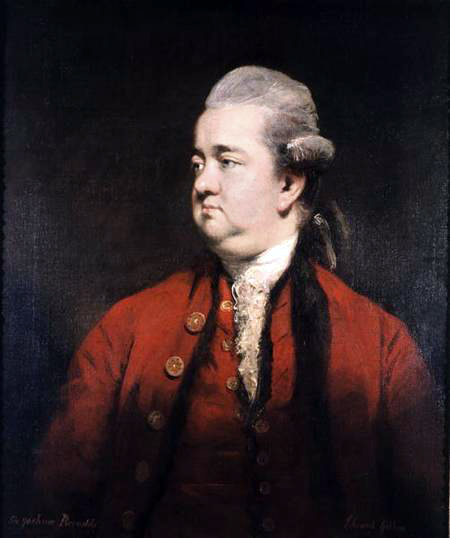
If people think at all about civilizational collapse, they tend to think of the fall of the Roman Empire. Famously chronicled by English historian Edward Gibbon, the fall of the Western Roman Empire in 476 B.C. is considered a red letter date in history. Those who have not read Gibbon may reasonably suppose he stopped his account at that point. But such is not the case. Gibbon was just getting warmed up. From the fall of Rome, he want on the chronicle the rise of Islam in the 6th century and its conflict with, and eventual conquest of, the Eastern Roman Empire. He ended his history with the fall of Constantinople to the Turks in A.D. 1453.

But as impressive as it is, Gibbon’s The
History of the
Decline and Fall of the Roman Empire is not the first or the best account of civilizational collapse. That honor would have to fall to Old Testament, much of which chronicles of The Decline and Fall of the Hebrew Republic. Established in Canaan under Joshua, the Hebrew Republic devolved into a monarchy under

BBC206171 Portrait of Edward Gibbon (1737-94) c.1779 (oil on canvas) by Reynolds, Sir Joshua (1723-92) oil on canvas 73.6x62.2 Private Collection English, out of copyright

Portrait of Edward Gibbon (1737-94) c.1779 (oil on canvas) by Sir Joshua Reynolds (1723-92)

Saul in 1050 B.C., reached the height of its wealth and power under Solomon between the years 970 and 930 B.C., then split into a Northern and a Southern Kingdom under Solomon’s son Rehoboam. From there, the fortunes of the two kingdoms trended downward over the course of several centuries until the fall of the Northern Kingdom to Assyria in 722 B.C. and the final conquest of the Southern Kingdom by Babylon in 586 B.C.

The history of the Decline and Fall of the Hebrew Republic is exceptionally well documented, for it is given to us in the form of God’s inspired, infallible, inerrant Word. As such, we have a perfect record, not only of what took place, but God’s own interpretation of why it took place. One of the problems of secular history is getting the facts straight. But even if a historian were to be given perfect documentation of the period they were studying, there still would remain the issue of interpreting the events. Events do not interpret themselves. Events must themselves be explained. Those problems do not exist with the Old Testament. God has graciously provided to us both the facts and their correct interpretation.

Though many people do not seem to recognize it, we who are alive at the beginning of the 21th century are living through a civilizational collapse, one that has much in common with that experienced by the ancient Israelites and recorded in I and II Kings, I and II Chronicles, and in the prophets. Many of the same ills that beset us in the 21st century are the same as those experienced by the Hebrews in the centuries leading up to the collapse of that nation. But not only are the symptoms the same – moral decline, economic decline, disastrous foreign policy, internal strife – the cause is the same as well. In both cases, the people turned their backs on God and his Word. And just as the Israelites learned that a godly heritage without actual godliness is no protection against disaster, so too are we in the West being taught that that same hard lesson

(more…)

Read Full Post »

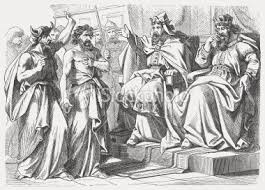
Ahab and Jehoshaphat listen to Michiah.

Ahab and Jehoshaphat listen to Michiah.

“Should you help the wicked,” asked the prophet of the defeated and humiliated king upon his return to Jerusalem, “and love those who hate the LORD?” The prophet was Jehu.  The king was Jehoshaphat.  The occasion was the aftermath of a crushing defeat inflicted by the Syrians on the allied armies of Israel and Judah.

Jehoshaphat was a godly man; one of the few good kings Judah ever had.  But in spite of this, he made a major spiritual and strategic mistake in seeking alliance with Ahab, the evil king of Israel.  I Kings 22 and 2 Chron. 18 provide the details of the alliance.  Jehoshaphat went on a state visit to see Ahab in Samaria, the capital of the northern kingdom.  During the visit, Ahab persuaded Jehoshaphat to join him in a grand alliance of Israel and Judah and to make war against the Syrians, all for the purpose of recapturing for Israel territory that had been lost to Syria earlier.  In other words, it was an Old Testament version of a crusade against the infidel.

Jehoshaphat made several errors that led to his defeat.  The first of which was that he, apparently, did not consult  the Lord before traveling to Israel to meet with Ahab.  The Scriptural record shows no evidence of Jehoshaphat ever seeking the Lord’s counsel as to whether he should go to Samaria.  It appears that he did this on his own.

Jehoshaphat’s second mistake was not heeding the voice of the Lord when it became clear that the military alliance would end in disaster.  The prophet Michiah plainly told Ahab in  Jehoshaphat’s hearing that the offensive against Syria would fail miserably.  His words were, “I saw all Israel scattered on the mountains, as sheep that have no shepherd” (I Kings 22:17).  Jehoshaphat heard all of this, and yet followed Ahab into battle anyway.

In all this, Jehoshaphat also managed to serve as Ahab’s dupe.  Ahab reacted angrily to Michiah’s prophesy of defeat at the hands of Syria, but he had the good sense to hedge his bets.  When Ahab and Jehoshaphat went into battle, Ahab disguised himself, but told Jehoshaphat to wear his royal robes.  Jehoshaphat did so, and nearly lost his life when the Syrians mistook him for the king of Israel, against whom they had been ordered to fight.

(more…)

Read Full Post »

« Newer Posts - Older Posts »