Feeds:
Posts
Comments

Archive for the ‘Economics’ Category

Angry Voter

The angry voter.

The angry 2016 voter. Anyone who’s followed presidential politics even a little this year has heard all about it. The establishment seems puzzled by it. Jeb Bush, the early odds on favorite to win the Republican nomination, never connected with voters. His campaign is over, an object lesson that all the money in the world cannot buy public support. Hillary Clinton began the campaign with an aura of inevitability about her. Everyone knew the White House was hers for the taking. Instead she finds herself in a political dogfight with an elderly socialist Vermont. And with a possible FBI indictment hanging over her head, her problems on the campaign trail may be the least of her worries.


When it comes to voter anger, my first reaction is wonder what took them so long. Theft, lies and double standards have infected the whole of society, and it is amazing to this author just how much nonsense people have been willing to tolerate from the so-called masters of the universe who rule us. But on second thought, is voter anger really a positive development? The apostle Paul tells us it’s good to be zealous in a good thing always. And anger, if it’s focused on the proper object and seeks redress in the proper way, can be good. But anger can easily be channeled in the wrong direction, scapegoating the wrong party or going about things in such a way as to actually make a bad situation worse.

Ever since Soren Kierkegaard famously praised the pagan for worshipping his false god with infinite passion, men have carried about in their minds the false notion that sincerity is more important than truth. But the Bible knows nothing of this notion. Truth is everything. How one feels about it makes no difference. It was the same apostle Paul who praised zeal when focused on good ends, who rebuked the Jews, his countrymen, for having a zeal for God, but not according to knowledge. Zeal without knowledge is not a good thing. In fact, it is downright dangerous.

(more…)

Read Full Post »

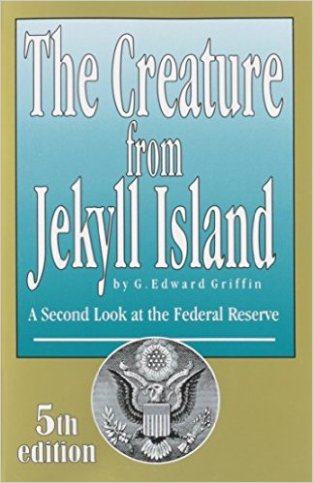
Creature from JekyllThe Creature from Jekyll Island: A Second Look at the Federal Reserve, 5th Edition by G. Edward Griffin (Westlake Village, California, 608 pages, 2010), $19.44.

“The most boring question in the world,” announced the accounting professor to my B-School class, “is whether the government should have bailed out the financial system in 2008.” In his eyes, the answer was an obvious yes. End of story. But that struck me as a rather odd stance. For the question, to bailout, or not to bailout? seemed to me to be among the most fascinating topics imaginable in the field of finance and accounting. And in truth, any answer one could give would have to go well beyond finance and accounting, touching upon the basic philosophical disciplines of politics, ethics, and ultimately epistemology. Further, any answer given would go a long way to telling you something about the man himself. So no, it was not a boring question at all. That is, unless you’re interest is in perpetuating the status quo, in which case you would prefer that it not be asked at all.

I have elected to introduce my review of G. Edward Griffin’s The Creature from Jekyll Island [hereafter, the Creature] by way of this personal account, because it illustrates perfectly the sort of close-minded contempt that emanates from the financial mainstream toward anyone who dares question its reigning orthodoxies. Examples of these nostrums are: Central bank issued fiat currency is good, but the gold standard is a barbarous relic, the money supply cannot be left to the free market, it must be a function of a government appointed central bank; banks are not like other businesses, they must be chartered, regulated, and, if needed, bailed out by the government using taxpayer funds. None of these orthodoxies is true, for none can be supported from Scripture. Yet they are accepted by politicians, academics and ordinary folks alike almost without question.

G. Edward Griffin, on the other hand, is a man who does question these orthodoxies, concluding at the very beginning of his book that the Federal Reserve must be abolished. He provides seven reasons for this, namely:

  • It is incapable of accomplishing its stated objectives.
  • It is a cartel operating against the public interest.
  • It is the supreme instrument of usury.
  • It generates our most unfair tax.
  • It encourages war.
  • It destabilizes the economy.
  • It is an instrument of totalitarianism.

The remainder of the book is used to flesh out why these things are so. In Griffin’s words, the book is a who-dunit, which, in the words of USA Daily, “documents an organized and successful attempt to seize control over the U.S. monetary system by powerful American and European families.”

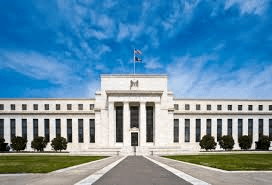
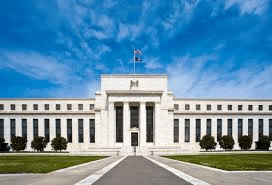
Eccles Building

The Eccles Building, the Washington D.C. headquarters of the Federal Reserve.


At this point one may by asking himself, why is it that Christians should care about the obscure workings of the Federal Reserve System [hereafter, the Fed]? Why not just leave banking to the bankers and get on with more important matters? After all, talking about money doesn’t seem very spiritual. And doesn’t the Bible say that money is the root of all evil? Wouldn’t it be best simply to leave the whole matter alone and focus on the Great Commission instead?

Taking these objections in reverse order, let us consider what Christ commanded in the Great Commission. What did Jesus say to his followers? Go into all the world and teach the five fundamentals? No. Christ called his disciples to go into all the nations and to teach, “them to observe all things that I have commanded you.” The Great Commission includes all of Christ’s teachings. And since there is no field of endeavor not covered by Christ’s teachings,, all statements of all men in all areas of study, including banking, finance, and accounting, must be brought back to Scripture and judged by it. Therefore banking is a proper field of Christian study.

(more…)

Read Full Post »

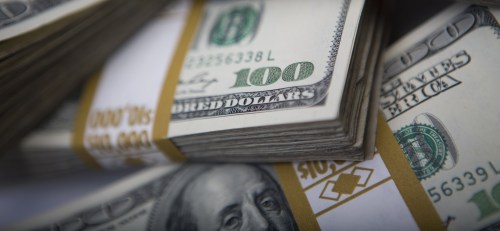
100 dollar bills.jpgWhen Harvard Economics professor and wannbe Fed Chairman Lawrence Summers speaks, it’s usually a good idea to pay him heed. Mind you, not because pearls of wisdom fall from his lips as manna from heaven, but because what he says carries weight. He is among the very elite of the intellectual and financial elite. A true master of the universe, if you will. And if Summers writes in the Washington Post that he wants to grab your cash, you’d best be paying attention. Because if he’s saying it in the mainstream media, you can take it to the bank (bad pun intended) that the rest of the elite is thinking along those same lines.

Of course, he wasn’t so crude as to suggest he was just going to take your money. People of his ilk never do. They’re far too genteel for such talk. No, what they do is make the case for some small, seemingly innocuous move. The sort of thing that, not only seems downright reasonable, but actually appears to be the very essence of patriotism and upright thinking. I’m speaking here of Summers’ recent call to “kill the $100 bill.”

Now why would this economics professor think that killing a perfectly good Federal Reserve Note is so important that he would take the time to write a newspaper column on the subject? The better to fight crime and terrorism, he tells us. Besides, he adds, we don’t need that silly old $100 bill anyway.

Citing Peter Sands, a senior fellow at Harvard’s Mossavar Rahmani Center for Business and Government, whose recent paper on the subject of banning large denomination bills was the inspiration for his article, Summers writes,

The fact that – as Sands points out – in certain circles the 500 euro note is known as the “Bin Laden” confirms the arguments against it.

Cash, you see, means terrorism. But it’s not just terrorism that we can stop by banning large bills. Crime of the more ordinary sort can be reduced as well. Summers continues,

I confess to not being surprised that resistance within the ECB [European Central Bank, the issuer of the euro] is coming out of Luxembourg, with its long and unsavory tradition of giving comfort to tax evaders, money launderers, and other proponents of bank secrecy…

So, banning the big bills helps us catch crooks too. And on top of that, “technology is obviating whatever need there may ever have been for high denomination notes in legal commerce.”

If we take Summers’ at his word, there simply is no legitimate reason for large denomination notes to even exist at all. And if you think otherwise, you must be a terrorist or tax evader. And you wouldn’t want people to think that about you, now would you?

(more…)

Read Full Post »


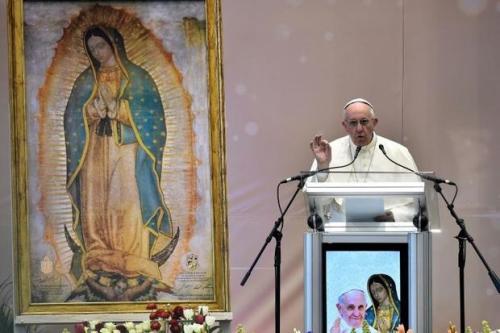
Pope Francis_Juarez

Pope Francis speaks at the Bachilleres College in Ciudad Juarez, Mexico on February 17, 2016. Background image is Our Lady of Guadalupe.  Gabriel Bouys, AFP


“The Romanists have very cleverly built three wall around themselves,” observed Martin Luther in his treatise To the Christian Nobility of the German Nation. “Hitherto,” he continues, “they have protected themselves by these walls in such a way that no one has been able to reform them. As a result, the whole of Christendom has fallen abominably.

In the first place, when pressed by the temporal powers they have made decrees and declared that the temporal power had no jurisdiction over them, but that on the contrary, the spiritual power is above the temporal. In the second place, when the attempt is made to reprove them with the Scriptures, they raise the objection that only the pope may interpret the Scriptures. In the third place, if threatened with a council, their story is that no one may summon a council but the pope.”

In this way they have cunningly stolen our three rods from us, that they may go unpunished. They have ensconced themselves within the safe stronghold of these three walls so that they can practice all the knavery and wickedness which we see today.” Thus Luther.

(more…)

Read Full Post »

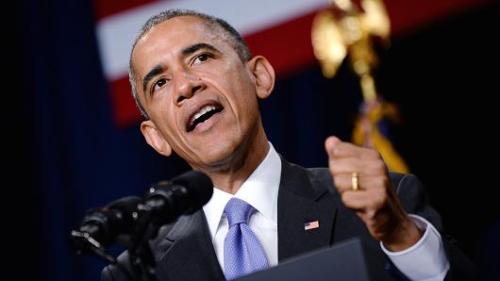
Obama

Obama to propose $10-per-barrell fee on oil,” blared the CNBC headline. Surprise, surprise. Obama wants a new tax. The Obama administration claims the funds generated by this proposed energy tax will be used to fund clean transportation research, high-speed railways, autonomous cars and other such like. (Sigh)… Can Obama just leave office already? The economy is teetering on the brink of a recession, and possibly something much worse, and all the president can think to do is gin up more government spending. I guess Nixon was right, we really are all Keynesians now.

It’s fascinating how statists such as Obama try to portray themselves as of the people, by the people, and for the people, but in reality they are anything but. In truth, he is more like of the statists, by the statists and for the statists. There is nothing that he does that is not all about growing government. And that’s what gives the lie to this and to his other proposals. But government is the problem, not the solution. Growing the state does not make us better off. It’s a drain on our wealth. More power in Washington means less freedom for Americans. And yet, almost like a cuckoo clock, out pops Obama to to announce yet another government spending initiative.

(more…)

Read Full Post »

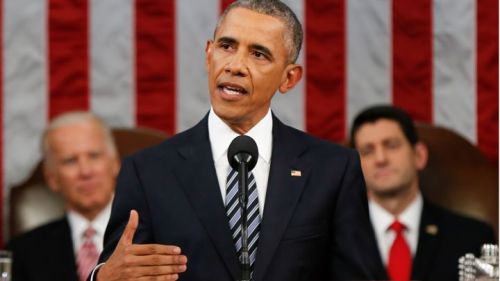
Obama_2016 SOTU

President Barak Obama delivers his State of the Union address to Congress, January 12, 2016.

“Anyone claiming that America’s economy is in decline is peddling fiction,” or at least that’s what President Obama would have Americans believe based on his remarks in his State of the Union address last week. Yes, according to the president, everything is awesome. And anyone who thinks otherwise is simply, to quote a Vice President from a few decades back, a nattering nabob of negativism.


But is everything as rosy as Obama would have us believe? The following points would suggest otherwise:

  • The New York Stock Exchange (NYSE) just experienced the worst opening week in its history. During the first two weeks of trading in 2016, the market has declined by 4%.
  • The Labor Force Participation Rate – this the total number of people who are either employed or actively looking for work divided by the total working age population – is at lows not seen in nearly 40 years, going back to a time when women were just entering the workforce in large numbers.
  • The Baltic Dry Index – a shipping and trade index measuring the changes in the cost to transport raw materials by – is at record low levels and continuing to sink rapidly. These low and rapidly declining readings – the index has dropped 19% just since the first of the year – indicate a sharp drop in international shipping, implying a significant drop in international trade and a global economic slow-down. According to this article, the index has hit new record lows for the past nine days straight.
  • According to FactCheck.org, the number of Food Stamp recipients grew by 45% for the period from 1/9/2009 – 1/9/2015.
  • Breitbart reports that, “American’s middle class has shrunk by almost 20% since the 1970s and is now a minority of the population in the United States.”
  • In connection with a shrinking middle class, income distribution has become significantly skewed toward the top of society. This video give a good breakdown of just how unequal incomes have become in the US. Among its findings: 40% of the wealth of the country is held by 1% of the population, those in the top 1% own 50% of value of the stock and bonds markets. Taken together with a shrinking middle class, it appears that the US is coming to resemble more a feudal society than the healthy middle class nation most of us grew up in.
  • US federal government debt has exploded in recent years. When Obama entered office in January 2009, the debt stood at a frightening $10.6 trillion. According to estimates by the Congressional Budget Office, the debt was $18.1 trillion in January 2015 and is projected to grow to $19.1 trillion a year from now when Obama leaves office. To put it another way, it took the US 236 years to amass $10.6 trillion of debt, but by the time he leaves office next year, Obama will have presided over a near doubling of this amount. According to Boston University economist Laurence Kotlikoff, “Our country is broke. It’s not broke in 75 years of 50 years or 25 years or 10 years. It’s broke today.”

Considering only the bullet points above, it would appear that precarious is about the kindest word one could use to describe the economic condition of the US. To say we’re headed off an economic cliff likely would be closer to the mark.

So how did we get here? How did a nation founded by the Puritans and committed to the principles of civil and economic liberty end up a bloated, socialist over extended empire suffocating under the largest debt edifice in the history of mankind? Although a full answer to that question is beyond the scope of a single blog post, the short answer is that the American people have, to borrow what Isaiah said about the people of Judah, turned away backwards from God and from his law. We have rejected the truth and embraced the lie, and now the chickens are coming how to roost.

In this post, I would like to look specifically at three economic lies that are held by nearly all academic economists, politicians and their enablers in the media: central banking, fiat currency and Keynesian economics. Any one of these by itself is dangerous to the health of a nation. Taken together, they are a sort of perfect storm, guaranteed to bring economic destruction to any nation whose leaders embrace them.

(more…)

Read Full Post »


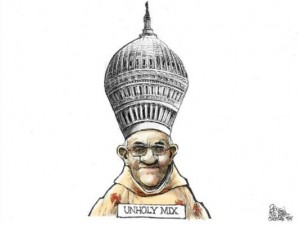
Pope Francis_Unholy MixNot content with parading around the nation’s capital, New York City and Philadelphia, Pope Francis I, the current occupant of the office of Antichrist, has big plans for the U.S. Mexican border. According to a recent report,

The Vatican has announced the program for Pope Francis’ upcoming visit to Mexico, which will include a visit to the U.S.-Mexican border with the celebration of a “cross-border” Mass.

The focus of the pope’s border visit, which is to take place during his February 12-17 tour of Mexico, will be to press for immigration reform, which is code for flooding the U.S. with taxpayer subsidized third-world Roman Catholics. According to a statement by El Paso Bishop Mark J. Seitz,

During Mass, Pope Francis will undoubtedly call attention to many realities that are lived on both sides of our U.S.-Mexico border, particularly the plight of so many migrants and refugees fleeing violence and poverty in their home countries, in search of better lives for themselves and their children.

As the Breitbart article notes, the pope’s visit will take place, “just as voters are heading to the polls in both Iowa and New Hampshire, where immigration policy is a major issue.” The timing of the papal visit almost certainly is no coincidence. Rome has long sought to turn the U.S. into a majority Roman Catholic country. To date, its efforts have failed, as the Roman Catholic population of America is about 65 million in a nation of over 300 million. But with a virtually bottomless supply of potential immigrants from Latin America at its disposal, the Church hopes to finally realize its goal of a majority Roman Catholic America. What are American Evangelicals to make of this latest push by Antichrist?

(more…)

Read Full Post »

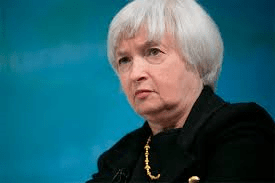
Yellen_2

Federal Reserve Chairman Janet Yellen

Reading the comments of Janet Yellen and other Federal Reserve officials this past week brought to mind the words Jesus used to rebuke his disciples when they argued about who was t he greatest, The kings of the Gentiles exercise lordship over them, and those who exercise authority over them are called ‘benefactors” (Luke 22:25). “Benefactors” translates the Greek word “euergetes,” a title adopted by many kings in the ancient Greek speaking world. To be known as a Euergetes was a way for the king to boast, letting all the world know what a charitable fellow he truly was.


But Christ did not leave it at that. In addition to telling his disciples what not to do, he also provided positive instruction about how those in positions of authority ought to behave, telling them, “he who is greatest among you, let him be as the younger, and he who governs as he who serves” (Luke 22:26). It is this passage that serves as the basis for the idea of government as a servant of the people.

I bring up Janet Yellen and the Federal Reserve, because by their comments this week in opposition to a bill (H. R. 3189) before Congress, they once again they showed they think of themselves as “Benefactors” and lords rather than servants of the people. Established in 1913, the Federal Reserve is the central bank of the United States, and as the issuer of the US dollar, world’s reserve currency, it is among the most powerful institutions in the world. But despite the fact that its decisions affect the lives of every single American citizen, not to mention pretty much every person on the planet, the Federal Reserve conducts its business behind a veil of secrecy. H. R. 3189 would pull back the curtain on the Fed, allowing Congress and the American people better information on how the Fed goes about its business. Naturally, Yellen and others are appalled at the thought.

When asked to comment on the bill, Richmond Fed President Jeffrey Lacker huffed that its provision to audit the Fed amounted a, “mechanism for high-frequency harassment.” In a letter to House Speaker Paul Ryan and Democratic Leader Nancy Peolsi, Federal Reserve Chairman Janet Yellen complained that the legislation requiring greater transparency from the Fed, “would severely damage the U.S. economy were it to become law.” In what amounts to something like comic relief, Yellen continued in the same letter by commenting that, had the bill’s provisions been law in 2008 during the financial crisis, “inflation would be even further below the FOMC’s [Federal Open Market Committee, the body of Federal Reserve governors tasked with setting interest rates] 2 percent objective. Indeed, a recent study by Federal Reserve economists suggests that…inflation would now be running somewhat below zero, if the FOMC had not taken the actins it did.” In other words, Yellen is complaining that had the Fed been held accountable by the provisions in H. R. 3189, she and her colleagues would be unable to destroy the value of your hard earned dollars as fast as what they are now doing. In fact, were this bill to become law, your money may well gain in value, as this is what Yellen means when she says, “inflation would now be running somewhat below zero.” Horrors! H. R. 3189 would stop the crony capitalists at the Fed from ripping off the rubes in fly over country. At all costs such madness must be stopped!

The Eccles Building, main office of the Federal Reserve located in Washington D.C.


In evaluating these comments it is worth noting what the Fed actually is, a private cartel of the bankers, by the bankers and for the bankers. The Fed does not have and never has had the best interests of the American people in mind. It’s overriding purpose is and always has been doing what is right by the private member banks that own it. The fact that it was given its charter in 1913 by an act of Congress means that it represents the merger of state and corporate powers, which is the very definition of fascism. Simply put, the Fed, far from being and exemplar of constitutional capitalism, represents instead monetary fascism. In light of this, it is not surprising that then Fed Chairman Ben Bernanke moved heaven and earth to bail out the banks-too-big-to-fail [n.b. in capitalism there is no such thing as too-big-to-fail; individuals and institutions reap what they sow] during the 2008 financial crisis.

The behavior of the Federal Reserve over the past 100 years – its secrecy, favoritism and cronyism – is a perfect example of the sort of unaccountable power and arrogance that is characteristic of the “rulers of the Gentiles” Christ spoke about. The Fed has lorded it over the people of the United States for over one hundred years and impoverished all of us in the process. It’s high time to audit the Fed. Then end it.


Read Full Post »

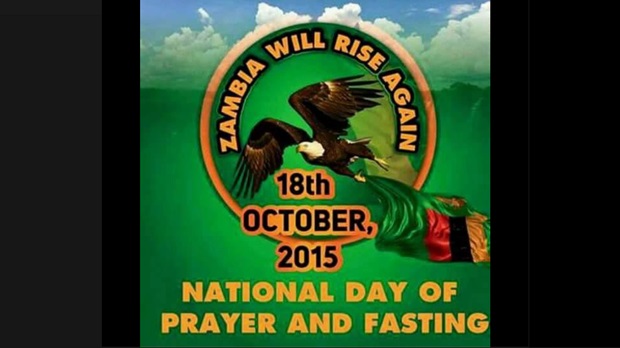
ZambiaGod have mercy on the currency,” read the headline. Curious, I followed the link to an article about the president of Zambia calling for a national day of prayer and fasting to address country’s currency crisis. It turns out that Zambia’s national currency, the Kwacha, has fallen by 45% against the US dollar in 2015, causing Zambians a host of economic difficulty. It is eminently Christian and sensible to call on the Lord in times of trouble The Bible is filled with promises that God will deliver his people if they call upon his name. Typical is Ps. 50:15 which reads, “Call upon Me in the day of trouble; I will deliver you, and you shall glorify Me. And because it is eminently Christian and sensible to call on the Lord in times of trouble, no Western president or prime minister would ever think of doing it. “We’ve got this,” they say, “no divine help needed.”

Such was not always the case. During the American Civil War, Abraham Lincoln called for a national day of prayer and fasting. But that sort of thing doesn’t fly anymore. In the aftermath of the greatest national disaster of my lifetime – I’m speaking here about the 9/11/2001 terrorist attacks on New York and Washington D.C. – George Bush encouraged Americans to go to Disney World. What’s worse, he participated in a blasphemous ecumenical prayer service at the National Cathedral in Washington which featured, among others, a female Episcopal bishop, a Rabbi, a Muslim cleric and a Cardinal of the Roman Catholic Church-State. Far from being an example of turning to God, this service was a double-minded affront to the Lord Christ Jesus. And because it was double-minded, those who participated had no reason to think they would receive God’s blessing or assistance. The failure of the Global War on Terror stands as a stark testimony to this principle.

(more…)

Read Full Post »

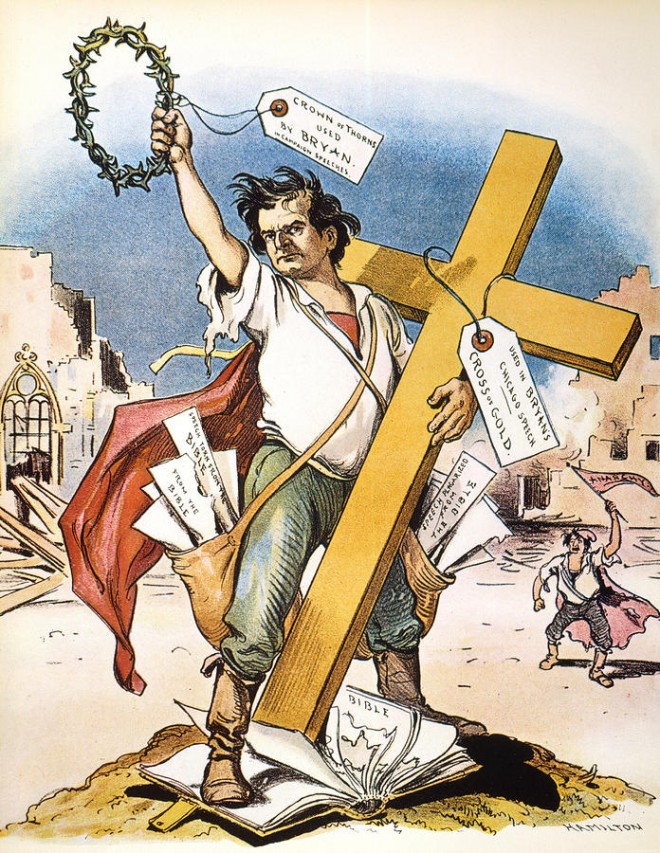
"You shall not crucify mankind upon a cross of gold." - William Jennings Bryan, 1896

“You shall not crucify mankind upon a cross of gold.”
– William Jennings Bryan, 1896

Talk of the US returning to a gold standard, at least according to the anointed wise men of our time, is the province of weirdoes, wackadoos and wingnuts and ought never to be mentioned in polite company by any serious presidential candidate. At least that’s the sense one gets when reading Matt O’Brien’s Washington Post article “Dear Jeb: Gold won’t make America great again.” O’Brien is upset that, when given the opportunity to squash any notion that he might support a gold standard, Jeb Bush waffled in his comments, implying that he may in fact be prepared to crucify mankind upon that dreadful cross of gold.  The horrors.  According to O’Brien, “The right answer would have been that the gold standard was a “barbarous relic” even 80 years ago, and might be the world’s worst idea today.”

O’Brien goes on to chide both Ben Carson and Bush, the former for his positive support of the gold standard, the latter for his failure to live up to his duty as “the candidate of serious policy,” which in O’Brien’s mind means taking a stance of uncompromising devotion to the central bank driven, fiat money status quo. The reason O’Brien gives for this is simple, “We tried it [the gold standard], and it failed.”

But did the gold standard fail as O’Brien thinks it did? O’Brien’s chief beef with the gold standard is that the price of gold is controlled by the Federal Reserve’s [the central bank of the United States] interest rate policy.

[T]he gold standard says that the dollar will always be worth a certain amount of gold. But that alone isn’t enough to make it true. The Federal Reserve has to do that. So, for example, think about what would happen when the price of gold “wanted” to go up. That is, when supply and demand would make its price go up if it were allowed to do so – which it wouldn’t be under the gold standard. In that case, the Fed would have to make the dollar go up instead to keep the relationship between the two the same. And making the dollar go up is just another way of saying that it makes interest rates go higher, since more people will want to hold a currency that pays more interest.

There are at least two fallacies with this argument. First, the gold standard does not require that the Federal Reserve (the Fed) do anything. In fact, the gold standard does not even require the existence of the Fed, as can be seen from the fact that the US was on the gold standard long before the it came into being in 1913. In truth, it was the Fed’s activism that caused both the stock market and real estate boom during the 1920’s and the subsequent 1929 bust that contributed to the depression of the 1930’s. It is the Fed, not gold, that failed during the depression. But as a good statist, O’Brien puts the blame exactly where it does not belong, on gold, while exonerating the Fed which did so much to create the mess. This is an example of calling good evil and evil good.

“Centralization of credit in the hands of the state, by means of a national bank with State capital and an exclusive monopoly” – Karl Marx and Frederich Engels – The Communist Manifesto
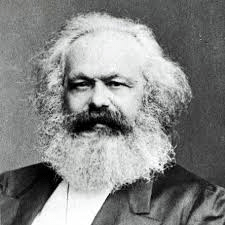
Karl Marx

Karl Marx

Worth noting too, is that central banking of the sort practiced by the Fed, and so admired by O’Brien and his counterparts in the media, academia and government, was actually advanced by Marx and Engles as one of the planks in their Communist Manifesto. It is unsurprising that the communists, favoring as they did government ownership of the means of production, would also insist on government control the monetary system. What is worth noting, however, is that so many in the West seem to be of the opinion that a modern economy cannot function in the absence of a central bank. But far from being a necessity, the central banks of the world are a positive hindrance to economic development. In the 100 years of its existence, the Fed has managed to destroy 96 percent of the dollar’s value, robbed savers with artificially low interest rates to bail out its billionaire banker buddies, and created unprecedented economic distortions, the worst of which have yet to play out. It is the Fed and its unseemly support of Wall Street investment banks that is to blame for the record income inequality in the US. Not, as is commonly assumed, laissez faire capitalism. It is the Fed that helped to bring on the depression of the 1930’s and caused the tech bubble of the 90’s, the real estate bubble of the 00’s and the current stock and bond market bubbles, both of which are set to pop and threaten to send the US and world economies into an economic tailspin such that the Great Depression will seem like a golden age of prosperity by comparison. When it comes to central banks, the best thing to do is to bury them in the same pit as the rubble from the Berlin Wall.

A second problem with O’Brien’s analysis is that he assumes that a gold standard requires the government fix the price of gold at a certain level. According to the Bible, governments have only two legitimate functions: to punish evil doers and praise those who do what is right. Nothing more. Though many people assume that they should, governments have no right to manufacture money. This means that for a gold standard – or any monetary standard – to work properly, it should be the free market, and not the government, that determines what is, and what is not money as well as the market price of money, that is, the free market should set interest rates, not some monetary politburo at the Fed as is currently the case.

Conclusion

Although the Bible does not require a gold standard or a silver standard, it does require that money, in whatever form it takes, be honest. Historically, gold and silver have done the best job in this role. Our current system, in which central banks conjure up capital out of thin air, crediting billions of dollars to the accounts of favored financial institutions with the click of a mouse, is about as far from honest as it can get. In any other context, the normal activities of the Fed would be called counterfeiting. Or to put in another way, lying at the heart of our current financial system is a consistent violation of the Eighth Commandment, Thou shalt not steal.

Contrary to O’Brien, there is nothing serious about advocating the continuance of the current broken, immoral, central bank dominated, debt based, fiat monetary system. But statists look for every excuse under the sun to defend the central banks and their fiat money ponzi schemes, one example of which is O’Brien’s claim that a gold standard cannot be trusted to regulate interest rates. This is simply false. Since the interest rate is simply the price of money, it is regulated in the free market by the laws of supply and demand, just like any other good or service. A gold standard set by the free market is honest money enabling honest commerce conducted apart from the interference of government. It is Biblical. And it works. Seriously.

Read Full Post »

« Newer Posts - Older Posts »