The Wittenberg Church Door where Martin Luther nailed his 95 Theses, October 31, 1517.
In two days, we will mark the 506th anniversary of Martin Luther’s nailing his 95 Theses to the Wittenberg church door.
Luther wasn’t the first to push back on the theological and political abuses of the Roman Church-State. John Wycliffe in England had done so 150 or so years earlier. Jan Hus, another reformer, was murdered by the Church-State in 1415, just 102 years before Luther’s famous act.
Predating these men were the Waldenses, Italian Christians who left the Roman Church-State and built their own civilization in the valleys of the Alps. According to Wylie in his History of the Waldenses, “When their [the Waldenses] co-religionists on the plains entered within the pale of the Roman jurisdiction, they retired within the mountains, and spurning alike the tyrannical yoke and the corrupt tenets of the Church of the Seven Hills, they preserved in its purity and simplicity the faith their fathers had handed down to them.”[1]
As our nation, as the whole of the formerly Christian West, turns more and more away from its historic Protestant roots and more and more toward tyranny of various stripes, I cannot help but wonder if we twenty-first century Protestants will not have to follow in the footsteps of the Waldenses to escape what appears to be a coming wave of persecution in our own time.
Joe Biden presumes to lecture his political opponents at what is supposed to be a memorial service in Buffalo, NY, on 5/17/2022. Photo Andrew Harnik, AP.
Whoso sheddeth man’s blood, by man shall his blood be shed: for in the image of God made he man.
Genesis 9:6
No sooner had the terrible news of yesterday’s mass shooting in Buffalo, NY broken than the usual crowd was out on social and legacy media pushing the usual illogical arguments.
When I say illogical argument, allow me to provide a few examples.
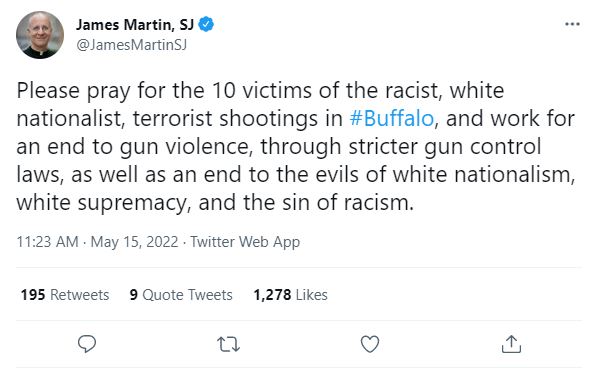
First up on our list is the tweet from noted Jesuit James Martin (you know he’s a Jesuit by the “SJ” listed after his name, SJ standing for “Society of Jesus). Martin calls for prayers, “for the 10 victims of the racist, white nationalist, terrorist shootings.” Christians, of course, are not called to pray for the dead. But this is a teaching of the Roman Church-State.
Martin then goes on to call, “for an end of gun violence, through stricter gun control laws.” This an example of the erroneous approach to criminal justice known as “crime prevention.” The idea is that you regulate – that is, you punish – everyone in advance in hopes of preventing some future criminal action. An extreme form of this unbiblical approach to criminal justice was depicted in the dystopian science fiction movie Minority Report based on a short story by Philip K. Dick. In that movie, a Department of PreCrime would arrest people for crimes that they supposedly were going to commit based upon visions of the future by individuals known as pre-cogs.
But Scripture does not countenance crime prevention. The Scriptural approach to criminal justice is crime punishment, and idea which Martin, at least in part, rejects. In a 2020 article in America Magazine (America is a publication of the Jesuits), Martin approvingly wrote of Pope Francis decision to change the Church’s teaching on capital punishment. According to Martin, in his encyclical “Fratelli Tutti,” Jesuit Pope Francis “placed the full weight of his teaching authority behind this statement: The death penalty is inadmissible, and Catholics should work for its abolition.” Put differently, Pope Francis, James Martin, and the Roman Catholic Church-State (RCCS) generally have committed themselves to subverting justice in all the nations of the world.
Perhaps one motive for the Catholic Church’s desire to subvert criminal justice is the horrifying numbers of murders that historians have laid at the feet of Rome. Scholars have attributed differing numbers of murders to Rome. One of the more conservative figures this author has seen is found in John Dowling’s book The History of Romanism. Writes Dowling, “From the birth of Popery in 606, to the present time, it is estimated by careful and credible historians, that more than Fifty Millions of the human family, have been slaughtered for the crime of heresy by popish persecutors, and average of more than forth thousand religious murders for every year of the existence of Popery” (541-42).
So while on one hand Martin attempts to short-circuit Biblical justice that calls for executing murders, on the other hand, he seeks to punish all Americans by taking away their God-given, Second Amendment guaranteed right to keep and bear arms. That’s very Jesuitical of him indeed. And Marin is hardly the only Jesuit of this opinion. Podcaster Christopher Pinot has discussed on his podcast how the Jesuits have advocated banning even handguns such as 9mm pistols. It seems that their goal is to strip Americans of all their firearms. Now why would they want to do that.
Martin denounces “the evils of white nationalism, white supremacy, and the sin of racism,” but does not tell us what he means by these terms. Perhaps he defines them elsewhere. I don’t know. But given the sloppy way such terms as “white nationalism,” “white supremacy” and “racism” used, given the social justice bent of Martin’s tweet and of the Jesuits generally, and given the Jesuit practice of mental reservation, he may mean something very different by these terms than do his readers.
Former Supreme Court justice John Paul Stevens has written a most remarkable editorial in today’s New York Times. I hope to do a video on his piece later this week, but for now I’d like to share with you this pearl of wisdom from Stevens. He wrote, “For over 200 years after the adoption of the Second Amendment, it was uniformly understood as not placing any limit on either federal or state authority to enact gun control legislation” (emphasis mine).
Well, I’m certainly no legal eagle. I’ve never so much as been to law school, let alone sat as judge on the highest court in the land. But for all that, I do understand the English language and I beg to different with Justice Stevens.
You see, there’s this little thing called the Second Amendment, and it reads
A well regulated militia being necessary to the security of a free state, the right of the people to keep and bear arms shall not be infringed (emphasis mine).
Now my dictionary gives the following definition of infringe: “Violate, transgress, encroach.” For infringement it gives: “an encroaching or trespass on a right or privilege.”
To put in another way, the Second Amendment prohibits the Federal Government from violating, transgressing, encroaching, or limiting the right of the American people to keep and bear arms. Just what part of “shall not be infringed” does this addled former Justice not understand?
“I know and am convinced by the Lord Jesus that there is nothing unclean of itself,” wrote the Apostle Paul to the Romans. The context of these words from Romans 14:14 was a treatment about the proper Christian attitude toward, and use of, food. In particular, it centered around the controversial topic of food sacrificed to idols. Some Christians had no problem with eating it. For others, it was a major stumbling block.
Paul’s point was that meat, even if it had been sacrificed to idols, was simply meat. A Christian could eat of it and be blameless. But not all Christians saw it that way. Some believers saw eating such meat as sinful. Concerning these individuals, Paul wrote, “but to him who considers anything to be unclean, to him it is unclean. That is to say, if a Christian was convinced that the act of eating meat sacrificed to idols was a sin, then it would be a sin for him to do so.
This passage is one of the clearest proof texts in Scripture showing that things in themselves are neither good nor evil – “there is nothing unclean of itself,” but rather that good and evil reside in the heart of the man.
Jesus made this same point when answering his disciples about a question they had about one of his parables. He said to them, “Are you thus without understanding also? Do you not perceive that whatever enters a man from outside cannot defile him, because it does not enter his heart but his stomach, and is eliminated, thus purifying all foods?…What comes out of a man, that defiles a man. For from within, out of the heart of men, proceed evil thoughts, adulteries, fornications, murders, thefts, covetousness, wickedness, deceit, lewdness, an evil eye, blasphemy, pride, foolishness. All these evil things come from within and defile a man” (Mark 7:18-23).
Because some people misuse food does not make food bad in itself. Sex is not inherently evil because some men are fornicators and adulterers, nor is language itself wicked because some men are deceivers and blasphemers. Scripture does not seek to ban any of these things. What it does do is to define what constitutes the lawful and the unlawful use of them.
What is true of food, sex and language is also true of guns: They are neither good nor evil in themselves; rather, it is the thoughts and intents of the heart that make their use right or wrong.
One man uses a gun to defend his family and property from a home invader; another uses it to rob a bank or to shoot up a school. Those who seek to ban private citizens from owing and using guns argue, contra Jesus and Paul, that the problem lies with the thing itself, not with the evil thoughts of evil men.
It’s an old saying, but one that holds true, guns don’t kill people, people do.
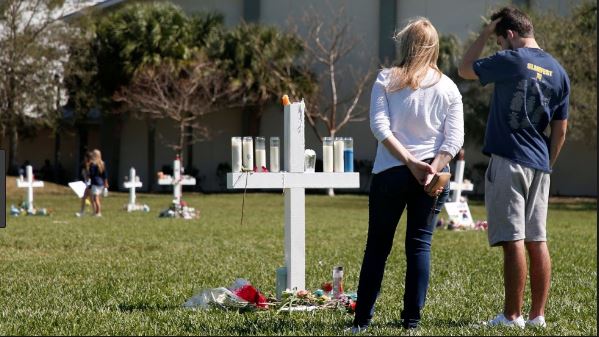
Mourners look at a memorial for the victims of the Marjory Stoneman Douglas High School shooting, in a park in Parkland, Florida on February 16, 2018. A former student, Nikolas Cruz, opened fire at the Florida high school leaving 17 people dead and 15 injured. / AFP PHOTO / RHONA WISE
In light of the well-organized, well-funded, and unprecedented attacks on the Second Amendment and on its supporters in recent days, it seemed good to me to set down a few inconvenient truths relating to the right to bear arms and the causes of mass shootings
True, the argument has been around for a while. I remember it being used back in the day when I was a kid, but that doesn’t make it tired. In fact, it may be one of the most important truths to bring up in any discussion about the Second Amendment.
Guns are inanimate objects. They have now will of their own, no moral agency. In themselves, they are neither good nor evil. Guns are tools as are hammers, baseball bats and pickup trucks. And just as hammers, baseball bats and pickup trucks can be used for both good and evil, so too can guns.
Neither good nor evil reside in the gun, they reside in the heart of the person using the gun.
The Huffpo calls this point obvious. But is it? It’s fair to say that it should be obvious, but given the rush to restrict or outright ban gun ownership by certain groups following the school shooting in Parkland, FL, I’m not so sure it is.
If it were obvious, it should be equally obvious that stripping citizens of their right to bear arms is not the proper response to mass shootings. Yet the gun grabbers have never been more shrill in their demands to limit, or completely eliminate, Americans’ Constitutionally guaranteed right to own guns.
“There ought to be a law to banning ‘X’ to ensure that ‘Y’ never happens again,” on the other hand, really is a tired response to tragedy, but that doesn’t stop people from making the argument.
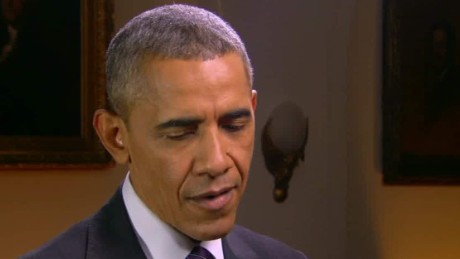
Barak Obama calls for new “common sense” gun laws in the wake of the shootings in San Bernardino, 12/2/15.
It is, I believe, a chronic disease of the political class, this boring and predicable clamor for new laws, “to ensure this sort of thing never happens again!” every time a disaster or tragedy strikes. Really, it’s almost like a twisted sort of reflex arc.
The latest example of this is President Obama, who, showing himself a true devotee of Winston Churchill’s maxim “never let a good crisis go to waste,” could be found calling for more “common sense” gun laws almost before the echoes of the shootings in San Bernardino had died away.
In this case, “common sense” was defined by Obama as passing a law to prevent those on the “No Fly List” from owning fire arms. This sounds reasonable enough, until you realize that getting on the “No Fly List” requires no due process – the federal government can arbitrarily put you on it, no explanation needed – and having your name removed can be almost impossible. What kind of man considers it “common sense” to deny Second Amendment rights to an American citizen already the victim of a lawless federal government Star Chamber? Methinks he shows the heart of a tyrant. .
But beyond the issue of due process, as important as this topic is, there’s another problem with crying “there ought to be a law” every time something bad happens: the idea of the regulatory state itself.
There are two basic approaches to dealing with crime: crime punishment and crime prevention. The Biblical and historic American approach is that of crime punishment. According to the apostle Paul, the job of the civil magistrate is, “to execute wrath on him who practices evil.” Note well, Paul does not say it is the place of the magistrate to regulate everyone in the hope of preventing a crimes, but to punish those who actually commit them.
In like manner, the law of Moses is set up to address how to handle cases where a violation of the law has occurred, not to prevent it from happening. For example, Deuteronomy 19:5 provides direction on how to deal with the case of a man who accidently kills his neighbor while chopping wood. In the event the head slips from a man’s ax and, “strikes his neighbor so that he dies,” the Bible indicates that he should flee to a city of refuge, so that he is not killed by the dead man’s avengers.
But while the Bible is very specific on how to handle a case of this sort, it makes no provision for an Israelite Department of Ax Inspection whose job was to harass farmers and level fines on them if their tools were not up to government standards.
To all the busybodies, regulators, snoops and scolds among us, the answer is, no, there ought not to be a new law. No now. Not ever. We’re already choking on the ones you’ve passed. And as for Obama, we can only hope he would change his tired old tune. But I wouldn’t count on it.





 Former Supreme Court justice John Paul Stevens has written a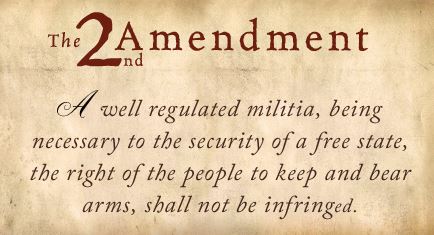

 Lux Lucet