“Like the Sun Going Down on Me” by Timothy F. Kauffman. In this article, Tim Kauffman lays out his view that the apparitions of “Mary,” including Our Lady of Guadalupe on which the Catholic church builds so much of its ungodly immigration doctrine, are the Second Beast described in Revelation 13 and the False Prophet of Revelation 19.
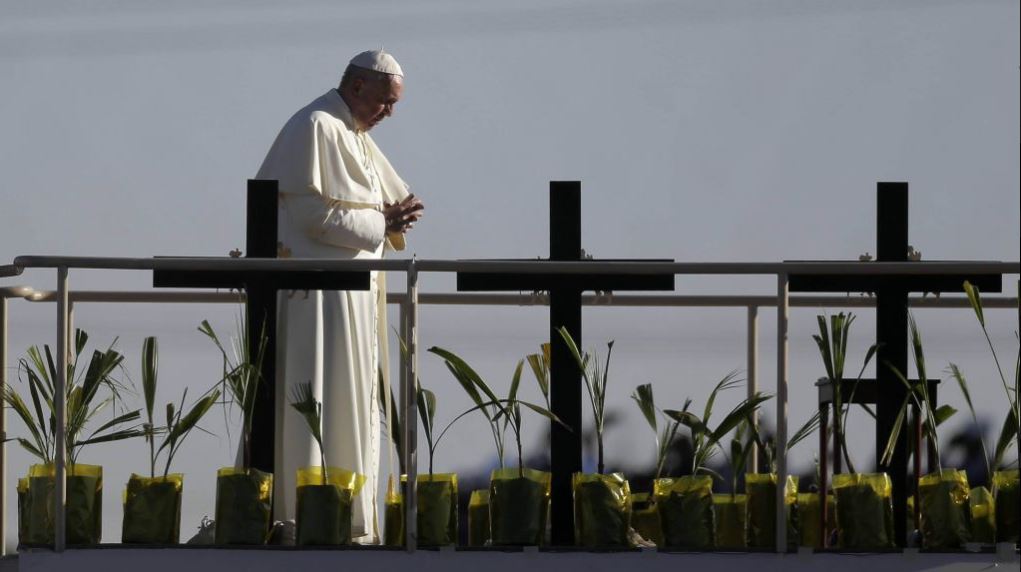
Pope Francis stands on an altar facing the U.S. before celebrating Mass during a February 2016 trip to Juarez. A mere five years later, America’s second Roman Catholic president unleashed a border invasion the likes of which America had never seen. Photo: Robin Zielinski/Las Cruces Sun-News.
Strangers No Longer: Together on the Journey of Hope (SNL) is the title of a 2003 pastoral letter issued jointly by the United States Conference of Catholic Bishops (USCCB) and their counterparts in Mexico. We will now turn to an analysis of this document.
In his 1984 book American Democracy & the Vatican: Population Growth & National Security, author Stephen D. Mumford noted, “Americans…are also aware that 90 percent of all illegal immigrants are Roman Catholic.”[1] Granted, these are old numbers and may not reflect the current religious affiliation of the millions of illegal aliens who have entered the United States during the Biden Administration. Nevertheless, Roman Catholics remain a significant portion of the aliens, legal and illegal, currently pouring across America’s borders.
Drawing on the dogmas outlined in Pope Pius XII’s 1952 Apostolic Constitution Exsul Familia Nazarethana, SNL can be seen as Rome’s irredentist battle plan to conquer America for the Roman Church-State using illegal immigration as one of its principal weapons. Rome’s approach to illegal immigration can be summarized thus: get ‘em in, keep ‘em in, put ‘em on the dole, legalize ‘em.
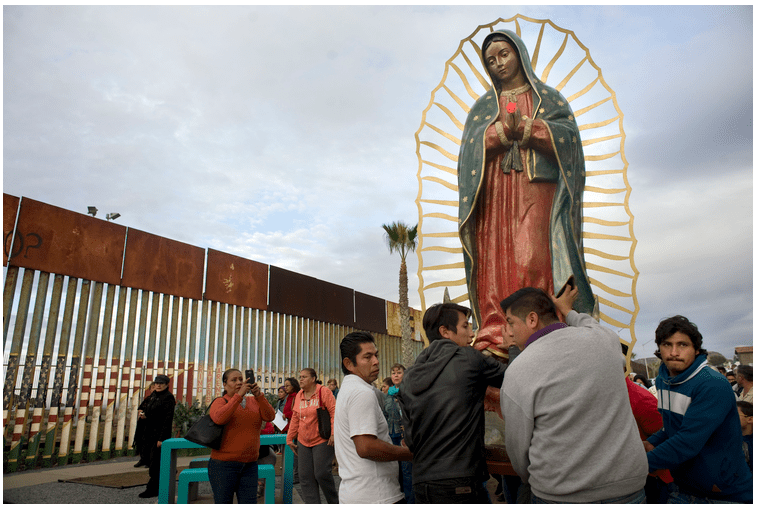
Idol of Our Lady of Guadalupe on America’s southern border
And have no fellowship with the unfruitful works of darkness, but rather reprove them.
Ephesians 5:11
Is it logically possible to hold to Rome’s theology while at the same time rejecting her politics and economics? Many American Roman Catholics, some of whom may be more Protestant in their thinking than they realize, would answer yes.
Writing in his 1999 book Ecclesiastical Megalomania, John Robbins gave the opposite answer. In the Introduction of his book, Robbins noted that Rome’s pronouncements on politics and economics were not, “disjointed statements, but the logical conclusions of premises accepted in Roman theology.” Put another way, if someone accepts Rome’s theology, he logically must also accept Rome’s politics and economics.
Rome’s theology, politics, and economics are part of a “package deal” as Robbins put it, and one does not have the option of following Rome in its theology while at the same time rejecting its political and economic philosophy. “This,” Robbins commented, “flies in the face not only of the claims of the Church-State itself but of reason as well.
I bring up this point as today, December 12, marks the date on which the Church-State celebrates the Feast Day of Our Lady of Guadalupe. According to one article in the America Magazine, a Jesuit publication, Our Lady of Guadalupe (OLG) “remains a cherished part of Mexican national identity.” Another piece in America magazine gives several other titles OLG is known by: Nuestra Señora de Guadalupe, La Virgen de Guadalupe, Empress of the Americas, and Our Lady of Tepeyac.
Here’s one interesting item of OLG trivia from one of the America Magazine articles. Juan Diego, the fellow to whom the demon in the form of Mary is said to have first revealed herself, may never have existed. Despite his possible non-existence, he was canonized anyway in 2002, “as part of a strategy to retain indigenous Catholics in Mexico and across Latin America who have been defecting in droves to Protestantism, especially Pentecostalism.”
In one way, this really isn’t surprising. Rome makes up stuff all the time and has done so for centuries. Still, to come right out and say that “there is no hard evidence St. Juan Diego ever existed” while at the same time canonizing him is a bit shocking. Apparently, the Church-State really is running scared that it’s losing its centuries-long grip on “indigenous Catholics in Mexico and across Latin America.”




 Lux Lucet