Feeds:
Posts
Comments

Posts Tagged ‘Immigration’

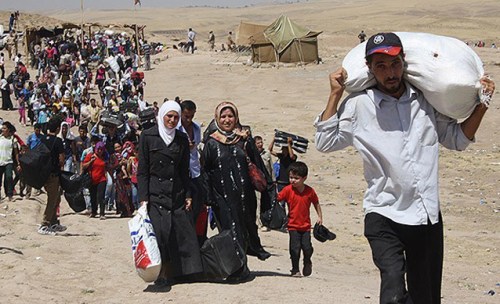
Syrian refugees

Syrian refugees


The uproar surrounding how to deal with the waves of Syrian refugees surging through Europe and the US reached a new high this past week, with several governors and Republican presidential candidates pushing back on President Obama’s refugee resettlement plan. While opinions on how to handle this situation run hot, what generally is not well understood is what caused the crisis in the first place. It is well worth asking, why is it that so many people just now have decided to flee an ancient nation dating back to the time of the Old Testament?

Regime Change Blowback

Since the end of WWII, the US federal government has engaged in what amounts to a high-stakes, global game of thrones, overthrowing regimes its views as hostile to perceived US interests and installing compliant puppet rulers who will go along with the State Department/CIA program. In short, the US has acted less like a republic and more like a global empire, which indeed it has become. And, as was the case with its imperial predecessors, imperial Washington sees nothing wrong with this high-handed policy. It’s just business as usual.

Bashar Assad

Bashar al-Assad, President of Syria


The situation in Syria is just one of the more recent examples of this long-standing policy. Since the Syrian civil war began in 2011, the US has supported the Free Syrian Army, a rebel group attempting to overthrow the government of Syrian president Bashar al-Assad. According to an article the New York Times, “Under the administration’s division of labor, the State Department is in charge of supplying nonlethal aid, while the C.I.A. runs a covert program to arm and train the Syrian rebels.”

(more…)

Read Full Post »

Pope Francis_Unholy MixThe past five days have seen the citizens of the United States subjected to a most extraordinary propaganda campaign. As the result of pope Francis’ visit to Washington D.C., New York and Philadelphia, the airwaves and newspapers of our nation have been filled with countless images of and reports on the pope’s activities, nearly all of which serve to cast Francis and his church in the most positive light possible. If it wasn’t clear before, it should now be abundantly evident to anyone, Catholic or not, that the mainstream media in this country is more than willing to prostitute itself as a megaphone for the Man of Sin. This shouldn’t be surprising. The Roman Catholic religion is designed and built to appeal to the flesh, and papal pomp certainly makes for good television.

But for all its gaudy appeal, Rome lacks that most important mark of a true church of God: the Gospel of Jesus Christ, Justification by Faith Alone. All Rome’s smells, bells, mitres, and masses put together cannot save a single soul. They cannot do so much as remit the guilt of a single sin. It is the righteousness of Christ alone imputed to believers by faith alone that saves sinners from death eternal. But this Rome flatly denies. And not only that, but it actually curses and damns all who believe this simple truth. The Roman Catholic Church-State is a false spiritual harlot of a church, teaching a false faith plus works non-gospel, presided over by the Son of Perdition himself. And yet this Babylonian Harlot-drunk-with-the-blood-of-the-saints institution is lifted up by the American press as representative of the best of Christianity. Watching this spectacle is enough to prompt any thinking Christian to repeat the words of the apostle John, who, when confronted with the vision of the Whore of Babylon, was astonished, declared, “And when I saw her, I marveled with great amazement.”

(more…)

Read Full Post »

The Bible and Immigration: A Few Preliminaries

Your people shall be my people, and your God, my God. (Ruth 1:16)


Immigration. Mention the word in conversation and you’ll likely find few people lacking an opinion on the topic. It’s a hot button issue and one badly in need of a Scripturalist analysis. In the past I have made abortive attempts to write on immigration, but found the results unsatisfactory and thought it best to lay off the topic until I had the chance to do further study.

As if my ignorance weren’t enough of a hindrance, my plans to write on immigration have been further hindered by the bane of many an amateur scholar and blogger: a lack of study time. Work and school combined to play havoc with my schedule, but even so, I have had some opportunity to read and reflect on the subject. In light of this, it seemed best to at least get a few thoughts down in writing, if only as a starting point for further development.

One thing that has impressed me in my admittedly brief survey of Christian literature on the immigration: the lack of sound scholarship on the subject. This is disappointing. The world is in search of answers on the question of immigration, but Christians, who of all people should be able to provide the needed answers, are largely absent from the discussion. And what work they have done is, for the most part, not of high quality. For instance, in June 2011 the Southern Baptist Convention issued a resolution titled Immigration and the Bible, which the SBC leadership intends to serve as a framework for solving the immigration problem. Unfortunately, while I am sure the framers of the resolution meant well, their efforts miss the mark. For while this resolution is put forth as the answer to the nation’s immigration problem, in reality it addresses only the problem of undocumented workers already in the US, while failing completely address what caused that problem in the first place: a broken immigration system badly in need of reform. In other words, they have offered the American people a band aid when it needs radical surgery. For example, the resolution states,
(more…)

Read Full Post »

When discussing immigration, the conversation usually revolves around immigrant rights.  Rarely is the subject of immigrant responsibilites ever broached.  But what do the Scriptures say?  Do immigrants have responsibilites?  If so, what are they?  To help answer these questions, let’s consider the example of Ruth, one of the clearest examples of immigration in the Bible.

Elimelech and Naomi were a Hebrew couple, natives of Bethlehem, who had fled from Israel to escape a famine then gripping the land.  Along with their two sons, they settled in the neighboring land of Moab.  AFter their arrival Elimelech died, leaving Naomi and her two sons, both of whom married Moabite women.  After about ten years, both the sons died as well, leaving Naomi alone with her two daughters-in-law.   When Naomi set out to return to Israel, she urged her daughters-in-law to return to their people.  One, Orpah, did so.  But the other, Ruth, upon being prodded to return to Moab , answered Naomi,

Entreat me not to leave you, or turn back from following after you; for wherever you go, I will go; and wherever you lodge, I will lodge; your people [shall be] my people, and your God, my God.     Where you die, I will die, and there will I be buried.  The LORD do so to me, and more also, if [anything but death] parts you and me.    (Ruth 1:16, 17)

The sum of this passage is that Ruth declares her intention to immigrate to Israel.  She is not planning to sojourn in the land, or go there on a short visit and then return to Moab, but rather she emegrates from Moab with the expressed aim of becoming and Israelite.  Very often in discussing immigration, those who use Scripture point to the Bible’s instructions regarding sojourners and strangers in the land, but these passages do not bear directly on immigration.  But the case of Ruth clearly does.  What can we learn about immigration from this passage?

While declaring her intention to immigrate, Ruth takes a threefold oath of loyalty.  She declares her loyalty to Naomi, “wherever you go, I will go,” to the nation of Israel, “your people [shall be] my people,” and to God, “and your God, my God.”  She even invokes God as a witness to her promises, using the familiar oath, “The LORD do so to me, and more also.”  In short, Ruth was not a social revolutionary who sought to impose Moabite language and religion on the people of  Israel all in the name of cultural diversity, but rather she clearly expressed her desire to adopt the ways of the Israelites and become one of them.

From this short study, we see that while the Bible recognizes the right of people to immigrate, neither Naomi nor anyone else questioned the legality of Ruth’s immigration, it also imposes certain responsibilities on immigrants.  Those who argue that immigrants have a right to impose their ways and their costs on the people of their adopted land are not arguing as Christians, but as cultural Marxists and socialists.

Read Full Post »

Immigration Part 1

The debate over US immigration policy has become heated in recent years and shows no sign of going away.  Part of the reason for this is the failure of those engaged in the debate, whatever their position on immigration, to understand and believe what the Bible has to say about the subject.  It may come as a surprise to some to hear that the Bible has anything to say about immigration.  Others may concede that the Scriptures do address the subject, but dismiss their teaching as irrelevant to the present debate.  But the Bible claims to have a monopoly on truth, not just religious or moral truth, but all truth, political truth included.  Let us briefly consider some of its teachings on the subject.

 The debate about immigration is fundamentally a debate about citizenship, to whom does is rightfully belong?  In Scripture there are only two ways in which a man gains citizenship:  birth, and immigration.  This point is illustrated by Paul’s conversation with the Roman commander shortly after his arrest in Jerusalem,

Then the commander came and said to him (Paul), “Tell me, are you a Roman?” He said, “Yes.”

The commander answered, “With a large sum I obtained this citizenship.” And Paul said, “But I was born [a citizen].” (Acts 22:27, 28)

The task, then, for the Christian scholar is to determine how the Bible applies applies the law in both cases. 

The concept of citizenship by birth may seem so obvious as to need no comment.  But there are two different types of birthright citizenship: jus sanguinis (right of blood) and jus soli (right of soil).  In the former case if one’s parents are citizens of a country, their citizenship is passed on to their children because of the blood relationship that exists between parents and children.  On the other hand, Jus soli is the idea that citizenship is conveyed by place of birth.  If a child is born within the territory of a country, the child is considered a citizen on that country regardless of the citizenship status of his parents.  Our question then becomes, does the Bible approve of jus sanguinis or jus soli, or reject both in favor of some other alternative?  While these are interesting questions, ones which I propose to answer, for now I pass them over and will turn in my next essay to the question of what the Bible has to say about immigration.

Read Full Post »

« Newer Posts