Feeds:
Posts
Comments

Posts Tagged ‘Eschatology’

From the sole of the foot even to the head, there is no soundness in it.

Isaiah 1:6

If people think at all about civilizational collapse, they tend to think of the fall of the Roman Empire. Famously chronicled by English historian Edward Gibbon, the fall of the Western Roman Empire in 476 B.C. is considered a red letter date in history. Those who have not read Gibbon may reasonably suppose he stopped his account at that point. But such is not the case. Gibbon was just getting warmed up. From the fall of Rome, he want on the chronicle the rise of Islam in the 6th century and its conflict with, and eventual conquest of, the Eastern Roman Empire. He ended his history with the fall of Constantinople to the Turks in A.D. 1453.

But as impressive as it is, Gibbon’s The
History of the
Decline and Fall of the Roman Empire is not the first or the best account of civilizational collapse. That honor would have to fall to Old Testament, much of which chronicles of The Decline and Fall of the Hebrew Republic. Established in Canaan under Joshua, the Hebrew Republic devolved into a monarchy under
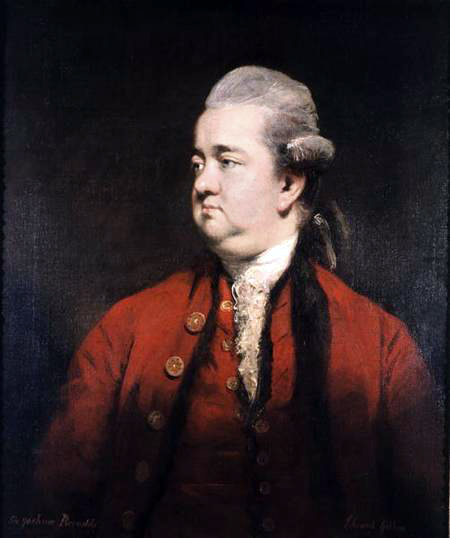
BBC206171 Portrait of Edward Gibbon (1737-94) c.1779 (oil on canvas) by Reynolds, Sir Joshua (1723-92) oil on canvas 73.6x62.2 Private Collection English, out of copyright

Portrait of Edward Gibbon (1737-94) c.1779 (oil on canvas) by Sir Joshua Reynolds (1723-92)

Saul in 1050 B.C., reached the height of its wealth and power under Solomon between the years 970 and 930 B.C., then split into a Northern and a Southern Kingdom under Solomon’s son Rehoboam. From there, the fortunes of the two kingdoms trended downward over the course of several centuries until the fall of the Northern Kingdom to Assyria in 722 B.C. and the final conquest of the Southern Kingdom by Babylon in 586 B.C.

The history of the Decline and Fall of the Hebrew Republic is exceptionally well documented, for it is given to us in the form of God’s inspired, infallible, inerrant Word. As such, we have a perfect record, not only of what took place, but God’s own interpretation of why it took place. One of the problems of secular history is getting the facts straight. But even if a historian were to be given perfect documentation of the period they were studying, there still would remain the issue of interpreting the events. Events do not interpret themselves. Events must themselves be explained. Those problems do not exist with the Old Testament. God has graciously provided to us both the facts and their correct interpretation.

Though many people do not seem to recognize it, we who are alive at the beginning of the 21th century are living through a civilizational collapse, one that has much in common with that experienced by the ancient Israelites and recorded in I and II Kings, I and II Chronicles, and in the prophets. Many of the same ills that beset us in the 21st century are the same as those experienced by the Hebrews in the centuries leading up to the collapse of that nation. But not only are the symptoms the same – moral decline, economic decline, disastrous foreign policy, internal strife – the cause is the same as well. In both cases, the people turned their backs on God and his Word. And just as the Israelites learned that a godly heritage without actual godliness is no protection against disaster, so too are we in the West being taught that that same hard lesson
(more…)

Read Full Post »

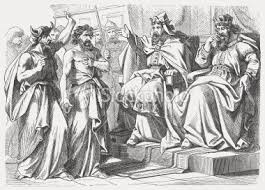
Ahab and Jehoshaphat listen to Michiah.

Ahab and Jehoshaphat listen to Michiah.

“Should you help the wicked,” asked the prophet of the defeated and humiliated king upon his return to Jerusalem, “and love those who hate the LORD?” The prophet was Jehu.  The king was Jehoshaphat.  The occasion was the aftermath of a crushing defeat inflicted by the Syrians on the allied armies of Israel and Judah.

Jehoshaphat was a godly man; one of the few good kings Judah ever had.  But in spite of this, he made a major spiritual and strategic mistake in seeking alliance with Ahab, the evil king of Israel.  I Kings 22 and 2 Chron. 18 provide the details of the alliance.  Jehoshaphat went on a state visit to see Ahab in Samaria, the capital of the northern kingdom.  During the visit, Ahab persuaded Jehoshaphat to join him in a grand alliance of Israel and Judah and to make war against the Syrians, all for the purpose of recapturing for Israel territory that had been lost to Syria earlier.  In other words, it was an Old Testament version of a crusade against the infidel.

Jehoshaphat made several errors that led to his defeat.  The first of which was that he, apparently, did not consult  the Lord before traveling to Israel to meet with Ahab.  The Scriptural record shows no evidence of Jehoshaphat ever seeking the Lord’s counsel as to whether he should go to Samaria.  It appears that he did this on his own.

Jehoshaphat’s second mistake was not heeding the voice of the Lord when it became clear that the military alliance would end in disaster.  The prophet Michiah plainly told Ahab in  Jehoshaphat’s hearing that the offensive against Syria would fail miserably.  His words were, “I saw all Israel scattered on the mountains, as sheep that have no shepherd” (I Kings 22:17).  Jehoshaphat heard all of this, and yet followed Ahab into battle anyway.

In all this, Jehoshaphat also managed to serve as Ahab’s dupe.  Ahab reacted angrily to Michiah’s prophesy of defeat at the hands of Syria, but he had the good sense to hedge his bets.  When Ahab and Jehoshaphat went into battle, Ahab disguised himself, but told Jehoshaphat to wear his royal robes.  Jehoshaphat did so, and nearly lost his life when the Syrians mistook him for the king of Israel, against whom they had been ordered to fight.

(more…)

Read Full Post »

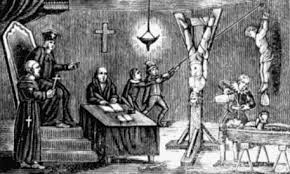
InquisitionIn last week’s post Must Christians Defend the Crusades?, I pointed out a common apologetical error of contemporary Evangelicals.  When the discussion turns to the obvious, gross sins committed by the Roman Catholic Church-State during the course of the Crusades and the Inquisition, rather than taking the opportunity to denounce these activities for what they are the evil fruit of the papal Antichrist, too often Christians implicitly or even explicitly defend them.  Take for example the following video of Southern Baptist minister Dr. Robert Jeffress on the O’Reilly factor from 2/6/15 program.  At about the 2:12 mark Jeffress begins his  comments on the Inquisition.

https://www.youtube.com/watch?v=XVAugy_EBlE

Jeffress’ words were, “The Inquisition lasted 450 years; there were 2,200 people who died.  That’s about 5 a year.  More people died on 911 in one day at the hands of Muslim terrorists than in all of the Inquisition.” In fairness to Jeffress, he is not attempting to argue that the Inquisition was a good thing.  But in his discussion with O’Reilly, Jeffress made at least two critical mistakes.  First, failed to draw any distinction between Roman Catholicism and Christianity, and thus left Evangelicals on the hook for the sins of Inquisition.  Second, he attempted to minimize the evil of the Inquisition, what was one of the most heinous crimes ever carried out by any organization in history.

And this was not some momentary slip by Jeffress.  In his 2/10/15 interview on Fox News with Gretchen Carlson, Jeffress was even more explicit in identifying Christianity with Romanism.  At about the 1:30 mark, he made the following comment, “Christians have done some terrible things in the past, but nothing compared to radical Islam.  For example, the President brings up the Inquisition [Jeffress is here referring to Obama’s comments at the National Prayer Breakfast, the same ones he discussed with Bill O’Reilly].  Did you know that in the 450 years of the Inquisition there were about 2,200 people killed.  That’s about five a year.”  By his claim that, “Christians have some terrible things,” once Jeffress identified the Inquisition with Christianity, thus putting himself and other Evangelicals in the awkward and unnecessary position of having to answer for the sins of Rome.

(more…)

Read Full Post »

« Newer Posts