Feeds:
Posts
Comments

Posts Tagged ‘Apologetics’

Is God FairOld memories, how vivid they can be. I recall quite well when my brother was born. At the time, I was three years old. My first day of kindergarten at Lakeside Elementary school still stands out in my mind. And although it’s been more than 30 years, I remember my last act as a high school senior as though it were yesterday. In my case, I finished a typing test then went to get lunch at the neighborhood McDonalds with a friend.

But there’s something else I remember from my youth. I remember being afraid of Romans 9. It was part of the Bible. That I didn’t question. But Paul’s great chapter on election and reprobation, his teaching about predestination, did not sit well with me. If I looked at the chapter at all, it was with the same sort of apprehension that a man behind in his payments looks and his credit card bill – out of the corner of his eye, hoping against hope that he won’t see what he knows is there.

By nature, I like to think that I’m in charge, the captain of my own ship. And Romans 9 just ran roughshod over all that. “Does not the potter have power over the clay, from the same lump to make one vessel for honor and another for dishonor?” asked Paul rhetorically, clearly demanding a “yes” from his readers. “This can’t be right,” I would think to myself and quickly move on to a more comfortable subject.
(more…)

Read Full Post »

Slavery & Christianity
by John W. Robbins (Unicoi, Tennessee: The Trinity Foundation, 2007, 84 pages).

Slavery & Christianity

Slavery & Christianity

As Christians, we are called to bring every thought into captivity to Christ. That is to say, we are required to judgeallthings by the Word of God. And by doing so, Christians living in the West more and more find themselves at odds with their own societies. To the cheers of just about all the movers and shakers in the US, this summer the Supreme Court of the United States legalized so-called gay marriage in all 50 states.

Many Christian writers have objected to this very clear rejection of the Law of God by citing the Bible. The Bible, they say, condemns homosexuality not only as a sin, but also as a crime. And indeed, they are right in what they say. But arguing from the Bible can be dangerous too. For someone, and it usually doesn’t take very long for this to happen, will be sure to bring up the topic of slavery. “So, you say that the Bible condemns homosexuality,” they will say. “Very well. What about slavery? The Bible support slavery, doesn’t it? After all, Peter tells servants to be submissive to their masters. Even Christian writers have endorsed slavery. The writers of the New Testament were nothing but bigoted, homophobic, misogynist racists. Why should anyone listen to them?” This line of attack is designed to put Christians on the horns of a dilemma. By arguing this way, the opponents of Christianity hope to force Christians into the uncomfortable position either of defending slavery and misogyny, or dropping their Biblical opposition to homosexuality. Too often, this line of questioning reduces Christians to embarrassed silence or incoherence. Chalk up another win for the secularists. Game. Set. Match.

(more…)

Read Full Post »

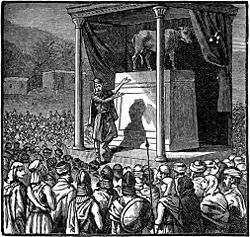
Jeroboam sets up a golden calf.

Jeroboam sets up a golden calf.

Among other things, the Bible is a book of examples. As God’s people, we can be thankful for this. Had he wished, God could have given his bare commandments and left it to us to draw our own lessons. But that’s not what he did. After providing very clear instructions to his covenant people in the Law of Moses, God inspired the writers of the Old Testament to record a detailed and fascinating history of his people. Some of this history was recorded as a warning to future generations. In his letter to the Corinthians, the apostle Paul highlighted several negative examples from the history of Israel and made the point, “Now all these things happened to them as examples, and they were written for our admonition, upon whom the ends of the ages have come” (I Corinthians 10:11).

In a previous post, we looked at two bad examples from the Old Testament, specifically the actions of kings Rehoboam and Jeroboam. In the case of Rehoboam, his was a political failure. Instead of being a servant to his people, he instead chose to lord it over them, answering a reasonable request for lower taxes with a churlish threat to increase them. His arrogance was the proximate cause of the division of the twelve tribes into the Northern and Southern Kingdoms. On the other hand the failure of Jeroboam, the first ruler of the Northern Kingdom, was of an ethical nature. He was charged by the prophet Ahijah to walk in the commandments of God. But Jeroboam, doing what he ought not, was quick to set up an idolatrous religion in the Northern Kingdom, which corrupted the people for generations. At bottom, the failures of both kings were epistemological, for both men rejected the clear commands of God and followed the dictates of their own hearts.

As a follow up to the bad examples, over the next two weeks we will look at two good examples from the Old Testament, one of them a prophet, the other a king. Both of had this in common: they trusted in God, not themselves.

(more…)

Read Full Post »

“Judge not lest you be judged,” is a favorite quote of unbelievers. They delight in hurling them at Christians during an argument. And all too often, these words have exactly the effect intended, that is to reduce the Christian is reduced to silence. After all, are not these words not found in Scripture? Were they not spoken by Jesus himself? The answer to these questions is yes and yes. But do these words really mean, as the unbelievers seem to think they do, that Christians have not basis for making moral judgments? The short answer is no.

My Introduction to Irrationalism

As is the case with most who grow up in church, I was not taught to think rigorously. I recall many years ago asking someone at my church about a passage I did not understand. It seemed to me that there was a contradiction in Scripture, so I asked for an explanation and was given the standard quote from Isaiah 55, saying God’s thoughts and God’s ways are higher than ours. This was then interpreted to mean we just have to accept that some things in the Bible do not and cannot make sense to our finite minds. There are mysteries, tensions, and apparent contradictions in the Bible that finite man simply cannot understand with mere human logic.

I didn’t know it at the time, but this was my introduction to irrationalism. The person with whom I spoke provided me the best answer he knew. I have no reason to believe he had any intention of deliberately misleading me. And yet, mislead me he did. And it would be many years before, by the grace of God, I found my way out of that intellectual cul-de-sac.

(more…)

Read Full Post »

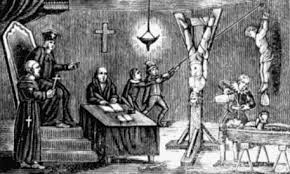
InquisitionIn last week’s post Must Christians Defend the Crusades?, I pointed out a common apologetical error of contemporary Evangelicals.  When the discussion turns to the obvious, gross sins committed by the Roman Catholic Church-State during the course of the Crusades and the Inquisition, rather than taking the opportunity to denounce these activities for what they are the evil fruit of the papal Antichrist, too often Christians implicitly or even explicitly defend them.  Take for example the following video of Southern Baptist minister Dr. Robert Jeffress on the O’Reilly factor from 2/6/15 program.  At about the 2:12 mark Jeffress begins his  comments on the Inquisition.

https://www.youtube.com/watch?v=XVAugy_EBlE

Jeffress’ words were, “The Inquisition lasted 450 years; there were 2,200 people who died.  That’s about 5 a year.  More people died on 911 in one day at the hands of Muslim terrorists than in all of the Inquisition.” In fairness to Jeffress, he is not attempting to argue that the Inquisition was a good thing.  But in his discussion with O’Reilly, Jeffress made at least two critical mistakes.  First, failed to draw any distinction between Roman Catholicism and Christianity, and thus left Evangelicals on the hook for the sins of Inquisition.  Second, he attempted to minimize the evil of the Inquisition, what was one of the most heinous crimes ever carried out by any organization in history.

And this was not some momentary slip by Jeffress.  In his 2/10/15 interview on Fox News with Gretchen Carlson, Jeffress was even more explicit in identifying Christianity with Romanism.  At about the 1:30 mark, he made the following comment, “Christians have done some terrible things in the past, but nothing compared to radical Islam.  For example, the President brings up the Inquisition [Jeffress is here referring to Obama’s comments at the National Prayer Breakfast, the same ones he discussed with Bill O’Reilly].  Did you know that in the 450 years of the Inquisition there were about 2,200 people killed.  That’s about five a year.”  By his claim that, “Christians have some terrible things,” once Jeffress identified the Inquisition with Christianity, thus putting himself and other Evangelicals in the awkward and unnecessary position of having to answer for the sins of Rome.

(more…)

Read Full Post »

« Newer Posts