Feeds:
Posts
Comments

While reading Augustine’s Confessions, I came across a passage where he discussed his beliefs while an adherant of Manichaeism.  The Manichaeans emphasized the the immanence of God, that is, they believed the whole universe, every rock, every tree, every blade of grass was permeated by God.  For someone who holds this position, it’s only logical to see any act of farming or commercial development a great evil and affront to the divine nature. 

While  a  Manichaean, Augustine believed the mere act of plucking a fig resulted in the weeping of both the fruit and its mother tree.  Looking back many years later as a Christian, he described his earlier beliefs as,  “nonsense,” stating,

And I believed (wretch that I was) that more mercy was to be shown to the fruits of the earth, than to men for whose use they were created.

As a Manichaean, Augustine held to a superstitious reverence for the earth and its fruits.  As a Christian, he came to understand that the earth and all its fruits were given to men by God, that the earth was made for man, not man for the earth. 

What is striking about this passage is how much our modern environmentalists resemble the Manichaeans.  The folks meeting in Copenhagen all seem to think that the good of mankind ought to be subordinated to holy mother earth and are prepared to impose this position with draconian laws and regulations.  And like the Manichaeans, their errors can be traced to their ignorance or outright rejection of what God has said about creation and man’s relationship to it.  They should take a cue from Augustine who came to his senses sixteen hundred years ago.

Government is instituted, not in order to seek its own profit at the expense of its subjects and to exercise its self-will on them but in order to provide for the best interests of its subjects.

– Martin Luther

In his book Christ & Civilization , John Robbins argues that the freedom and prosperity which characterize Western civilization have their roots, not in the political philosophy of ancient Greece and Rome, not in the teachings of the Roman Catholic Church, but in the system of ideas found in the Bible.  What we call Christianity. 

One of the most significant  political ideas found in the Bible is the notion of the servant leader.  In Christian political thought, the governing authorities exist to serve the individual.  Of course because of sin, the world generally gets this exactly backward, tyrannically asserting that individuals exist to serve the polis, volk, or state.  In the words of Christ,

You know that the rulers of the Gentiles lord it over them, and those who are great exercise authority over them.

When we think of tyranny and rulers lording it over their people, it’s natural to call to mind the regimes of men such as Nero, Hitler or Stalin.  But tyranny has more subtle forms as well, one of which is central banking.  In the United States, this activity is carried out by the Federal Reserve, the central bank of the United States.  The activities of this organization affect the lives of every single person in the country, yet it arrogantly takes the position that it’s under no obligation to tell anyone what it does, instead demanding implicit faith in its wisdom to set monetary policy and manage the economy.  What is worse, there are many within the government and the financial community who agree. 

This financial tyranny, this lording it over people, is radically un-American. 

Continue Reading »

In this CNB Squawk Box interview, Ron Paul continues to press his case for an audit of the Federal Reserve. But with the exception of Rick Santelli, he is opposed by all of the panelists.  An audit, they say, is a threat to the independence of the Federal Reserve and will hamper its ability to effectively manage the dollar and the economy.

These poor folks just don’t get it.  But Paul counters their argument and exposes its foolishness by commenting that when people talk about Fed independence, “what they’re really talking about is secrecy.  What I’m talking about is transparecy.” 

There’s nothing in Paul’s bill (now admendment) that would involve Congress in monetary policy. Paul’s aim is to enable people to see what’s being done with their money, and the Wall Street community doesn’t like it.

Boo hoo.

Vodpod videos no longer available.


more about “Paul: Audit the Fed – CNBC.com“, posted with vodpod


CanThePresChurch Can the Presbyterian Church in America be Saved? by Sean Gerety.  The Trinity Foundation, 158 pages.  $9.95. 

The Presbyterian Church in America (PCA) is in trouble.  In many of the denomination’s churches, the central teaching of Christianity – which is that sinners are saved by believing the Gospel of Jesus Christ apart from any good works performed by them – is being supplanted by a clever substitute called the Federal Vision (FV) or New Perspective on Paul (NPP) that defines saving belief in such a way that it includes good works.  Of course attacks on salvation by belief alone are not new within the church; read Paul’s epistle to the Galatians for an account of this very thing in the first century.  The Roman Catholic Church-State, the largest visible church on earth, would later suppress this doctrine, also known as justification by faith alone, for a thousand years.  In the sixteenth century, salvation by belief alone was the central issue at stake in the Protestant Reformation.  Men such as Martin Luther and John Calvin –  correctly distinguishing between justification and sanctification, between a sinner being declared righteous by God and the process of that sinner becoming more like Christ – understood and taught that good works contribute precisely nothing to salvation but are the fruits of salvation already accomplished. That much of the PCA , an heir of the Reformation, could fall away from sound Gospel teaching is a remarkable thing.  How did the PCA get into such a mess?  Is there any hope of it getting out?  These are questions Sean Gerety addresses in his new book Can the Presbyterian Church in America be Saved?            

Gerety’s crisply written book (the main body of the text is a brief 88 pages) falls into three main sections: 1) a discussion of the Report of Ad Interim Study Committee on Federal Vision, New Perspective, and Auburn Avenue Theology adopted by the PCA in 2007, 2) an analysis of how Van Tilian epistemology and apologetics have undermined the ability of many PCA church officers to respond effectively to the Federal Vision challenge, and 3) a refutation of key errors used by Federal Vision (FV) supporters to advance their ideas.  A brief conclusion follows. Continue Reading »

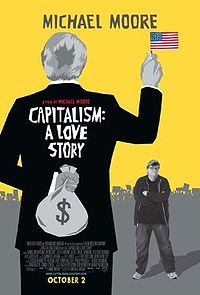
Capitalism_a_love_story_poster

Capitalism:  A Love Story.  Michael Moore director.  2 hours and 6 minutes. Rated R for strong language.

Michael Moore wants you to know two things about Capitalism:  1) it’s evil and 2) he hates it.  Moore makes both points abundantly clear in his latest, ironically titled film Capitalism: A Love Story.  That Moore would disapprove of capitalism came as no surprise to me; I expected as much.  But the degree of blatant anti-capitalist hostility manifested in this film left me shocked.  In a way, that’s to Moore’s credit.  He’s willing to clearly speak his mind on the subject, and I can respect that.  This is preferable by far to listening to men who would bore us with ambiguous words designed to hide their true beliefs.  But for all that, in this film Moore also shows himself to be a deeply confused man. He seems not to have a clear idea of what capitalism is, and being unsure of his target, he ends up savaging capitalism for sins properly attributed to socialism, and praising socialism for benefits brought by capitalism. 

Moore’s position on capitalism is evident from the film’s opening, where he presents the viewer with a collection of still photos of bank robberies.  What could such pictures possible have to do with capitalism?  Really, it’s not hard to figure out.  You see, in Moore’s world, capitalism is robbery, or as he states later in the film, “capitalism is a system of giving and taking, mostly taking.” Capitalism, Moore believes, is theft and thoroughly corrupt at the ethical level.  This notion he defends, not by presenting a coherent argument, but through anecdotes such as: families losing their homes to foreclosure, an outrageously sleazy real estate agent buying condos on the cheap, teenagers who were thrown in juvenile detention to make money for a private prison contractor, a  sit-down strike at a Chicago window factory, and the little known corporate practice of buying life insurance policies on rank and file workers, also known as dead peasant insurance.  Of course, none of these anecdotes prove capitalism evil, but they can sway many people by appealing to their emotions. Continue Reading »

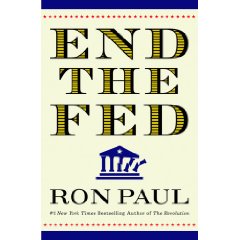
End the Fed                                                                                                          

End the Fed by Ron Paul.  212 pages. Grand Central. $21.99.

Ron Paul has always been something of a political misfit.  An eleven term Republican congressman from Texas, he’s labored most of his career in obscurity, only recently achieving national prominence on the strength of his 2008 bid for the Republican presidential nomination.  The reaction to Paul’s campaign by both voters and media alike was a curious mixture of perplexity, enthusiasm and scorn.  His pro-life, pro-gun positions certainly resonated with many values conservatives.  Fiscal conservatives  no doubt appreciated his small government rhetoric, accompanied as it was by a congressional voting record so hostile to new taxes and regulations that Paul, a physician by trade, earned himself the nickname Dr. No.   And yet during the campaign, Paul often found himself at odds with many of these same conservatives.  His denunciation of the Bush administration’s undeclared war in Iraq got him booed at the 2007 Values Voter Presidential Debate, and for the same reason he was openly rejected by major figures in the Republican party and conservative media.  How, people wondered, can Paul be so conservative and so liberal at the same time?  He appeared full of contradictions.  In reality, there was no contradiction among Paul’s positions, but instead a remarkable underlying consistency.  For Paul, as he says of himself on his congressional website, “never votes for proposed legislation unless the measure is expressly authorized by the Constitution.” Paul’s stand on abortion, guns and war is governed by what the Constitution says on these issues, not by the changing winds of popular opinion.  But public opion, even among self-described conservatives, has drifted so far from constitutional moorings that consistent arguments based on the Constitution sound strange to contemporary listeners.    

While his opposition to Bush’s War on Terror garnered Paul a great deal of attention and no little animosity during the campaign, it was not his sole, or even main focus.  Paul was and is one of the best informed members of Congress on a wide range of issues, but his area of speciality is monetary policy.  Considered a rather wonkish and eccentric subject by many, the Federal Reserve Bank’s (the Fed) monetary policy had long been an object of Paul’s criticism.  Paul, as his Constitutionalist philosophy demanded, was an advocate of hard, commodity money, a position often identified with the gold standard.  As a member of the House Financial Services Committee, Paul grilled Fed chairmen such as Alan Greenspan and Ben Bernanke for many years, asking pointed, informed questions of them while others were lobbing softballs.  And while Paul would question and criticize the Fed chairmen on this or that point, ultimately it was not individual Fed policies to which he objected, but the very existence of the Fed.  For long time Paul admirers such as myself, this always made his C-SPAN head to heads with Greenspan and Bernanke must see TV.  But aside from the entertainment value of watching Fed chairmen squirm under Paul’s questioning, these House Committee meetings were serious affairs.  For the power of those chairmen was awesome, and their decisions affected the lives of every single person in the country in ways few people understood.  But while they were no small matter, the Fed’s activities remained out of sight and out of mind for most Americans.  

All that changed in the fall of 2008. Continue Reading »

Last night I watched Sean Hannity interview two women identified as protesters at the G20 (Group of Twenty) meeting in Pittsburgh.  It was a revealing interview.  Hannity took the approach that the protests were a clash between the good guy forces of capitalism, represented by the G20, and a bad guy cabal of liberalism, represented by the protesters.  The protesters viewed themselves as proud socialists combatting the immoral forces of capitalism.  Neither side understood the issues at hand.  

Hannity’s notion that the G20 represents capitalism is a joke.  According to its own website, the G20 is made up of the Finance Ministers and Central Bank Governors of, “important industrialized and developing economies.”  In other words, the G20 is an international gathering of the same Keynesian monetary cranks, including our own “Helicopter” Ben Bernanke,  who’ve done so much to bring the West to the brink of financial collapse.  The governing philosophy of this group is fascism, not capitalism.  

One of the protesters censured capitalism for putting profits ahead of people, citing as an example American health insurance companies that seek profits by denying medical services to patients.  But any resemblance between the American health care industry and capitalism is, as they say, purely coincidental.  With the doctors union, the AMA, limiting the number of medical providers, with governmental regulations and subsidies driving up costs, the health care industry is one of the most socialized, least free segments of the American economy.  In fact, the problems that we’re having with health care in this country can be traced, not to the existence of profit seeking by health care providers, but to the lack of capitalism in the industry.

Hannity also mentioned that the G20 protesters were at times violent and he asked the women if they condemned the acts of vandalism that had taken place in the Pittsburgh marches.  They didn’t.  No Christian can support them in this.  However, one of them raised an interesting question with Hannity, asking him if he condemned the acts of violence committed in Iraq, Afghanistan and Pakistan.  By this question, she apparently was referring to acts of violence committed by the US military in those countries.  Hannity replied that there was no moral equivalence between what the US military did and the actions of the protesters.  He’s right, of course.  By waging wars of aggression on behalf of the US federal government, the American military has committed acts of violence far worse than anything done by the protesters, and those who have committed these acts must bear the guilt for them.  This guilt is shared by those who, like Hannity,  provide intellectual justification for the immoral doctrine of preemptive war.

In the end, neither side understood the issues, for neither side took counsel in God’s word.  The wisdom of this world, whether conservative or liberal,  is foolishness.

It’s because of  interviews like this that investor Jim Rogers is a capitalist hero.  To the stunned disbelief others on the panel and against all consensus opinion, he makes the case that the US government acted properly last September in allowing Lehman Brothers to go bankrupt.  Furthermore, he argues, the Feds should have allowed market forces to take down all of Wall Street’s incompetent financial  institutions. 

Another featured guest, Julian Pendock, lamely argues that, while some banks needed to fail, we just couldn’t have allowed them to fail all at once.  How many banks should have failed, he doesn’t say.  Over how long a period these bankruptcies should have been allowed to occur, he doesn’t say.  What he does say is that what’s needed is more bank regulation. 

Rubbish. 

Capitalism is the economic system of the Bible.  And capitalism says that when somebody mismanages his assets, you let him fail,

Then he who had received the one talent came and said, ‘Lord, I knew you to be a hard man, reaping where you have not sown, and gathering where you have not scattered seed.  And I was afraid, and went and his your talent in the ground.  Look, there you have what is yours.’  

and suffer the consequences of his actions,

But his lord answered and said to him, ‘You wicked and lazy servant, you knew that I reap where I have not sown, and gather where I have not scattered seed.  So you ought to have deposited my money with the bankers, and at my coming I would have received back my own with interest.  So take the talent from him,

 and give the assets those who act prudently,

and give it to him who has ten talents.  

This is God’s justice, both sure and swift,

For to everyone who has, more will be given, and he will have abundance; but from him who does not have, even what he has will be taken away.  And cast the unprofitable servant into the outer darkness. 

although it’s not appreciated by the guilty parties,

There will be weeping and gnashing of teeth.’  (Matt.25:24-30) 

Obamacare Part 1

If you’ve watched the news over the past few weeks, no doubt you’ve seen numerous video clips of angry people shouting down their congressmen at townhall meetings.  From all the uproar, it’s clear that people take health care to heart in a way they do few other things.  Wall Street can steal obscene amounts of money from taxpayers, and for the most part people take it with a few murmurs of discontent.  But let the federal government try to expand its role in health care, and townhall meetings are filled to bursting with angry protesters.  

Several commentators on the liberal side have put forth the notion that the protests are motivated by latent racism, but there’s no evidence for this.   Some on the conservative side view the uproar as evidence that the principles of limited government are gaining popularity.  But I’m skeptical of this as well.  As one who loves liberty, I have to say it’s nice to see arrogant public “servants” getting an earful from the folks back home.  And the Obama administration’s whining about organized protests is hilariously ironic, considering that Obama himself was a community organizer back in the day.  But while watching the protest scene unfold, I also detect an underlying problem.  For all their anger at Obama’s health care proposal, the protesters don’t seem to have any consistent philosophy of liberty to support their opposition to the latest federal government power grab.   Generally speaking people are upset not that the government is getting involved in health care, but rather that it is getting more deeply involved than in the past.  Perhaps some don’t even realize that our healthcare system is, far from being a bastion of free market economics, already heavily socialized.    

In any debate, the more logically consistent party has the advantage and tends to prevail.  By calling for greater socialization of health care, Obama and his supporters are consistently applying their socialist principles, whereas those who oppose Obamacare have failed to clearly state why the government should not play doctor.  Unless those what advocate liberty make philosophically sound, non-contradictory arguments against further government intrusion into the health care industry, I think it likely that the proponents of medical socialism will prevail and some form of Obama’s plan will pass. 

This raises the question, where do supporters of liberty find such arguments?  Some may invoke natural law, believing that liberty can be defended by the study of nature.  But, as the Marquis de Sade demonstrated, nature can be called upon to defend things other than freedom.  Others prefer arguments from tradition.  “We’ve never done this before,” is their mantra.  Common sense persuades many.  “Everyone knows this is a bad idea,” they say.  “Government health care doesn’t work,” is the claim of the pragmatists, who seek “results” however that word is defined.   While all of these methods are frequently tried, none is adequate for defending liberty in health care, or, for that matter, in society generally. 

A wiser head may argue that control over healthcare is not one of the enumerated powers of the Federal Government in the US Constitution; therefore, since nationalized health care is unconstitutional, it should be rejected.  This is a valid argument, and at one time it would have ended the dispute.  For that matter, it likely would have prevented the dispute from arising in the first place.  But Americans long ago rejected the Constitution as the touchstone for judging the worth of legislative proposals.  The rejection of the Constitution as the nation’s supreme law followed hard upon, and was caused by, the rejection of biblical Christianity in the nation’s churches.   This should not be surprising, for the idea of a limited government of enumerated powers was a product of the Protestant Reformation.  When the American people rejected Christianity, the constitutional superstructure erected upon it inevitably began to crumble.  

Therefore, although it’s true that a federal takeover of the nation’s health care industry is unconsitutional, pointing this out is not enough to win the argument.  If we are to have freedom in healthcare, people must first be convinced that this is the ethical position.  For that to take place, we must demonstrate this by sound arguments.  And the only place to find those arguments is God’s revealed word: the Bible.   Now some may protest that the Bible has nothing to say about medical care or the government’s role in society.  But recall what the apostle Paul said to Timothy,

All Scripture is given by inspiration of God, and is profitable for doctrine, for reproof, for correction, for instruction in righteousness, that the man of God may be complete, thoroughly equipped for every good work (2 Tim.3:16).

If every good work includes politics and providing medical care, and it does, then Scripture has much to teach us on these subjects.  What does it say?

In the winter of 2001 a friend gave me a book on justification titled The Everlasting Righteousness by Horatius Bonar.  Being relatively new to reformed theology, I was eager to read about the doctrine on which the church stands or falls.  I started reading at the Foreword, and immediately found myself riveted by the stirring introduction.  Here’s what I read,

  It has been nearly 2,000 years since the apostle Paul wrote his letters explaining the gospel of justification by faith alone to the churches in Asia and Europe, and the light of the Gospel shone brilliantly in the spiritual, intellectual, and moral darkness of ancient Rome.  But Antichrist, already at work in the first century, soon sat in the temple of God, expelling and persecuting the saints and suppressing the Gospel of Christ for a millennium.  His dominion ended when God raised another witness to his truth in the sixteenth century.

It has been nearly 500 years since Martin Luther recovered the Gospel in Europe.  Once again, in the sixteenth century, the light of justification by faith alone dispelled the spiritual, intellectual, and moral darkness of medieval Rome.  The resulting civilization owed its salient features to the Gospel of Jesus Christ – to the first Christians and the Reformers – but for the past century the proclamation of that Gospel – and civilization – has been waning…

Clarity, brevity and power were the hallmarks of this writer, who in three brief pages did more to explode false gospels and proclaim the true one than many authors could do in thiry.  “Who writes like this?”  I asked myself.  And at the end of the  essay on page xi I found my answer:  John W. Robbins. 

I had never heard of John Robbins and knew nothing about his work.  The book’s publisher, The Trinity Foundation, was completely unknown to me.  But I was intrigued and wanted to find out more.  Over the next year I was a regular visitor to the Foundation’s web site, and what began with one small book soon turned into a whole library of Trinity Foundation material.  But the effect on me was far greater than the further stuffing of my alrealy overstuffed book shelves.  It was nothing short of a spiritual and intellectual revolution.

After several years of corresponding by email, I had the opportunity to meet Dr. Robbins in January of 2007.  By this time I had read and listened to so much of his work I felt that I already knew him.  But what was he like in person?  When we met he was wearing a flannel shirt, jeans and some old work boots.  Not the sort of thing you’d expect from a brilliant scholar, but Dr. Robbins, or John as he insisted,  was not an ordinary sort of man.  The apostle Paul commented that knowledge puffs up, and I have witnessed many men with a fraction of John’s accomplishments bear witness to the truth of this statement.  But John, like the Savior he loved so well, was not a pretentious man.  He was easy to talk to and quick with a laugh.  He showed me into his study where he had to move stacks of books and papers just so I could find a place to sit on the couch.  And while I was concerned about imposing on his schedule, far from being too busy to talk, he graciously gave me three hours of his time.  In fact, I probably could have stayed longer, but I still had a long drive home that night and had to get on the road.

In the providence of God, John entered into glory a year ago this week.  He was for me and elder brother in the Lord, a mentor, and a friend. Selfishly I wish he were still here.  But though the Lord took him this life, his bold proclamation of God’s truth, which is all truth, remains.