Feeds:
Posts
Comments

Archive for the ‘Uncategorized’ Category

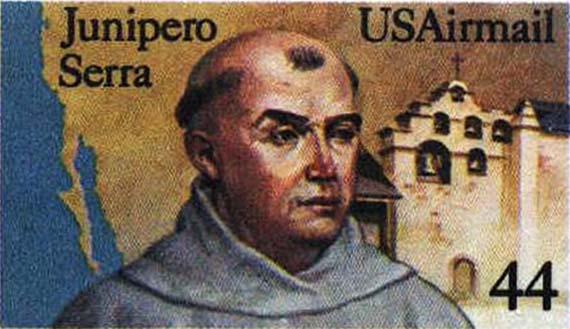
The Saintly Junipero Serra.

The Saintly Junipero Serra.

Back in the day, 1517 to be exact, it was Johannes Tetzel’s selling of indulgences – a sort of early release from purgatory bought with a price – that prompted Martin Luther to write and his famous 95 Theses and post them on the Wittenberg door.

And what do you know. 498 years later the folks at the Vatican are still up to their old tricks. When pope Francis was in the US in September, one of the key events of his visit was the canonization of a Junipero Serra. Serra, a Franciscan monk who founded several missions in California, was elevated to sainthood by the Francis, marking the first time a canonization ceremony was held in the United States.

The canonization was controversial with some, as Serra’s missions had a reputation for brutality. According to one report, “Indians brought into the missions were not allowed to leave, and if they tried they were shackled and severely beaten…When the Native Americans rebelled, which they did on at least two occasions, their rebellions were put down in brutal fashion. When Native American women were caught trying to abort babies conceived though rape, the mission fathers had them beaten for days one end, clamped them in irons, had their heads shaved and forced them to stand at the church altar every Sunday carrying a painted wooden child in their arms” (Andrew Gumbel, “Junipero Serra’s brutal story in spotlight as pope prepares for canonisation“). Beatings, imprisonment, ritual humiliation. Such a lovely place.  In truth, it sounds a lot more like the Hotel California than anything resembling an actual Christian mission.

At any rate, this raises the question of just how the Church selects whom to canonize. According to a new book by Italian journalist Gianluigi Nuzzi, money helps. As the AP reports, “In his book “Merchants in the Temple,” obtained Tuesday by the Associated Press two days ahead of publication, Nuzzi estimates the average price tag for a beatification cause at around 500,000 euros ($550,000) – and some have gone as high as 750,000 euros ($822,000). Causes of saintly candidates who don’t inspire rich donors can languish.”

Amazing.  The more things change with the Roman Catholic Church-State, they more they stay the same.  Of course, Rome even boasts about this. Semper eadem, always the same, is their motto.  Which does kind of make you wonder, just who was it that greased the skids for Serra?

Read Full Post »

Judge Not

Tonight in one of his show’s segments, Bill O’Reilly commented on some recent remarks made by Phil Robertson of Duck Dynasty fame. Robertson stands accused of making judgmental statements about homosexuality, commenting that it is sinful. Now I don’t have O’Reilly’s exact words, but his argument ran something like this: Phil Robertson passed judgment on homosexuality, saying it was a sin; The Bible forbids men from judging others, only God can do this; Therefore, Phil Robertson was wrong to make critical remarks about homosexuality.

This left me a bit puzzled. Think about it. Bill O’Reilly argued that Phil Robertson was wrong to say homosexuality is a sin. In other words, Bill O’Reilly judged Phil Robertson, doing the very thing he said we, as mere mortals, have no right to do. For arguments sake, if were we to adopt O’Reilly’s position, we would be forced to conclude one of two things: 1) Bill O’Reilly is God and was right to take Phil Robertson to task, or 2) he contradicted himself in his editorial and owes Mr. Robertson an apology both for his poor logic – his failure to see that his argument applied to his own words, for in criticizing Robertson he engaged in the very activity, judgment, he denied is permitted to men – and for making what are therefore, by his own standards, baseless, unwarranted, and impermissible comments about Robertson’s beliefs.

The truth is, O’Reilly’s argument is absurd. That is to say, it is self-refuting. Neither Bill O’Reilly nor anyone else can avoid making judgments. To criticize another for making judgments is not only unfair, for it asks the impossible, but also of necessity involves the critic in self-contradiction – in condemning another for passing judgment, the he condemns himself as well.

So the issue is not whether we ought to judge the words and actions of others, we all of necessity make judgments every day all the time. The issue is by what standard we make our judgments. Jesus said, “Do not judge according to appearance, but judge with righteous judgment.” That is to say, we are to judge based on the Bible, the Word of God. And by this standard, it is right and proper to condemn homosexuality. Further, to remain silent in the face of sodomy and say nothing, is itself sinful. To actively defend it is to call good evil and evil good, and demonstrates a more perverse conscience.

Read Full Post »

And there is no creature hidden from His sight, but all things are open and naked to the eyes of Him to whom we must give account. –

Heb.4:13

Several passages in Scripture speak of God’s omnipresence and his omniscience. At least some of them do so in the context of God’s judgment. The above passage is one such. Another is Jeremiah 23:24, which reads, ” ‘Can anyone hide himself in secret places, So I shall not see him?” says the Lord; “Do I not fill heaven and earth?’ says the Lord.” Not only does God see all things and know all things, but as our omnipotent creator he has the right and power to judge all things. These three attributes of God – his omnipresence, omniscience and omnipotence – are both a cause for men to fear, and, for the Christian at least, a cause of great comfort. King David, who was given the choice of punishment at the hands of his enemies or at the hands of God, expressed no doubt which he preferred, “Please let us fall into the hand of the Lord, for His mercies are great; but do not let me fall into the hand of man” (2Sam. 24:14).

And because omnipresence, omniscience and omnipotence are attributes of the true God, it should come as no surprise that false Gods, those who seek to imitate and usurp his rightful authority, seek to claim them for themselves. One such false god, one such idol, is the state. The state or ruler deified is hardly something new. Many ancient nations revered their leaders as gods. The pharaohs claimed to be gods. The degenerate Roman Caesars held likewise. The pope claims to rule in the place of God, and some zealous Romanists have even addressed the pope as God. In more recent times, German philosopher G.W.F. Hegel famously referred to the state as, “God walking on earth.” Economist Ludwig Von Mises coined, or at least made popular, the term “statolatry” to describe this flawed view of government.

I mention these things, because I can’t help but see the rise of the modern surveillance state as the outworking of Hegel’s deluded notions about government. If the state truly is God walking on earth, then it follows that any limits placed on its ability to see, hear, know and act are not only an affront to the government, but even rise to the level of blasphemy. This is essentially the message of the Obama administration, which when confronted about its unconstitutional, immoral spying, retorts that we should all just get over it already and trust them, doubting nothing. It’s all for our own good, don’t you see? Absolutely nothing should be hidden from the sight of federal snoops. If you’re not doing something wrong, you have nothing to worry about, or so goes the argument.

What is equally bad, or perhaps even worse, is the reaction of mainstream pundits both left and right. Not only do they fail to rebuke an out-of-control federal government for its many breeches of the Fourth Amendment, but they actually seem to go out of their way to provide intellectual cover for these activities. One example comes to mind from Fox News. In discussing the revelation that the USPS images every piece of mail passing through the postal system, and that there is no limit to how long these images are stored, commentator Charles Krauthammer dismissed any concerns with a rhetorical waive of the hand by noting that hardly anyone sends letters anymore. Nothing to see here folks, move along… I mean, thank goodness our emails, texts messages, internet searches and phone conversations are safe from the government snoops, otherwise we’d have nowhere to turn for privacy.

Despite what the ACLU would have us believe, Christianity is not the enemy of personal liberty, but the best friend it ever had. The whole idea of limited government has its roots in the Bible. This can be seen from many passages in the Old and New Testaments, from Samuel’s warnings to Israel about the behavior of future Israelite kings to the strict limitations placed on government by Paul in Romans 13. Bob Dylan made a good point in his song “You Gotta Serve Somebody,” for serve we all must. Americans can either repent and serve the Lord in freedom, or continue on their current path enslaved to the state. I’d like to think we’d make the right choice, but I’m not terribly optimistic.


Read Full Post »

Rebellion in the PCA

PCA Teaching Elder David Wegener has written a powerful piece against evangelical feminism that recently was posted on the Aquila Report. In it, he takes to task PCA church officers who continually violate the norms of the Scripture and the PCA’s BCO in order to push for women deacons.

One interesting observation Wegener makes is that the conflict over women in the deaconate is not an exegetical issue, but rather a cultural one. Wegener writes,

“Does anyone really think this issue is about what Scripture actually says? Would that it were true. Why is it that men all over the PCA are bringing up this topic at this particular moment in history? Might it have something to do with the air we breathe every day?

Women run for president and vice-president; they serve as CEOs and they are our supervisors and bosses, our teachers and principals and cell group leaders and spiritual directors.”

I’m not sure if I would go so far as to say that there is no doubt about what the Scriptures say on the subject of women deacons. The irrationalism that is so popular even in supposedly conservative circles has engendered a great deal of confusion in the churches about simple, basic doctrines. But on the other hand, Evangelical churches long ago ceased to heed Paul’s warning against conforming to the world and have instead pursued a policy of echoing the secular culture, just thirty or forty years late. Arguing for women deacons is simply another example of this trend.

I especially liked Wegener’s implication that the Bible’s teaching on the role of women extends beyond matters of church government, but instead speaks about their role in family and society as well. I’ve read articles by men who strongly oppose women ministers and deacons while at the same time thinking that Sarah Palin or Michelle Bachmann would make a great president. You’d think they’d notice the contradiction, but then again, nonsense has come.

Read Full Post »

A few brief thoughts about the Republican debate tonight:

  • Bain Capital is boring. It’s the sort of “controversy” that makes me want to tune out the first time I hear it.
  • The discussion about Social Security is a good example of what’s wrong with the political debate in this country. The candidates spent a lot of time going back and forth about what type of government plan is best. In other words, they were all about rearranging the deck chairs why the Titanic sinks. How about this guys: get the government out of the retirement business altogether.
  • Mitt Romney showed his jackboot tendencies by supporting the National Defense Authorization Act. It is frightening to think that we now have a law that gives the federal government the power to arrest and hold indefinitely an individual on suspicion that he is a terrorist. Romney promises that he will use the law with restraint. This is unconvincing. No president, no government should have such power, and it is an outrage that a presidential candidate can advocate the use – albeit responsible use – of unconstitutional police state powers and still receive broad based public support.
  • I’m not interested in Mitt Romney’s tax returns.
    (more…)

Read Full Post »

Q. How did Christ humble himself in his conception and birth?

A. Christ humbled himself in his conception and birth, in that, being from all eternity the Son of God, in the bosom of the Father, he was pleased in the fullness of time to become the son of man, made of a woman of low estate, and to be born of her; with diverse circumstances of more than ordinary abasement.


How different is the mind of Christ from that of fleshly man! From all eternity, the second person of the Trinity had agreed to humble himself. He freely chose to be born of a woman, to be born under the law, to suffer and to die. And that, not for those who loved him, but for his enemies.

Who would do such a thing? Certainly not I. In my flesh, I would react with anger at the merely slight to my personal dignity, forget about humbling myself for someone else. But Christ willingly laid aside his glory and died to save me, a child of wrath by nature.

Glory to God in the highest! For he who has the preeminence willingly emptied himself that he might redeem us, who were dead in our trespasses and sins.

Read Full Post »

George Will is a smart guy and widely recognized as such. He’s also to a large degree intellectually enslaved to establishment ideas about how the world works, or at least how it ought to work.

In a recent column analyzing various Republican presidential candidates, Will was quite good in his analysis of Newt Gingrich, saying that he, “was the least conservative candidate,” in the field and did a good job supporting this claim. According to Will, a vote for Gingrich is a vote for the status quo.

In general, Will was pretty good in his analysis of the other candidates as well, with one exception: his analysis of Ron Paul. Paul, in Will’s thinking, is an isolationist.
(more…)

Read Full Post »

Beware lest anyone cheat you through philosophy and empty deceit, according to the tradition of men, according to the basic principles of the world, and not according to Christ. (Col 2:8)

Before I came to the Scripturalism of Gordon Clark and John Robbins, my attitude toward philosophy was a mix of indifference, fear. Indifference, because I the little bit that I had been exposed to had left me baffled, fear, because I thought that I would be easy prey for deceptive teaching. So as is the case with many Christians, I labored hard to avoid the subject altogether, and Colossians 2:8 seemed make this avoidance easy to justify. “After all,” I thought to myself, “it tells us right there in Scripture not to be cheated by philosophy. So to ensure that I’m not cheated by it, I won’t study it at all.”

Of course, the verse says nothing about not studying philosophy, it simply enjoins Christians not to be cheated by it, which is a very different thing, so my conclusion really didn’t follow from the verse. But being ignorant of logic, it’s not surprising that I would fall into this common logical blunder.

Years later when I began to study Reformed theology, I met a Presbyterian fellow who intended to study for the ministry. He was in college at the time and studying, of all things, philosophy. This struck me as rather odd, since I had long considered philosophy the province of screaming atheist lunatics, not Christians. But while I was surprised at his major, I was intrigued by the fact that he believed training in philosophy would be helpful to him in his ministry. Not long after that, I was introduced to Gordon Clark’s work.
(more…)

Read Full Post »

Do Not Love the World

Do not love the world or the things in the world. If anyone loves the world, the love of the father is not in him.

  • 1 John 2:15

As Christians we know that the world is not our home and our call is to love God with all our heart, soul strength and mind. That is easy to say; it is not always so easy to do. The desire for the good things in this life and the wish to avoid pain can easily choke out the love of righteousness, even in those who are saved by faith in Christ. When this happens, as it did to some of the greatest saints in the Bible – think of David in his lust for Bathsheba or Peter’s fear of confessing Christ to a servant girl – our ability to be salt and light to a dying world is significantly impaired.

In the year A. D. 410 Aurelius Augustine had a problem. In fact, the whole Roman world did: a Visigoth name Alaric. Alaric, you see, had become the first man to successfully sack Rome in over 700 years, and for the Romans this was an end-of-the-world-as-we-know-it moment. The pagan Romans, what you might call the conservative coalition of the day, blamed the Christians for the disaster. It was the Christians, they charged, who were responsible for causing Rome to abandon her gods and bring about Rome’s defeat at the hands of the barbarians. Augustine, who at the time was bishop of Hippo in North Africa, heard these charges coming from Romans who had fled Italy to escape the Visigoth armies. Moved to defend Christianity against the pagan’s charges, Augustine set about writing his greatest work, The City of God.

Early on in The city of God Augustine set about to refute one of the charges flung at Christians by the pagans: Why, if your God is so powerful, does he allow Christians to suffer along with everyone else? In part, answered Augustine, it was the Christians’ love of the world and their resulting ineffective witness that helped bring God’s judgment. He wrote,

“We tend culpably to evade our responsibility when we ought to instruct and admonish them, sometimes even with strong reproof and censure, either because the task is irksome, or because we are afraid of giving offense; or it may be that we shrink from incurring their enmity, for fear that they may hinder and harm us in worldly matters, in respect either of what we eagerly seek to attain, or what we weakly dread to lose…Good and bad are chastised together, not because both alike live evil lives, but because both alike, though not in the same degree, love this temporal life.”

When the events of life turn against us, some Christians become angry with God and demand, “why me, Lord?” The present author knows of at least one such individual. The answer just may be that God in his mercy takes from us those things for which we have grown too fond, so that he may give us himself, whom we have held too lightly.

Read Full Post »

CNN Republican Debate

It was interesting to hear all the foreign policy talk last night at the Republican debate. If nothinig else, it confirmed my opinion that none of the cadidates save Ron Paul has any business going niear the Oval Office.

For the most part, the Republican position on foreign policy seems to be no-fly-zones, sanctions, dronings  and threatened invasions, war, more war,  and a good righteous tongue lashings against countries without nukes.  On the other hand if you, like Pakistan, have a nuke, you’re our best buddy well deserving of foreign aid so long as you don’t do anything really stupid like not fully cooperate with the US war on terror.

Now you tell me, why wouldn’t the Iranian mullahs want a nuke? It’s the only way a nation gets any respect from the US foreign policy establishment.  In today’s world, not having a nuke is like brining a knife to a gun fight.

Further, what’s the deal with foreign aid? There is no consititional or moral ground for the US federal government to take money from American taxpayers and give it to foreign governments. All such funding is theft, and the day it stops will be a huge step forward for American foreign policy.

The war on terror is a joke.  Terrorism, as has been pointed out by others much better qualifed than I, is a tactic.  War is declared against nations, not tactics.  There has been no declaration of war on terror by congress and there never will be.  If congress ever tried to do this, the logical absurdity of such an act would be apparent even to an average Republican presidential candidate.

Read Full Post »

« Newer Posts - Older Posts »