Ecclesiastical Megalomania: The Economic and Political Thought of the Roman Catholic Church by John W. Robbins (Unicoi, Tennessee: The Trinity Foundation, 1999, 326 pages).
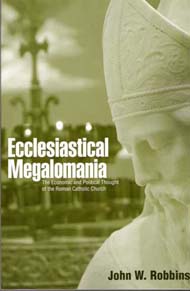 Although to some this may sound strange, Ecclesiastical Megalomania (EM) by Dr. John W. Robbins ranks among the best books ever read by this reviewer. It is crisply written, hard hitting without compromise, and God exalting. It also manages to be absolutely fascinating.
In a mere nine days citizens of the United States will be greeted with a visit from Antichrist in the person of pope Francis I, yet it is doubtful that even one American in a hundred has the discernment to recognize the pope for what he is. It is a marvelous thing that a nation founded by Protestants a little over 200 years ago could be so confused as the true nature of the papacy as to invite the pope, the absolute head of the Roman Catholic Church-State, to address Congress, visit the White House and tour Independence Hall. It is enough to remind one of Hezekiah giving the emissaries from Babylon the grand tour of his palace. But such is the case is this confused nation of ours.
No doubt, the papal visit will bring with it all the pomp and pubic adulation one would expect to accompany a royal visit. Public officials will clamor the pope’s attention and the media will sing his praises. But if this were not bad enough, what is far worse is the fact that many Evangelicals not only will swallow the mainstream media narrative hook line and sinker, but Evangelical leaders, not content to remain on the sidelines, will join the Antichrist’s chorus themselves and invite their foolish followers to sing along.
To all this nonsense Robbins’ book is the perfect antidote. The Oxford English Dictionary gives the definition of “megalomania” as, “the insanity of self-exultation.” “Ecclesiastical” means of or relating to the church. Taken together, Ecclesiastical Megalomania mans the insane self-exultation of the Church, the Roman Catholic Church, that is. Quoting the words of popes and various other Catholic prelates, Robbins does a brilliant job demonstrating that insane self-exultation is the modus operandi of the Roman Catholic Magisterium when it comes to making pronouncements on matters economic and political. But not only that, Robbins also shows that the economic and political thought of Rome is unalterably, radically opposed to constitutional capitalism, the political and economic system of the Bible, and historically of the nations of the West, including the United States. In Robbins’ words,
It might be expected that an institution such as the Roman Church-State, ruled by an absolute emperor, structured in a rigid hierarchy, supranational in scope, aristocratic in character, and none of whose officials is elected – an institution that in more than one way is an anachronism, and intrusion of the ancient world into the modern – would not favor constitutional capitalism. But how deep-seated its hostility to freedom and free enterprise is was a surprise even to this author. The popes have expressed their hatred, not only for Protestantism (a hatred perhaps muted recently, not by a change of mind, but by the relativism of the Church-State influenced by postmodern culture), but also for the political and economic expression of Christianity: capitalism (EM, 24).
With this in mind, the openly socialist and globalist pronouncements of pope Francis can be seen for what they are. Far from representing, as some think, a leftist aberration, the current pope’s obvious socialism is, in fact, a continuation of Rome’s longstanding war against constitutional government and laissez faire capitalism.


 Lux Lucet