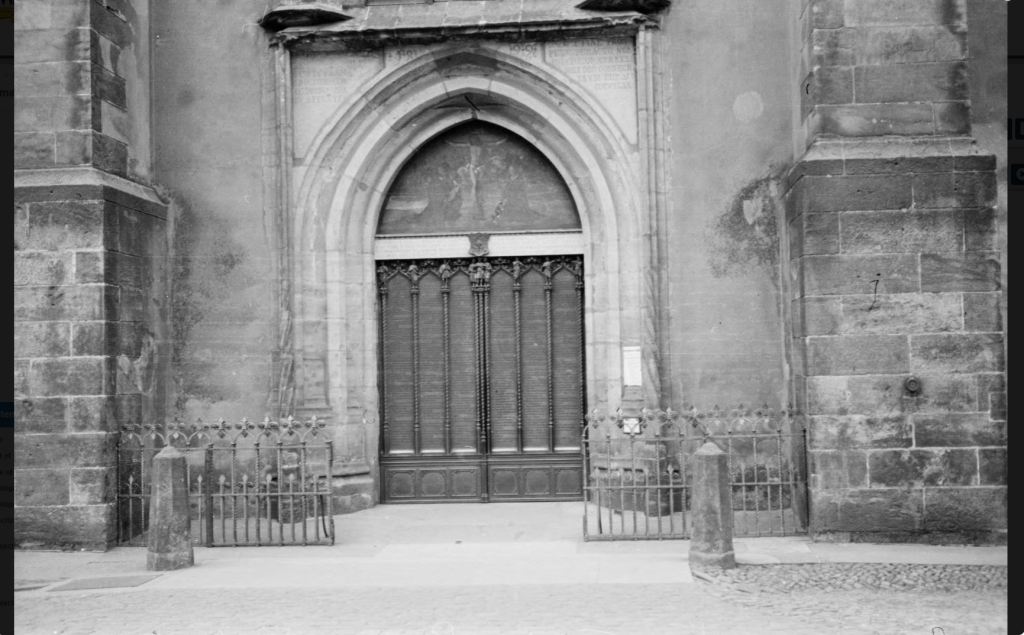
The Wittenberg Church Door where Martin Luther nailed his 95 Theses, October 31, 1517.
In two days, we will mark the 506th anniversary of Martin Luther’s nailing his 95 Theses to the Wittenberg church door.
Luther wasn’t the first to push back on the theological and political abuses of the Roman Church-State. John Wycliffe in England had done so 150 or so years earlier. Jan Hus, another reformer, was murdered by the Church-State in 1415, just 102 years before Luther’s famous act.
Predating these men were the Waldenses, Italian Christians who left the Roman Church-State and built their own civilization in the valleys of the Alps. According to Wylie in his History of the Waldenses, “When their [the Waldenses] co-religionists on the plains entered within the pale of the Roman jurisdiction, they retired within the mountains, and spurning alike the tyrannical yoke and the corrupt tenets of the Church of the Seven Hills, they preserved in its purity and simplicity the faith their fathers had handed down to them.”[1]
As our nation, as the whole of the formerly Christian West, turns more and more away from its historic Protestant roots and more and more toward tyranny of various stripes, I cannot help but wonder if we twenty-first century Protestants will not have to follow in the footsteps of the Waldenses to escape what appears to be a coming wave of persecution in our own time.
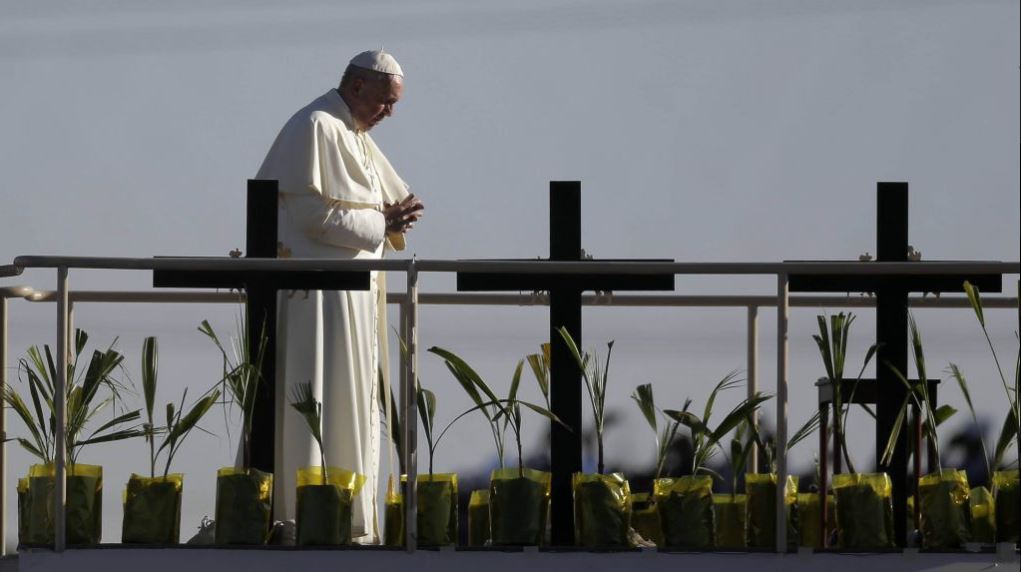
Pope Francis stands on an altar facing the U.S. before celebrating Mass during a February 2016 trip to Juarez. The papal visit was one of the El Paso Times’ top stories of 2016. Robin Zielinski/Las Cruces Sun-News
There are a few items I’d like to address before wrapping up this treatment of Exsul Familia Nazarethana (EFN), the Apostolic Constitution that provides the theoretical framework for the Roman Church-State’s massive and ongoing illegal alien assault on the United States of America.[1] The first of these is Rome’s “welcome the stranger” argument.
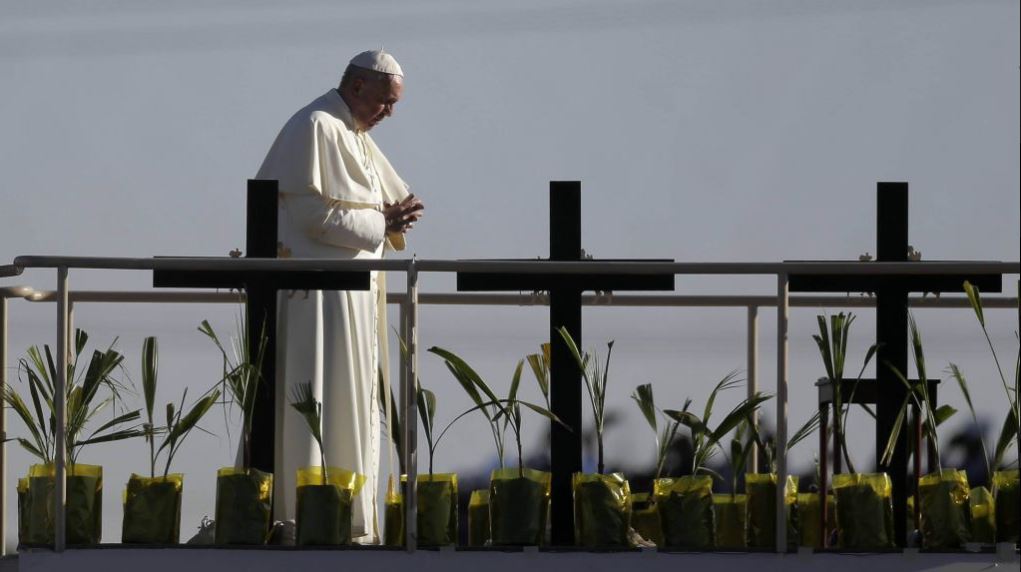
Pope Francis stands on an altar facing the U.S. before celebrating Mass during a February 2016 trip to Juarez. The papal visit was one of the El Paso Times’ top stories of 2016. Robin Zielinski/Las Cruces Sun-News
While Pius XII chose to build his case for mass welfare migration on the flight of Joseph and his family to Egypt recorded in Matthew 2:13-15, this is not the only passage in Scripture on which to build a doctrine of immigration. One could argue that, in fact, it is not even the best passage of Scripture to cite for that purpose.
There are several important differences between the situation with Joseph’s family and the sort of mass border rush that’s taking place in America under the current presidential administration. One of these we’ve already mentioned: Joseph and his family were truly asylees according to the modern definition of the term, but many of those pouring across America’s southwest border are economic migrants.[1] Certainly, one can sympathize with those seeking a better life, but their situation is not the same as those fleeing for their lives due to persecution.
But the problems with Pius XII’s argument don’t end there. One minor point worth noting is that both Judea and Egypt were constituent parts of the Roman Empire at the time of Christ’s birth. Fleeing from Judea to Egypt was simply going from one Roman province to another. Even Pius XII pretends to acknowledge that national borders matter, yet he builds his immigration case on an example where notional borders did not come into play.
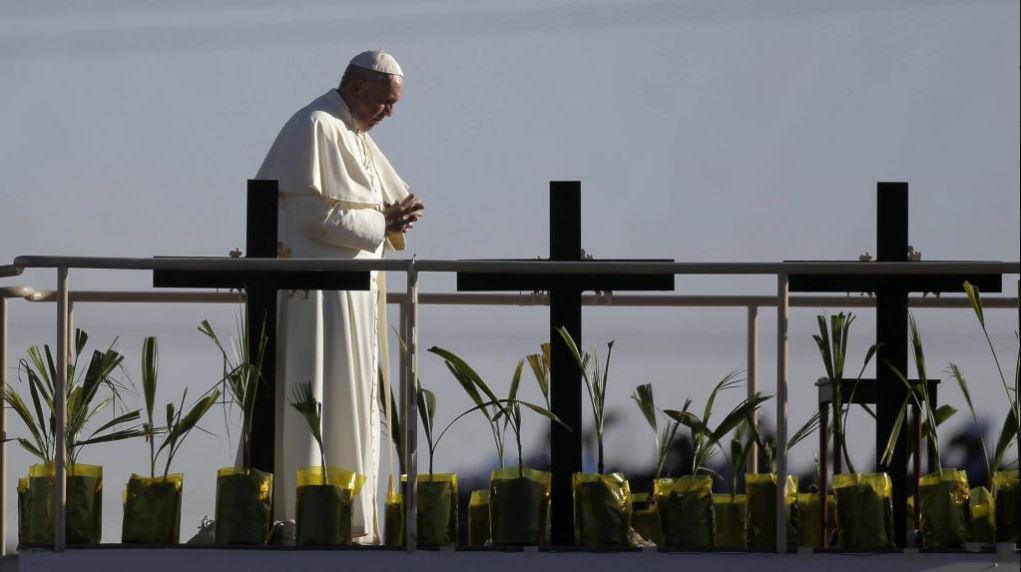
Pope Francis stands on an altar facing the U.S. before celebrating Mass during a February 2016 trip to Juarez. The papal visit was one of the El Paso Times’ top stories of 2016. Robin Zielinski/Las Cruces Sun-News
In his book Ecclesiastical Megalomania, John Robbins quoted Roman Catholic historian Brian Tierney’s comment on Rome’s doctrine of the of the two swords. This doctrine, which asserts that God had delegated both spiritual and temporal power to the bishop of Rome, is based on Luke 22:38 “And they said, Lord, behold here are two swords. And he said unto them, It is enough.” Wrote Tierney, “A whole inverted pyramid of political fantasy was erected on the basis of this one verse.”[1]
In much the same way as with the doctrine of the two swords, Rome likewise has erected a whole inverted pyramid of immigration fantasy on the basis of three verses in the second chapter of Matthew that record the flight into Egypt.
Now when they had departed, behold, an angel of the Lord appeared to Joseph in a dream, saying, “Arise, take the young Child and His mother, flee to Egypt, and stay there until I bring you word; for Herod will seek the young Child to destroy Him.”
When he arose, he took the young Child and His mother by night and departed for Egypt, and was there until the death of Herod, that it might be fulfilled which was spoken by the Lord through the prophet, saying, “Out of Egypt I called My Son” (Matthew 2:13-15).
This flight, according to Pope Pius XII’s[2] 1952 Apostolic Constitution Exsul Familia Nazarethana,[3]the Émigré Family of Nazareth, hereafter EFN, is the “archetype of every refugee family.” In the words of Pius XII,
The émigré Holy Family of Nazareth, fleeing into Egypt, is the archetype of every refugee family. Jesus, Mary and Joseph, living in exile in Egypt to escape the fury of an evil king, are, for all times and all places, the models and protectors of every migrant, alien and refugee of whatever kind who, whether compelled by fear of persecution or by want, is forced to leave his native land, his beloved parents and relatives, his close friends, and to seek a foreign soil.[4]
Clearly, Joseph and his family were refugees under any reasonable definition of the term. Had they remained in Bethlehem, it is certain that Jesus would have been executed by King Herod, who “sent forth and put to death all the male children who were in Bethlehem and in all its districts, from two years old and under, according to the time which he had determined from the wise men” (Matthew 2:16) in his attempt to kill the newborn King of the Jews. Webster’s Seventh New Collegiate Dictionary gives the definition of refugee as, “one who flees to a foreign country or power to escape danger or persecution.” According to the 1951 UN Convention and Protocol Relating to the Status of Refugees, the term refugee applies to “any person who…owing to well-founded fear of being persecuted for reasons of race, religion, nationality, membership of a particular social group or political opinion, is outside the country of his nationality and is unable or, owing to such fear, is unwilling to avail himself of the protection of that country; or who, not having a nationality and being outside the country of his former habitual residence as a result of such events, is unable or, owing to such fear, is unwilling to return to it.” [5] The definition of “refugee” in US law is essentially the same as that of the 1951 UN Convention.
Pope Francis stands on an altar facing the U.S. before celebrating Mass during a February 2016 trip to Juarez. The papal visit was one of the El Paso Times’ top stories of 2016. Robin Zielinski/Las Cruces Sun-News
In his book The Incarnation, Gordon Clark criticized the Council of Chalcedon for its failure to define the terms it used in the famous creed it produced. “Discard or define,” was Clark’s slogan.
John Robbins put the same thought this way, if you define your terms, you don’t know what you’re talking about.
So in the spirit of Gordon Clark and John Robbins, I’d like to take time to define the terms used in the title of this talk.
Antichrist
My definition of Antichrist is that which was accepted by nearly all Protestants before the 20th century. Antichrist is the office of the papacy. The original language of the Westminster Confession of Faith summed up this view quite nicely in Chapter 25.6. It reads, “There is no other head of the church but the Lord Jesus Christ: nor can the Pope of Rome, in any sense be head thereof: but is that Antichrist, that man of sin and son of perdition, that exalteth himself in the Church against Christ, and all that is called God.” But this language was altered in the 1903 revision of the Confession by the Presbyterian Church USA to remove the language identifying the pope as “Antichrist,” “man of sin,” and “son of perdition.”
Two of the best Presbyterian theologians of the 20th century did not offer much in the way of objection to the removal of this language from the Confession. Writing in the November 28, 1936 issue of the “Presbyterian Guardian,” J. Gresham Machen commented that the edition of the Confession adopted by the Presbyterian Church of America[1] was the same as the doctrinal standards that existed in 1902, “except that two brief statements – one declaring the Pope to be Antichrist and the other declaring it to be sinful to refuse an oath when the civil magistrate requires it, are omitted.”[2]
B.B. Warfield noted in his article “The Confession of Faith as Revised in 1903” that “The motive of the revisers seems to have been to avoid calling the Pope of Rome ‘that antichrist, that man of sin, and son of perdition, that exalteth himself in the church against Christ and all that is called God” – which does seem rather strong language. Why the revisers wished to avoid applying these terms to the Pope of Rome we can only conjecture. But their avoidance of it need not imply that they – some or all of them – felt prepared to deny that the Pope of Rome is the Antichrist of Scripture.”[3] As do many Bible-believing Presbyterians, I count myself an admirer of B.B. Warfield, but these comments from him are disappointing. The most likely reason that the revisers excised the language identifying the Pope of Rome as Antichrist, man of sin, and son of perdition is the very one Warfield denies was their motive, that they – some or all of them – were prepared to deny that the Pope of Rome was the Antichrist of the Scriptures. The history of the American Presbyterian church since 1903 substantiates this reasoning, as even highly educated Presbyterians from that day to the present have become increasingly willing to deny that the Pope of Rome is the Antichrist of the Scriptures, something that was once clearly understood even by the plowboy with a Bible.
But what the revisers did by striking the Confession’s language about the identity of Antichrist was something far worse than merely sowing confusion about who Antichrist is. By denying that the Pope of Rome is the Antichrist, the revisers of the Confession also denied the entire Protestant system of prophetic interpretation known as historicism, of which system the identity of Antichrist as the papacy is a key component.[4]
It seems to this Presbyterian in the Year of Our Lord 2023 that the removal of the Confession’s language on the identity of Antichrist, while it may have appeared minor to observers at the time, opened the floodgates for the false Jesuit eschatologies of Preterism and Futurism – both of which deny a present Antichrist, instead placing him far in the past or at a time still to come – to come pouring into Protestant church, thus blinding, as it were, even the elect to the work of Antichrist taking place right in front of their noses.
One of these works, I argue in this paper, is the flooding of America with illegal aliens, many of them Roman Catholics, for the purpose of subverting our Protestant Republic, capturing the nation for Rome, and incorporating it into Rome’s planned system of world government.

 Lux Lucet