To promote a woman to bear rule, superiority, dominion or empire above any realm, nation or city is repugnant to nature, contumely to God, a thin most contrarious to His revealed will and approved ordinance, and finally it is the subversion of good order, of all equity and justice.
– John Knox, The First Blast of the Trumpet Against the Monstrous Regiment of Women

Carly Fiorina
Last week we looked a World Magazine
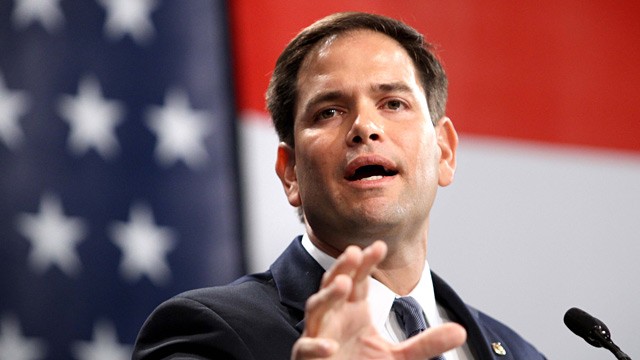
survey of “evangelical insiders” conducted to determine their views on the Republican presidential candidates for the upcoming 2016 election. Of the 91 respondents, the first place winner was Florida Senator Marco Rubio. Carly Fiorina polled well, coming in, “as the most popular second-choice candidate.” Given the ecumenical world-view that has come to dominate much of the American Evangelical church, it is unsurprising, but still disappointing, to see so many Evangelicals approve candidates no Christian should support
In the case of Marco Rubio, the issue is his Roman Catholicism. Because the Constitution requires a that president swear to, “preserve, protect and defend the Constitution of the United States,” and because this oath conflicts with the obligation a Roman Catholic has to obey the pope, it is improper for an Evangelical – for that matter, it is improper for anyone who holds dear the Constitution – to support a Romanist for president. And yet steeped as they are in several decades of neo-evangelicalism, these “evangelical insiders” see no problem with promoting a son of Rome, who openly admits, “I craved, literally, the Most Blessed Sacrament, Holy Communion, the sacramental point of contact between the Catholic and the liturgy of heaven.” Rubio, as have many Roman Catholic candidates over the years, has stated that he follows the pope on matters of faith and morals but not on political or economic issues. He may well be sincere in what he says, but Rome offers its teaching as a packaged deal. Roman Catholics are not free to follow the Church’s teaching on faith and morals while rejecting what it says on economics and politics. That the popes currently allow Roman Catholic politicians the freedom to stray from the Church’s teaching should be seen as the Church’s concession to the fact that its power is not at this time absolute as is was in the middle ages. Should Rome again attain to the position of power it held prior to the Reformation – and this is, in fact, its long-term goal – you can be assured that when the pope says “jump,” Roman Catholic magistrates will have but one response: how high?

 Lux Lucet