Feeds:
Posts
Comments

And Asa did that which was right in the eyes of the LORD, as did David his father. And he took away the sodomites out of the land…

– (1Kings 15:11-12)

“How did it come to this?,” I muttered to myself the other day. “How did it come to this?” My words were my reaction to the latest story in the mainstream press about the collapse of Western Civilization. Specifically, I was referring to yet another story about the normalization of homosexuality in the United States.

It was a story about how the State of California banned official travel to yet another state deemed by its all-wise legislators to be insufficiently submissive to the enlightened LGBT – or whatever this month’s alphabet soup variant happens to be – movement. If you’d like, you can read USA Today’s version of the story here. The short version is this, California has a state law requiring its attorney general to keep a naughty list of states subject to a travel ban due to “laws that authorize or require discrimination on the basis of sexual orientation, gender identity or gender expression.”

Now you’re probably wondering what outrage against humanity Oklahoma committed to earn the opprobrium of California’s Attorney General. It was this, the Governor or Oklahoma recently signed into law a statue that allowed private adoption agencies to refuse to place children with same-sex married couples.

How did it comes to this? Well, I doubt a single blog post can fully answer that question, but I would like to outline at least a few of the major factors that have produced the current state of affairs: the disappearance of Christianity in the West, the usurpation known as Judicial Review, and the Civil Rights Movement’s attack on property rights.

The Disappearance of Christianity in the West

As John Robbins argues in Christ and Civilization, Western Civilization is the by-product of the widespread preaching of and belief in the Gospel of Justification by Belief Alone. In nations to which the Reformation came, the role of government was reduced to something close to its Biblical norm of punishing evildoers and the secular work, what the Reformers called “vocation”, came to be seen as pleasing to God. As a result of this explosion in political and economic freedom, the nations of the West became the most prosperous on earth.

But Christianity has long been under attack in the West. 200 years ago, higher critics in Germany were ruining the nation’s universities with their skeptical attacks on the truth of the Bible. At the same time, those who professed to defend Christianity embraced irrationalism, perhaps the greatest heresy of all. Feminism, Marxism, Darwinism all rose to prominence as the 19th century wore on and helped to lay the groundwork for our modern world. Even many in the professing church, instead of being salt and light in the world as Jesus commanded, were instead swept up in these anti-Christian movements and began to use the aegis of the Bible as cover for advancing their unbelief, and thus was born the social gospel.

It stands to reason that if the ideas that formed a civilization are no longer held by the people in that civilization, the laws and social mores of that society will be changed to conform to the new belief systems that rush in to fill the void.

Even in the churches, few there be who hold to the teachings of the Reformation which birthed the West. And if the spiritual heirs of Luther and Calvin no longer believe what their forefathers believed, why would one expect those outside the Protestant churches to have any use for laws based upon a Biblical worldview?

The Old Testament associates the presence of sodomites in Israel with times of apostasy, and the removal of such persons from the land with periods of reformation. In the New Testament we find homosexuality condemned as a sin, saying of those who practice it that they will not inherit the kingdom of God. And from the colonial period right up to the recent past, the American legal system reflected this with the multitude of sodomy laws on the books.

But to take such a stance today in our post-Christian world is to court being branded a hater, a bigot, and unfit for polite society. The shift from laws criminalizing homosexuality to ones promoting it is a stunning change, and one that was made possible by Americans’ rejection of Christianity.

The Usurpation of Judicial Review

One assumption shared by both political liberals and political conservatives is that the Supreme Court has the right to declare a law either constitutional or unconstitutional. Liberals want to pack the court, so that liberal judges can give constitutional blessings to current laws favored by liberals and pave the way for more such legislation. Conservatives want conservative justices to do the same for their favored causes.

Almost no one stops to ask whether the Supreme Court actually has the power to do what it does, declare laws constitutional or not.

The short answer to this question is, no, it does not. This probably comes as a shock to many people. I know it did me when I first heard it.

As originally conceived, the Supreme Court was to decide, not whether a given law was Constitutional, but whether it had been applied properly. With Marbury v Madison in 1803, that all changed. For it was in this decision that the Supreme Court first asserted what is now known as judicial review, the power to decide whether a given law is constitutional.

Judicial review is essentially the Roman Catholic view of the Church applied to Constitutional law. In Rome, the Bible is what the Church says it is. In Christianity, the church is what the Bible says it is.

In like fashion, those who argue that the Constitution is what the Supreme Court says it is are legal Romanists. The correct view, the Supreme Court is what the Constitution says it is, is legal Protestantism.

The Romanist view of the Supreme Court is one of the major, and very underappreciated, sources of the massive change in American law with respect to homosexuality. It was just three years ago in 2015 that the US Supreme Court in one fell swoop declared unconstitutional all laws prohibiting same-sex marriage.

The astounding arrogance of five lawyers on the Supreme Court has basically gutted the ability of Christians to find any legal recourse to resist the unchristian and aggressive LGBT agenda.

But these ungodly men and women would never have had the power to do this were it not for the Court’s prior usurpation in claiming for itself the power of judicial review.

The Civil Rights Movement’s Attack on Property Rights

Of the three reasons for the success of the homosexual movement, probably the most controversial is to point out the role of the Civil Rights movement in paving the way for the explosion in LGBT friendly legislation in recent years.

The Civil Rights Movement was a mixed bag. To the extent that its supporters sought to overturn Jim Crow laws, they have the support of this author. But to the extent they attacked property rights they deserve to be rebuked.

The attack on property rights by the Civil Rights Movement was codified into law in Title II of The 1964 Civil Rights Act. This section of the Act drew an unbiblical distinction between types of property, one called places of public accommodation and another called private clubs. Specifically, it made it illegal to discriminate in places of public accommodation – places of public accommodation were defined, for example, as inns, restaurants, movie theaters – “on the ground of race, color, religion, or national origin.”

One could read the Scriptures from cover to cover and find no such distinction between places of public accommodation or private clubs. Private property is private property, regardless of whether it’s a home, a private club or a lunch counter in a drug store. And just as a home owner has the right to refuse to all someone in his house, so too does a business owner have the right to refuse to serve someone.

“So,” someone will say to me, “Matthews, by arguing this way you’re just an apologist for racism!” To which charge I would answer, “Not at all.” Racism is a sin. It is a failure to love our neighbor as ourselves.

But not all sins are crimes. Just look in the case law of the Old Testament. Some sins, theft for example, were crimes. We know this because theft, while being condemned in the 10 Commandments, which are the summary of the moral law, also had civil penalties attached to it in ancient Israel. It is the presence or absence of civil penalties that determine whether a specific sin is also a crime.

The Bible’s stance on private property is summed up in Jesus’ parable of the workers in the vineyard. When the workers complain to the vineyard owner about their wages, he responds, “Is it not lawful for me to do what I wish with my own things?”

The answer to this rhetorical question is, yes it is. And one implication of “doing what I wish with my own things” is that a business owner has the right to decide with whom he wishes to do business and with whom he does not. This includes making decisions with which we may disagree and which, in fact, may even be sinful. Ultimately, that’s between the businessman and God to whom he must give account.

So why do I bring up the errors of the Civil Rights Movement? Because the LGBT Movement has followed in its footsteps. For example, the homosexual activists have applied the principle of public accommodation to those who refuse services to LGBT persons. For example, there have been a number of Christian business owners in serious legal trouble for refusing to provide cakes, flowers, or wedding photography services for same-sex weddings. These cases occurred in states that have statues preventing business owners from discriminating against homosexuals in the same way the 1964 Civil Rights Act prohibits discrimination on the ground of race, color, religion, religion, or national origin.

Had the principle of “places of public accommodation” not been established in the 1964 Civil Rights Act, LGBT activists would not be in a position to force Christians to serve them.

Many veterans of the Civil Rights Movement have been shocked by the tactics of LGBT activists, who have appropriated the logic and methods of the Civil Rights Movement to promote the homosexual agenda.

For example, commenting on then President Obama’s use of 50th anniversary of the “Bloody Sunday” march to advocate for same-sex marriage, Rev. William Owens of the Coalition of African American Pastors said, “I marched with many people back in those days and I have reached out to some of my friends who marched with me, and all of them are shocked. They never thought they would see this day that gay rights would be equated with civil rights. Not one agreed with the comparison.”

Admittedly it is shocking. But once the LGBT Movement was able to attach itself to the Civil Rights Movement, by force of logic all the laws enacted in the 1964 Civil Rights Act also apply to them. Hence the proliferation of state-level laws prohibiting business owners from denying service to someone based on his being a homosexual.

And don’t suppose that this is going to stop with traditional businesses either. For example, this 2017 story “Ohio LGBT Group Announces Plans to Target Churches for Homosexual Weddings” is a shot at Evangelicals, not just in Ohio, but across the nation. As the article explains, An LGBT organization in Ohio has announced plans to target churches if they refuse to offer their property to be used in a homosexual wedding. In opposing the Ohio Pastor Protection Act (HB-36), the group Equality Ohio announced that they would target churches, forcing them to rent church facilities to groups that oppose their beliefs.”

This is seriously dangerous stuff, and perhaps represents the biggest threat to religious freedom in the US today. Given the current legal climate, it is this author’s opinion that it is just a matter of time before we see such a case in court.

Had the “places of public accommodation” clause not been included in the 1964 Civil Rights Act, the threat posed by the LGBT Movement to the churches would be much less than it is today.

Conclusion

In conclusion, as a Christian I’m embarrassed at the current moral climate of our nation. And nothing highlights the current mess we’re in more than the stunning advance of the LGBT Movement over the past 50 years.

I’m embarrassed and ashamed that every year we’re enjoined to “celebrate Pride Month” as if sodomy were something to rejoice in. I’m embarrassed and ashamed that the leading institutions in my country not only do not stand up to the LGBT lie, but actually actively promote it. But perhaps most of all, I’m embarrassed that we Christians have been so ineffective in putting a stop to this nonsense.

Perhaps one of God’s purposes in allowing the stunning success of the LGBT agenda in the US is to chastise his people for their intellectual laziness and lack of faith. If so, may God grant us repentance as well as the knowledge of the truth and the wisdom and the courage to apply it to good effect.

In times past, God raised up Asa, Jehoshaphat and Josiah to put an end to the LGBT agenda in Israel. Has his arm been shorted that he cannot save today?
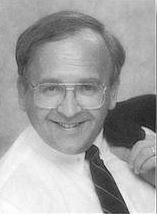
John Robbins“Many people in relatively orthodox churches are confused about sanctification,” wrote John Robbins in the forward to Gordon Clark’s book Sanctification.
And not only is there a great deal of confusion about sanctification, but the errors people make on this doctrine place them in two broad categories: mystics and workers.

Mystics, as Robbins points out, are those who say of sanctification, “Let go and let God.” They tend to be Charismatics. On the other hand, the workers think that justification is by grace but sanctification is by works. Such persons tend to be Reformed.

Neither of these approaches to sanctification is Biblical.

Before talking about what sanctification is, Robbins notes that salvation, “from start to finish, from election to glorification, from eternity to eternity, is all of grace.”

Robbins notes that justification – God’s declaring us legally righteous and pardoning all our sins – is by grace alone, through faith alone apart from any works. Further, justification is wholly outside us. It is a work that God has done for us by imputing – to impute means to ascribe or to reckon – Christ’s perfect righteousness to us. Justification is not a work done in us.

Continue Reading »

KTS_Night

As I wrap up this series on my brief time as a student at Knox Theological Seminary (KTS) and on some of the general lessons that can be drawn from the collapse of the school’s reformed witness, it seemed good to mention one last item before closing. In Part 2 of this series I mentioned that the collapse of KTS was in part a tale of missed opportunities. And so it was.

From the time KTS began to consider hiring Warren Gage right up through the events of the late summer and fall of 2007 when Gage and his posse seized control of the school, there were opportunities to expose Gage as the false teacher that he was and expel both him and his unbiblical leaven from the seminary. Regrettably, those in a position to do the job, for one reason or another, allowed these opportunities to pass them by.

Today, I’d like to suggest two reasons why these opportunities were allowed to pass by.

Continue Reading »

KTS_Night

Cover up is the Name of the Game

In March 2014, over seven years after leaving KTS, I received an email with the subject line “Important Announcement from Knox Seminary.” Opening up the email, I read, “It is with a sense of sadness that I report to you that at the executive committee of the Knox Seminary Board of Directors accepted the resignation of Dr. Warren Gage last Monday night.”

Worth noting is that the executive committee of the Knox Seminary Board of Directors was the same committee that in the late summer of 2007 decided to fire Gage, but whose decision was altered by the full Seminary Board to a suspension with pay for the fall semester. It was that fateful decision which essentially drove the final nail in the coffin of old KTS. The tragic farce which played out over the next few months and ended up, not only with Gage being reinstated to his teaching position, but all his opponents driven out of the school, was inevitable once the Board let Gage off the hook. By their refusal to take decisive action against Gage, in this author’s opinion the Board snatched defeat from the jaws of victory. Mind you, even if the Board had stood its ground and gone through with firing Gage, maybe the Session of Coral Ridge Presbyterian Church would have vacated his termination the same way they vacated his suspension.  Maybe KTS would have imploded anyway. But a firm stand by the Board would have put them is a stronger position to fight.  More importantly, they would have honored God by appropriately dealing with a false teacher in the school’s midst.

The email continues with a quote from Gage himself,

It is with both sadness and joy that I write this letter. It is sad because Knox Seminary has been a place of tremendous blessing for me for the past twelve years. I have the joy of knowing I have helped to train hundreds of men and women for the gospel ministry by my appointment here by Dr. Kennedy.

About three years ago, however, I felt the Lord was prompting me with the thought that my time at Knox was drawing to a close. I had a growing desire to bring the literary approach to the Bible I had taught there to a wider church beyond the academy. To that end, two years ago I filed for a 501 c3 and last fall the Florida Institute of Humanities and Culture was approved by the IRS. I have a clear sense that the Lord is calling me to give my full attention to this new ministry.

Notice the verbs Gage uses to describe his supposed calling, “I felt, “I have a clear sense.” This sort of touchy-feely language was typical (pun intended) of nearly everything he taught, either in my hearing or in print. He was all about feelings, imagination, intuition, sensation. Logic and systematic thinking, these, on the other hand, he felt free to disparage.

Continue Reading »

KTS_Night

Today’s post represents the third in a series of posts about my time as a student at Knox Theological Seminary (KTS) in Fort Lauderdale, Florida. I originally wrote about KTS and the controversy concerning Warren Gage in a 2008 book published by the Trinity Foundation titled Imagining a Vain Thing: The Decline and Fall of Knox Seminary.

In the ten years that have elapsed since I wrote the book under the guidance of the late Dr. John W. Robbins, my conviction that what I wrote was correct remains unchanged. I stand by the book, all of it.

That said, ten years is time enough for further reflection, and it seemed good to me to write a series of posts to share with readers some of the big-picture lessons that can be taken from the disaster that overtook KTS in the fall of 2007.

Continue Reading »

KTS_Night

As a continuation of last week’s post, I’d like to look a few more larger lessons that can be drawn from the events surrounding the decline and fall of Knox Theological Seminary (KTS). As a student at the school in the fall of 2006, my stay there, however brief, allowed me to witness part of the drama firsthand.

Last week, I outlined a couple lessons, the first of which was that God is faithful to his people, sometimes in unexpected ways. As a personal testimony to this, I related how my stay at KTS allowed me to meet John Robbins and, with his guidance, to write the manuscript for what would become the book Imagining a Vain Thing: The Decline and Fall of Knox Seminary. To that point in my life, it never once occurred to me that I would ever be an author. The fact that this actually happened is something that still to this day strikes me with amazement. I didn’t go to seminary planning to write a book. I had gone there to study for the ministry. But God had a different plan.

A second lesson Christians can take from the problems at KTS is the danger Roman Catholic trained faculty pose to Protestant institutions of learning. Dr. Warren Gage, the central figure in the decline and fall of KTS, nominally was a Presbyterian, but his cast of mind was distinctly Roman Catholic. In part this can be attributed to the fact that he took his Ph.D from the University of Dallas, a Roman Catholic school. But Dr. Gage is certainly not the only professor at a Protestant school to have received his professional training at a Roman Catholic or Jesuit university. These Romanist trained teachers pose a genuine threat to the doctrinal soundness of the Protestant colleges and seminaries where they are employed.

But as important as these lesson are, they are not the only ones that can be taken from the unfortunate events at KTS. So let us move on to continue some additional points.

Continue Reading »

KTS_Night

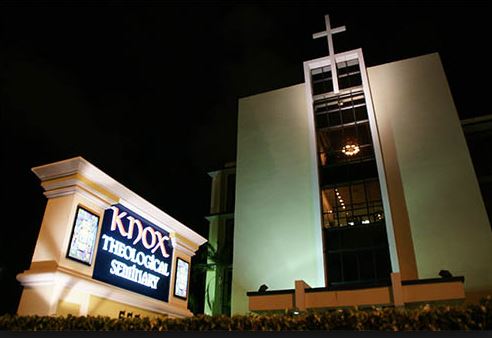
Knox Theological Seminary in Fort Lauderdale, Florida.

This past week I had the privilege of recording a podcast interview with two new friends and brothers in Christ, Tim Shaughnessy and Carlos Montijo, the hosts of the Semper Reformanda Radio
podcast.

The subject of our interview was a book I wrote – unbelievably for me to think this, ten years ago – titled Imagining a Vain Thing: The Decline and Fall of Knox Seminary. As the title states, the subject of the book is about the events that transformed Knox Theological Seminary (KTS) in Fort Lauderdale, Florida, a school founded by D. James Kennedy and subject to the session of Coral Ridge Presbyterian Church (CRPC), from a school noted for its fidelity to Scripture to an institution that speaks forth quite a different message.

In the book, I recounted the events in some detail. Here, I’ll give you the short version, which runs something like this: Contrary to Dr. Kennedy’s best judgment, in 2002 the school hired Dr. Warren Gage to teach Old Testament and head the schools new Culture and Christianity program. Dr. Gage, who had recently taken his Ph.D from the Roman Catholic University of Dallas, had a distinctly unreformed view of hermeneutics and typology, ideas which he had expressed very clearly in his doctoral dissertation. Further, Dr. Gage carried these ideas over into this teaching at KTS. Although the school officially backed Gage’s distinctive, and Roman Catholic influenced, teaching, there was an undercurrent of resistance.

In May 2007, a graduate of the school approached Dr. R. Fowler White with her concerns about Gage, prompting an investigation by Dr. White into Gage’s teaching. The report resulting from White’s investigation concluded, correctly I must emphasize, that 1) Gage taught, contrary to the Westminster Confession of Faith, that individual passages of Scripture have more than on meaning, and 2) he regularly disparaged logic and systematic theology in the classroom.

As a result of the report’s findings, the Executive Committee of the KTS Board of Directors wanted to terminate Gage’s employment at the school.  This was the correct decision, which it had stuck, likely would have saved KTS.  Unfortunately, the full board voted to suspend Gage with full pay rather than to fire him.  During his time away from the school, Gage was supposed to “contemplate his willingness to subordinate himself fully to the doctrinal standards of the Seminary and the P.C.A.,” according to a letter written by R.C. Sproul, Interim Chairman of the Board of Knox Seminary, to the Session of Coral Ridge Presbyterian Church.

But instead of taking time to think about, and repent of, his many glaring theological errors, Gage, a trained lawyer with many years of practice to his credit,  used this opportunity to overturn his suspension by making appeal to the Session of CRPC.  Gage’s five years at the school had allowed him to insinuate himself into the KTS community, and, with the help of his supporters, not only was he able to have his suspension reversed, but, quite remarkably, was able to oust all those who had opposed him, both on the Board of Directors and among the faculty 

After the remarkable events in the fall of 2007, Dr. Gage went on to teach at KTS through the 2013-2014 academic year, retiring from the school in the spring of 2014. One ironic twist to the story is that during this nearly seven year period, Gage went on to serve as Dean of Faculty at the school that had once very nearly fired him.  

In addition to the book and the 2014 Trinity Review I wrote at the time Gage retired, I have on occasion published blog posts on KTS (see here, here and here). But until last week’s interview, admittedly it’s been a while since I’ve publically commented on, or privately thought much about, KTS. Yet after talking to Carlos and Tim, I realized that there are some aspects of my time at KTS that are worth reviewing. Specifically, I believe there are important general lessons that Christians can take from my experience at seminary and the larger events that upended KTS back in 2007. I’d like to take this occasion to set them forth.

Continue Reading »

Foreign Policy_Syria2

Before and after in Aleppo.

The great law of morality ought to have a national as well as a personal and individual application. We should act toward other nations as we wish them to act toward us.

– Millard Fillmore, 13th President of the United States , 1850 State of the Union Address

Back during the 2012 Presidential campaign, I wrote a post critical of an article by Uri Friedman, who showed his utter disdain for candidate Ron Paul by accusing him of invoking the Millard Fillmore doctrine, which as the quote above indicates, is the application of the Golden Rule to foreign policy. Fillmore, notes Friedman, was “undistinguished” and “uninspiring” and self-evidently not worthy of emulation in any respect. Friedman goes on to write that Paul was both booed an laughed at when he presented his version of the “Golden Rule” approach to foreign policy on the campaign trail.

It is absurd to think that the Golden Rule has anything whatsoever to do with foreign policy, so opines Friedman. And not only is it wrong to suggest that it does, but it’s actually laughable. This we know because Millard Fillmore believed the Golden Rule was the standard for a proper policy and it’s just obvious that Millard Fillmore was a dunce, a boob and a fool. What is more, so are all those, such as Ron Paul, who follow him. That’s the sum of Friedman’s argument, who, as one writing in Foreign Policy, the house organ of the Council on Foreign Relations, could be said to be echoing the views of the American foreign policy establishment.

Perhaps if the accomplishments of America’s foreign policy establishment – dating back to the Spanish American War at the end of the 19th century, America’s leaders have rejected the nation’s original foreign policy of staying out of foreign wars in favor of a policy of interventionism – were more impressive, it would make sense to give ear to Friedman’s snarky dismissal of Fillmore and Paul. But after more than a century of foreign wars that seem only to set the stage for the next conflict, perhaps it’s worth asking just how much the sages at the Council on Foreign Relations actually know about foreign policy. It seems the this author that the answer is, not very much at all.

Continue Reading »