Feeds:
Posts
Comments

Archive for the ‘Uncategorized’ Category


 I think that if the data is overwhelming in favor, in favor of evolution, to deny that reality will make us a cult, some odd group that’s not really interacting with the real world – Bruce Waltke

I admit to being asleep at the wheel as far as the Bruce Waltke/ evolution controversy goes.  In fact, it was just yesterday that I received an email from a friend about this issue.  After getting myself up to speed by reading a transcript of Waltke’s comments here and what others had written about his comments here and here, I was struck by how this purported conservative Evangelical scholar was tripped up by his low view of the Scriptures. 

Waltke’s association with the NIV and TNIV mis-translations indicate a low view of Scripture.  Commenting in his article on Waltke, Paul Eliott wrote,

Waltke’s attitude toward the Bible itself belies orthodoxy. Waltke served on the translation committee of the New International Version of the Bible, and later on the translation committee of the gender-inclusive Today’s New International Version. In 2007, Waltke delivered the W. H. Griffith Thomas Memorial Lectures at Dallas Theological Seminary. He said that all Bible translations (the Jehovah’s Witnesses’ New World Translation excepted) “are faithful and adequate.” He clarified this by saying that “all translations lead their audience to faith in Jesus Christ, into sound doctrine, and never into heresy.” He then stated that he thinks the best available English translation is Today’s New International Version! A more sensible commentator once accurately described TNIV as a “bastard child of political correctness.”     

Had Waltke a proper Biblical understanding of the doctrine of Scripture, he would have had nothing to do with the NIV or TNIV.  Neither of these translations is based on a sound Greek New Testament text, and neither employs sound translation principles.

Apart from the issue of translations, there is another problem with Waltke’s understanding of the doctrine of Scripture: he fails to understand that the Bible alone is truth.  The opinions of scientists are not truth.  The opinions of historians are not truth.  The views of secular philosophers are not truth.  The Bible calls these things “foolishness” and “empty deceit.” But Waltke makes the mistake of thinking that these things are true, that the [scientific] data for evolution is such that it cannot be denied.  But Christ tells us where we may find truth.  He said, “Your word is truth” (Jn.17:17).  And God’s word tells us how he made the world: out of nothing, in the space of six literal days, and all very good.  

We do not judge the veracity of the Bible by what scientists say, we judge the veracity of what the scientists say by the Bible.  If scientists do not speak according to Scripture, we know their science is wrong.  Or as Isaiah would put it, “there is no light in them.” God’s truth is all truth.  There is no other.

Here’s the April 16, 2010 ABC News account of the Waltke controversy.

By the way, it’s true that in the wake of his leaving Reformed Seminary Orlando, Dr. Waltke has a new job:  giving prosepctive seminary students another good reason to avoid Knox Theological Seminary.
Read Full Post »

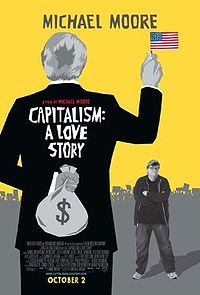
Capitalism_a_love_story_poster

Capitalism:  A Love Story.  Michael Moore director.  2 hours and 6 minutes. Rated R for strong language.

Michael Moore wants you to know two things about Capitalism:  1) it’s evil and 2) he hates it.  Moore makes both points abundantly clear in his latest, ironically titled film Capitalism: A Love Story.  That Moore would disapprove of capitalism came as no surprise to me; I expected as much.  But the degree of blatant anti-capitalist hostility manifested in this film left me shocked.  In a way, that’s to Moore’s credit.  He’s willing to clearly speak his mind on the subject, and I can respect that.  This is preferable by far to listening to men who would bore us with ambiguous words designed to hide their true beliefs.  But for all that, in this film Moore also shows himself to be a deeply confused man. He seems not to have a clear idea of what capitalism is, and being unsure of his target, he ends up savaging capitalism for sins properly attributed to socialism, and praising socialism for benefits brought by capitalism. 

Moore’s position on capitalism is evident from the film’s opening, where he presents the viewer with a collection of still photos of bank robberies.  What could such pictures possible have to do with capitalism?  Really, it’s not hard to figure out.  You see, in Moore’s world, capitalism is robbery, or as he states later in the film, “capitalism is a system of giving and taking, mostly taking.” Capitalism, Moore believes, is theft and thoroughly corrupt at the ethical level.  This notion he defends, not by presenting a coherent argument, but through anecdotes such as: families losing their homes to foreclosure, an outrageously sleazy real estate agent buying condos on the cheap, teenagers who were thrown in juvenile detention to make money for a private prison contractor, a  sit-down strike at a Chicago window factory, and the little known corporate practice of buying life insurance policies on rank and file workers, also known as dead peasant insurance.  Of course, none of these anecdotes prove capitalism evil, but they can sway many people by appealing to their emotions. (more…)

Read Full Post »

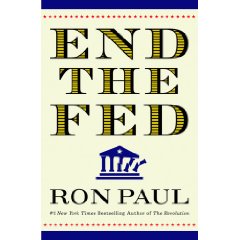
End the Fed                                                                                                          

End the Fed by Ron Paul.  212 pages. Grand Central. $21.99.

Ron Paul has always been something of a political misfit.  An eleven term Republican congressman from Texas, he’s labored most of his career in obscurity, only recently achieving national prominence on the strength of his 2008 bid for the Republican presidential nomination.  The reaction to Paul’s campaign by both voters and media alike was a curious mixture of perplexity, enthusiasm and scorn.  His pro-life, pro-gun positions certainly resonated with many values conservatives.  Fiscal conservatives  no doubt appreciated his small government rhetoric, accompanied as it was by a congressional voting record so hostile to new taxes and regulations that Paul, a physician by trade, earned himself the nickname Dr. No.   And yet during the campaign, Paul often found himself at odds with many of these same conservatives.  His denunciation of the Bush administration’s undeclared war in Iraq got him booed at the 2007 Values Voter Presidential Debate, and for the same reason he was openly rejected by major figures in the Republican party and conservative media.  How, people wondered, can Paul be so conservative and so liberal at the same time?  He appeared full of contradictions.  In reality, there was no contradiction among Paul’s positions, but instead a remarkable underlying consistency.  For Paul, as he says of himself on his congressional website, “never votes for proposed legislation unless the measure is expressly authorized by the Constitution.” Paul’s stand on abortion, guns and war is governed by what the Constitution says on these issues, not by the changing winds of popular opinion.  But public opion, even among self-described conservatives, has drifted so far from constitutional moorings that consistent arguments based on the Constitution sound strange to contemporary listeners.    

While his opposition to Bush’s War on Terror garnered Paul a great deal of attention and no little animosity during the campaign, it was not his sole, or even main focus.  Paul was and is one of the best informed members of Congress on a wide range of issues, but his area of speciality is monetary policy.  Considered a rather wonkish and eccentric subject by many, the Federal Reserve Bank’s (the Fed) monetary policy had long been an object of Paul’s criticism.  Paul, as his Constitutionalist philosophy demanded, was an advocate of hard, commodity money, a position often identified with the gold standard.  As a member of the House Financial Services Committee, Paul grilled Fed chairmen such as Alan Greenspan and Ben Bernanke for many years, asking pointed, informed questions of them while others were lobbing softballs.  And while Paul would question and criticize the Fed chairmen on this or that point, ultimately it was not individual Fed policies to which he objected, but the very existence of the Fed.  For long time Paul admirers such as myself, this always made his C-SPAN head to heads with Greenspan and Bernanke must see TV.  But aside from the entertainment value of watching Fed chairmen squirm under Paul’s questioning, these House Committee meetings were serious affairs.  For the power of those chairmen was awesome, and their decisions affected the lives of every single person in the country in ways few people understood.  But while they were no small matter, the Fed’s activities remained out of sight and out of mind for most Americans.  

All that changed in the fall of 2008. (more…)

Read Full Post »

It’s because of  interviews like this that investor Jim Rogers is a capitalist hero.  To the stunned disbelief others on the panel and against all consensus opinion, he makes the case that the US government acted properly last September in allowing Lehman Brothers to go bankrupt.  Furthermore, he argues, the Feds should have allowed market forces to take down all of Wall Street’s incompetent financial  institutions. 

Another featured guest, Julian Pendock, lamely argues that, while some banks needed to fail, we just couldn’t have allowed them to fail all at once.  How many banks should have failed, he doesn’t say.  Over how long a period these bankruptcies should have been allowed to occur, he doesn’t say.  What he does say is that what’s needed is more bank regulation. 

Rubbish. 

Capitalism is the economic system of the Bible.  And capitalism says that when somebody mismanages his assets, you let him fail,

Then he who had received the one talent came and said, ‘Lord, I knew you to be a hard man, reaping where you have not sown, and gathering where you have not scattered seed.  And I was afraid, and went and his your talent in the ground.  Look, there you have what is yours.’  

and suffer the consequences of his actions,

But his lord answered and said to him, ‘You wicked and lazy servant, you knew that I reap where I have not sown, and gather where I have not scattered seed.  So you ought to have deposited my money with the bankers, and at my coming I would have received back my own with interest.  So take the talent from him,

 and give the assets those who act prudently,

and give it to him who has ten talents.  

This is God’s justice, both sure and swift,

For to everyone who has, more will be given, and he will have abundance; but from him who does not have, even what he has will be taken away.  And cast the unprofitable servant into the outer darkness. 

although it’s not appreciated by the guilty parties,

There will be weeping and gnashing of teeth.’  (Matt.25:24-30) 

Read Full Post »

In the winter of 2001 a friend gave me a book on justification titled The Everlasting Righteousness by Horatius Bonar.  Being relatively new to reformed theology, I was eager to read about the doctrine on which the church stands or falls.  I started reading at the Foreword, and immediately found myself riveted by the stirring introduction.  Here’s what I read,

  It has been nearly 2,000 years since the apostle Paul wrote his letters explaining the gospel of justification by faith alone to the churches in Asia and Europe, and the light of the Gospel shone brilliantly in the spiritual, intellectual, and moral darkness of ancient Rome.  But Antichrist, already at work in the first century, soon sat in the temple of God, expelling and persecuting the saints and suppressing the Gospel of Christ for a millennium.  His dominion ended when God raised another witness to his truth in the sixteenth century.

It has been nearly 500 years since Martin Luther recovered the Gospel in Europe.  Once again, in the sixteenth century, the light of justification by faith alone dispelled the spiritual, intellectual, and moral darkness of medieval Rome.  The resulting civilization owed its salient features to the Gospel of Jesus Christ – to the first Christians and the Reformers – but for the past century the proclamation of that Gospel – and civilization – has been waning…

Clarity, brevity and power were the hallmarks of this writer, who in three brief pages did more to explode false gospels and proclaim the true one than many authors could do in thiry.  “Who writes like this?”  I asked myself.  And at the end of the  essay on page xi I found my answer:  John W. Robbins. 

I had never heard of John Robbins and knew nothing about his work.  The book’s publisher, The Trinity Foundation, was completely unknown to me.  But I was intrigued and wanted to find out more.  Over the next year I was a regular visitor to the Foundation’s web site, and what began with one small book soon turned into a whole library of Trinity Foundation material.  But the effect on me was far greater than the further stuffing of my alrealy overstuffed book shelves.  It was nothing short of a spiritual and intellectual revolution.

After several years of corresponding by email, I had the opportunity to meet Dr. Robbins in January of 2007.  By this time I had read and listened to so much of his work I felt that I already knew him.  But what was he like in person?  When we met he was wearing a flannel shirt, jeans and some old work boots.  Not the sort of thing you’d expect from a brilliant scholar, but Dr. Robbins, or John as he insisted,  was not an ordinary sort of man.  The apostle Paul commented that knowledge puffs up, and I have witnessed many men with a fraction of John’s accomplishments bear witness to the truth of this statement.  But John, like the Savior he loved so well, was not a pretentious man.  He was easy to talk to and quick with a laugh.  He showed me into his study where he had to move stacks of books and papers just so I could find a place to sit on the couch.  And while I was concerned about imposing on his schedule, far from being too busy to talk, he graciously gave me three hours of his time.  In fact, I probably could have stayed longer, but I still had a long drive home that night and had to get on the road.

In the providence of God, John entered into glory a year ago this week.  He was for me and elder brother in the Lord, a mentor, and a friend. Selfishly I wish he were still here.  But though the Lord took him this life, his bold proclamation of God’s truth, which is all truth, remains.

Read Full Post »

As I pointed out in my last post, Scripture assigns the civil magistrate the job of punishing evildoers.  This is far different from the modern regulatory state, in which the magistrate punishes everyone with burdensome regulations in order to prevent criminal activity.  But the problem with the theory of crime prevention by regulation doesn’t stop with the unjust punishment of the innocent.  Oddly enough, the regulatory state creates perverse incentives that can make it more likely that the crimes supposedly being prevented will, in fact, be comitted.

Take the case of Bernard Madoff.  Here was a man who ran what was apparently, apart from those operated by the US federal government,  the largest ponzi scheme in history.  Wasn’t the SEC created to prevent this sort of thing?  Well, yes, but by setting up a watchdog agency to protect investors, the federal government reduced the incentive for people to exercise due diligence when choosing an investment advisor or broker-dealer.  And when the incentive for doing something is reduced, economic law tells us that there will be less of it.  “After all,” people reason, “if Bernie Madoff is being supervised and audited by the watchful eye of the SEC, and they’ve given him their seal of approval, then he must be alright.”  But he wasn’t alright, and perhaps if  investors had had more incentive to check him out, he wouldn’t have been able to fleece them for the billions that he did.

Another problem with the regulatory state is its incompetence.  In the case of Madoff, the SEC had several opportunities going back many years to bust Madoff but competely dropped the ball.  And what is worse, the failure of the reglators is never seen as the failure of a fallacious theory of criminal justice, rather it becomes an excuse for another round of government regualtion more intrusive and expensive than the last.

The consistent application of the biblical principle of criminla justice, where there is no crime, there should be no punishment, would bring to an end to the regulatory state in this country.  That’s bad news for the bereaucrats and statists, but good news for those who love liberty.

Read Full Post »

The Bible has a monopoly on truth.  This holds not just for issues of salvation, but in all areas of life, including politics.  Therefore, immigration policy,  if it is to be sound, must be based on what the Scriptures have to say on the subject.  But acknowledgin the Bible’s authority in political matters is not enough in itself.  When searcing the Scriptures for answers, we must also be careful to interpret the Bible correctly, or our arguments will miss the mark.  And missing the mark is commonplace with writers who attempt to discuss what the Bible has to say about immigration.  

One way writers fall shortl in their discussions of the Bible and immigration mmigration is that they faile to include a definition of the relevant terms.  They’ll discuss the subject of immigration at great length, but the actual meaning of key words such as ‘immigration,’ ‘immigrant,’ and ‘immigrate’ is never brought up.  The authors seem to assume that everyone knows what these words mean.  But do they?  Do the authors themselves know?  Webster’s Seventh Collegiate Dictionary gives the definition for ‘immigrant’ as, “one that immigrates; a person who comes to a country for the purpose of permanent residence.”  The same dictionary says this about the verb immigrate, “to enter and usually become established; especiallyto come into a country of which one is not a native for permenent residence.” The word ‘immigration,’ though not defined by Wester’s, is simply the abstract noun used to describe the the act performed by one who immigrates.     

By failing to define their terms, writers leave themselves open to basic and embarrassing mistakes.  One such common mistake made in discussing the Bible’s position on immigration is the sojourner argument. This argument is often advanced as the Christian, biblical position on immigration and runs something like this,

Major Premise: Sojourners are welcomed based on the Mosaic law.

Minor Premise: All immigrants are sojourners.

Therefore: All immigranta are welcomed based on the Mosaic law.

Now while this is a formally valid argument, it is not a sound argument, for the minor premise is false.  Let’s look at it.

The most common Hebrew word translated ‘sojourner’ is ger.  Ger is defined by the Gesenius  hebrew Lexicon as, “1. a temporary dweller, new-comer; 2.  dwellers in Israel with certain conceded, not inherited rights.” The Zondervan Pictorial Dictonary of the Bible gives this definition of ger, “a resident alien, a non-citizen in a country where he resides more of less permanently, enjoying certain limited civic rights” (Vol.5, p.468). 

Webster’s Seventh New Collegiate Dictionary defines sojourn (noun) in this way, “a temporary stay.” For sojourn as a verb it gives this, “to stay as a temporary resident.” A sojourner, therefore, is one who engages in the activity of sojourning.

Sojourner’ and ‘ger’ mean the same thing, making sojourner a good choice for translating ger, but neither one of these terms means the same thing as ‘immigrant.’  Ger/ sojourner mean temporary resident or resident alien; immigrant means one who comes to a country for permanent residence.  One who sojourns in a country is there on a temporary basis.  A immigrant intends to stay permanently.  These are significantly different situations.

I’ll conclude this brief word study by stating that, because ‘sojourner’ and ‘immigrant’ mean different things, it is fallacious to apply the commandments in the Mosaic law regarding sojourners to the ongoing American immigration debate.   We must look elsewhere to find a biblical answer to the immigration question.

Read Full Post »

« Newer Posts