Feeds:
Posts
Comments

Archive for the ‘Scripturalism’ Category

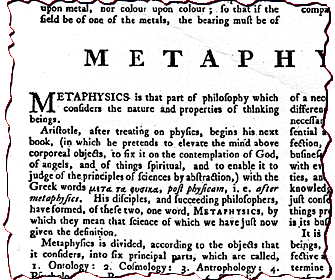
philosophy_dictionaryMy previous posts in this series were intended as a survey of what the Bible has to say about the four main disciplines of philosophy: epistemology (the theory of knowledge, metaphysics (the theory of reality), ethics (the theory of conduct), and politics (the theory of government). The structure and ideas contained in this series are taken from the tract What is Christian Philosophy? written by John Robbins and published by The Trinity Foundation.

These posts were written with three goals in mind. First, to lay my philosophical cards on the table. Since my purpose in writing this blog has always been to articulate the Scripturalism of Gordon Clark and John Robbins, it seemed good to set forth the basic assumptions of this system as clearly as I possibly could.

Second, it has been my hope to show the importance of systematic thinking. Systematic thinking is not popular today. That the world should passionately embrace irrationalism is not surprising. But the hostility toward logical thought in the professing church is alarming. Christ is the logos, the logic, of God. And those who bear his name, those who have the mind of Christ, of all people should have respect for sound thinking.

My third goal with this series has been to make philosophy accessible. Often people are turned off from philosophy, because they think they cannot understand it. Much of this is the fault of the philosophers themselves. If you are in that camp, I understand. In spite of my best efforts, I never understood philosophy until I started reading John Robbins. He was possessed of remarkable ability to take ideas that in the hands of other authors were all but impenetrable and make them clear. It has been my goal to do the same for others.

To close out this series, I have summarized my previous posts on Christian philosophy below.

(more…)

Read Full Post »

PoliticsSo far in this series on Christian philosophy, we have looked at three of the four major philosophic disciplines. First was epistemology, the theory of knowledge. It answers the question, How do you know? Second came metaphysics, the theory of reality. For those who have not previously studied philosophy, these terms may seem a bit strange or intimidating. Ethics, the theory of conduct, was third. Ethics is a more familiar term for us. It answers the question, What ought we to do ?

This post will address the disciple on politics. Politics is the theory of government. As you may suppose, there are many different views on government. Men differ on the origin of government – is it a natural institution?; does it arise from the consent of the governed? – the proper scope of government – should government be minimal or involve itself in every area of one’s life? – and what form of government – democracy, republic, or monarchy – is ideal.

The Origin of Government

In his book A Christian View of Men and Things, Gordon Clark raised the question, “How does a government get, not the power, but the right to coerce its people?” This may seem like a strange question to many people. For the most part, folks accept the existence of government in much the same way they accept the fact that the sun rises in the east, or the grass is green, or the sky is blue. But this is an important question. For if government cannot be justified in any form, there is no use in discussing its proper scope or form.

Historically, there have been several answers to Clark’s question. Aristotle, for example, believed that government was a natural institution. In one of his lectures on philosophy, John Robbins described Aristotle’s view thus, “People grow into states the way that acorns grow into oak trees.” Another view is the social compact theory: governments derive their coercive authority form the consent of the governed. Still another view is that government is power. This was the view of historian Oswald Spengler, who held that, “Great statesmen like Caesar or Napoleon act immediately on the basis of a flair for facts. Their action is not sicklied o’er by the pale cast of thought. If indeed ther ar any general principles of politics, they never enter the heads of great men” (Clark, A Christian View of Men and Things, 95). These views of government, diverse as they are, all have one important element in common: God, the God of the Bible, does not matter in any of them.

Christian political theory rejects all these answers to the origin of government. The Bible teaches us, in the words of Gordon Clark, that, “The existence of the state is a partial punishment and cure for sin” (A Christian View of Men and Things, 100). Government bears the power of the sword, the power of coercion, in response to man’s sin. Proof of this can be seen in Genesis 3:24, which reads, “So He drove out the man; and He placed cherubim at the east of the garden of Eden, and a flaming sword which turned every way, to guard the way to the tree of life.”
Civil government was not a natural institution, it was not part of the original created order, it came about after the fall of Adam. Writing in Romans 13 about the civil magistrate, Paul makes this same point where he tells us, “[H]e does not bear the sword in vain; for he is God’s minister, an avenger to execute wrath on him who practices evil.”

(more…)

Read Full Post »

Dictionary definition of the word

Throughout this series on Christian philosophy, it has been my argument that Christianity is a system of ideas thought out together. Christianity is not the only system of thought, it is not the only worldview. Marxism, for example, is a systematic attempt to provide a comprehensive worldview. On the other hand, Christianity is unique in that it is God’s revealed system of thought. it is truth itself. Paul’s statement, “Eye has not seen, nor ear heard, not have entered into the heart of man the things which God has prepared for those who love him” (I Corinthians 2:9), is a denial that man can discover truth on his own.

Throughout the course of history, men, brilliant men such as Plato and Aristotle, have argued that man can too discover truth by his own efforts. Secular epistemology – epistemology is logically the first discipline of philosophy, it is the theory of knowledge answering the question “How do you know?” – comes in one of two forms. Rationalism (Plato) tells us that men can know truth from ideas they come up with in their own minds. Empiricism (Aristotle) argues that man can know truth by observing things. Our senses, say the empiricists, furnish us with knowledge. Christianity, on the other hand, argues that truth, all truth, is graciously revealed by God to men, that men do not discover truth on their own, that the so-called wisdom men claim to have found by their own efforts is, in reality, foolishness.

One’s view of metaphysics – metaphysics is the theory of reality – depends upon his epistemology. Since we live in an age in which empirical epistemology is dominant, it is not surprising that people believe that matter, physical stuff, is the ultimate reality. Carl Sagan gave voice to this idea when he wrote, “The cosmos is all that is or was or ever will be.” But as John Robbins wrote in his tract What is Christian Philosophy?, Christian metaphysics, which is based upon a Christian theory of knowledge, speaks in this way, “in God, not matter, we live and move and have our being.” The universe is not eternal, but created Not independent, but upheld by God. Not evolving to perfection, but advancing in its decay.

(more…)

Read Full Post »

Encyclopaedia Britannica, 1771.

Encyclopaedia Britannica, 1771.

My earlier post In Praise of Karl Marx makes the point that Christians can take one positive lesson from Marx’ work: the power of systematic thought. Marx was a thoroughgoing atheist, and both he and his followers consistently applied atheism to all fields of study, creating a well-developed all-around view of the world. Systematic thought is powerful and impressive. One idea is related to and supports another, in much the same way the flying buttresses support a majestic gothic cathedral. This is true, even if the system itself is badly flawed.

Of all people, Christians should be the most systematic thinkers, for we have the systematic, non contradictory truth of God’s Word revealed to us in the 66 books of the Bible. From the express statements and necessary implications of Scripture, we are able to develop a coherent, complete, systematic worldview. The apostle Paul tells us that the Scriptures make the man of God complete, thoroughly equipping him for every good work. This includes the good work of developing a systematic, Christian view of the world.

(more…)

Read Full Post »

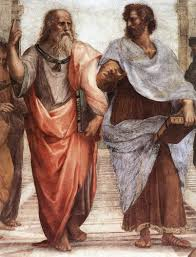
Raphael's The School of Athens, depicting Plato and Aristotle.

Raphael’s The School of Athens, depicting Plato and Aristotle.

Last week I mentioned one positive lesson Christians can take from Karl Marx. That may seem like a strange statement at first blush. After all, Marx was an atheist, a collectivist, and a violent revolutionary. Hardly the sort of fellow a Christian should look to for philosophical guidance. And yet, there is one aspect of his program that does recommend itself to the Christian: he was a systematic thinker. He didn’t randomly throw ideas together, but sought to develop a unified worldview based on certain philosophic principles. Systematic thinking, systematic philosophy, has tremendous power. So much so, that even an evil system of thought such as Marxism can take the world by storm.

Christianity also is a system of thought. But unlike Marxism, or Kantianism, or Objectivism, or any other system developed by man – what the apostle Paul deemed “the wisdom of this world” – Christianity is a revealed system of thought. One could even call it a revealed system of truth. For Christianity reveals the mind of God, the truth that comes from God, in every area of intellectual inquiry.

But even though Bible-believing Christians would be the first to defend the Word of God as inspired, inerrant and infallible, too often their thinking, and thus their practice, betrays a certain amount of inconsistency. The Bible, in the view of many Christians, is good for learning about God, sin, and salvation in Christ. But when it comes to questions of philosophy, well, the Christian will have to go to the experts. This always means the secular philosophers.

Thomas Aquinas is the ultimate example of this approach. In his case, he attempted to combine revealed ideas from the Bible with the empirical philosophy of the pagan philosopher Aristotle. The resulting system called Thomism is now the official philosophy of the Roman Catholic Church-State. It is also, unfortunately, the philosophical system of many Evangelicals. Well known evangelicals such as R.C. Sproul and Norman Giesler both espouse Thomism. And while Aristotle and Aquinas were brilliant men, neither one’s system of thought was Christian. By following Aquinas, these Evangelicals unknowingly undercut their Christian witness.

In one of his lectures on philosophy, John Robbins made the point that a major weakness of the Reformation was the fact that it never produced a systematic philosopher. That is, no one, at least in any coherent way, ever attempted to apply Scripture to the problems of philosophy. That is, no one until Gordon Clark. With Clark’s work, Christians for the first time were furnished with a Biblical system of thought capable of meeting and defeating all rivals in all fields of intellectual endeavor. In some ways, it is hard to believe that it took so long for this to happen. Yet happen it finally did. And as Christians we can take great delight in this. My goal in this and in the next few posts will be to summarize the basic ideas of Christian philosophy using John Robbins tract What is Christian Philosophy? as my guide.

(more…)

Read Full Post »

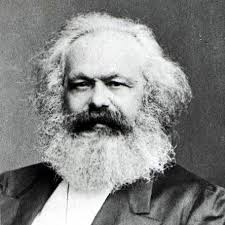
Karl Marx

Karl Marx

Christians can lean lessons in the oddest places, even from the likes of Karl Marx. Marx, of course, was the 19th communist radical whose ideas have proven to be one of the dominant forces in the world over the past 100 years. Now before you think I’ve gone off the deep end, I can assure you I’m not sporting a Che Guevara T-shirt or making plans to visit to Fidel Castro. No, my praise for Marx has nothing to do with his ideology, with which I vehemently disagree. But if not for his ideology, why would I praise him? What would a Christian writer find praiseworthy about a militant atheist whose considerable body of work was radically opposed to Christianity and has proven to be the cause so much misery in the world? The short answer to that question is this, Marx was a systematic thinker.

It was a Christian video series on worldviews that started me thinking about this. Marx was an atheist, and his atheism imbued every aspect of this thinking. Marxist views in the fields of politics, history, economics, sociology, psychology, ethics, etc. all can be traced back to atheist assumptions. Marxist ideas about a particular subject, economics for example, are not divorced from Marxist ideas on other subjects. Marxism is not a random collection of ideas, but a system of things thought out together. This is what gives Marxism much of its appeal. It provides, or at least seems to provide, people with a unified worldview. And this unified worldview is a powerful motivating force.

(more…)

Read Full Post »

“Judge not lest you be judged,” is a favorite quote of unbelievers. They delight in hurling them at Christians during an argument. And all too often, these words have exactly the effect intended, that is to reduce the Christian is reduced to silence. After all, are not these words not found in Scripture? Were they not spoken by Jesus himself? The answer to these questions is yes and yes. But do these words really mean, as the unbelievers seem to think they do, that Christians have not basis for making moral judgments? The short answer is no.

My Introduction to Irrationalism

As is the case with most who grow up in church, I was not taught to think rigorously. I recall many years ago asking someone at my church about a passage I did not understand. It seemed to me that there was a contradiction in Scripture, so I asked for an explanation and was given the standard quote from Isaiah 55, saying God’s thoughts and God’s ways are higher than ours. This was then interpreted to mean we just have to accept that some things in the Bible do not and cannot make sense to our finite minds. There are mysteries, tensions, and apparent contradictions in the Bible that finite man simply cannot understand with mere human logic.

I didn’t know it at the time, but this was my introduction to irrationalism. The person with whom I spoke provided me the best answer he knew. I have no reason to believe he had any intention of deliberately misleading me. And yet, mislead me he did. And it would be many years before, by the grace of God, I found my way out of that intellectual cul-de-sac.

(more…)

Read Full Post »

Jeremiah 5:31 The prophets prophesy falsely, And the priests rule by their own power; And My people love to have it so. But what will you do in the end? (Jer. 5:3)

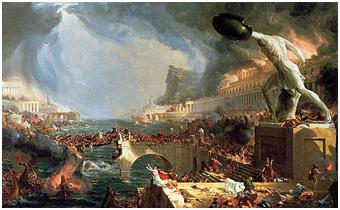
It’s long been popular to compare the obvious decline of American society over the past 100 years to that of the Roman empire. Perhaps some of this owes to the influence of Edward Gibbon’s famous Decline and Fall of the Roman Empire. Some purport to draw lessons from the Roman experience that can be applied in our day. Some will spot similarities between events in the Roman empire and those of contemporary times, and drawing from these likenesses the idea that America is in terminal, inevitable decline. Others of a more optimistic point of view hope to drawn lessons from the Roman example on how to stop or even reverse the decline.

But long before Rome famously declined and fell, for that matter, long before the city of Rome was even founded, two other kingdoms passed through experienced their own decline and fall. I speak of Israel and Judah. The books of Judges, Samuel, Kings, Chronicles, and the prophets could rightfully be called The History of the Decline and Fall of the Hebrew Republic. In them, we read how a nation originally founded as a constitutional republic, first devolved into a monarchy, next split into two separate kingdoms, and then following independent, centuries long glide paths of decline finally met their ruin.

If we want to examine the decline of American society, it is to these examples, rather than that of Rome, to which we should turn our attention. The experience of Israel and Judah are much more helpful in assessing out current condition as a nation than Rome ever could be, chiefly because we do not have to speculate as to why things happened as they did. Unlike even the best histories of Rome, the Scriptural record provides us not only a perfectly accurate account of the key events in the history of Israel, but also an infallible commentary on why these events occurred as they did. Let us now turn to God’s inspired history to see what lessons we may draw about the condition of the United States at the beginning of the 21st century.

(more…)

Read Full Post »

“I believe things happen for a reason,” or so the saying goes. It’s remarkable how often people give voice to this pop-culture proverb. But unlike most of the world’s supposed wise sayings, this one happens to be a true. In fact, one suspects it is far more true than most people realize.

Things do happen for a reason. But it’s not because of karma, or fate, or the alignment of the stars. The reason is this: God planned it that way from all eternity and inexorably brings his plans to fruition in his works of providence. Not just some things. Not just the big things. Not even just the pleasant things. But all things.

And he does it for his own glory.

Read Full Post »

For we must all appear before the judgment seat of Christ, that each one may receive the things done in the body, according to what he has done, whether good or bad. – 2 Cor. 10:5

The Bible asserts, and Christians hold, that sinners are justified by belief alone in Christ Jesus. Good works play no part in salvation. But if good works do not save us, what then is their purpose?

Glorify God

One answer to this question is that good works glorify God. Paul put it this way, “Therefore, whether you eat or drink, or whatever you do, do all to the glory of God” (1 Cor. 10:31). Echoing this idea, the Westminster Shorter Catechism tells us that part of man’s chief end is to glorify God. When we do good works, not only do we glorify God, but we prompt others to do the same. Jesus said, “Let you lifth so shine before men, that they may see your good works and glorify your Father in heaven” (Matt. 5:16).

(more…)

Read Full Post »

« Newer Posts - Older Posts »