Feeds:
Posts
Comments

Archive for the ‘Scripturalism’ Category

Logic and Typology

The whole counsel of God concerning all things necessary for His own glory, man’s salvation, faith and life, is either expressly set down in Scripture, or by good and necessary consequence may be deduced from Scripture: unto which nothing at any time is to be added, whether by new revelations of the Spirit or traditions of men.     – Westminster Confession of Faith I.6    

After a recent talk on the subject of the interpretation of Scripture, some one asked me a question about typology.  In essence her question was this:  how do we know a type is a type?  It was a good question.  For if I learned anything during my short stay at Knox Seminary it was that the study of typology can, when undertaken by unlearned and unstable hands, serve as a launching pad for the worst sort of theological nonsense.  Dr. Warren Gage, the current Dean of Faculty at the school, discerned types and antitypes by using what he called “poetic imagination” and “intuition.”  This was his academically respectable way of saying, “I’m making this stuff up as I go along.” “Logic,” he advised us in class one day, “is necessary, but we also need imagination.” This approach to Scripture is not the Biblical, neither is it confessional.  The Biblical and confessional method for determining types is the same method we use to settle all other questions of Christian doctrine:  the application of the laws of logic to Scripture.   

The laws of logic – contradiction, identity, excluded middle – are the principal tools for the interpretation of Scripture.  This was understood by the men who framed the Westminster Confession of Faith (WCF) and is the thought behind the famous quote at the top of this post.  Contrary to the opinion of many contemporary theologians, the laws logic are not something external to Scripture, not something to be curbed, but simply the description of how God thinks.  And man, because he is the image of God, thinks the same way.  The Gospel of John expresses this idea when it notes that Christ, “was the true light which gives light to every man coming into the world.” We think two plus two equals four because God thinks two plus two equals four and he has constructed our minds to be the image of his.          

The WCF recognizes two ways in which the whole counsel of God – and the whole counsel of God includes typology – is communicated in Scripture: 1) express statement, and 2) good and necessary consequence.  An example of an express statement in Scripture can be found in the first verse of the Bible, “In the beginning God created the heavens and the earth.”  This statement tells us several things explicitly.  Creation took place in the beginning, it was an act of God, and it included all things.  But there’s more to this verse that what is stated in explicit terms, there are several necessary consequences or implications in this statement as well.  For instance if creation took place in the beginning, it did not occur at some earlier or later point.  Furthermore this verse implies that the devil or the Big Bang did not perform the work of creation.  Also we can validly conclude that nothing was made that was not made by God. 

If the whole counsel of God is either expressly set down in or necessarily deduced from Scripture, and if typology is part of the whole counsel of God, by good and necessary consequence it follows that any claim that some one or something in the Old Testament is typical of some one or something in the New Testament must be proven by either an express statement or necessary inference from Scripture.  Herbert Marsh expressed this logical, confessional and Biblical approach to typology when he wrote,

Whatever persons or things, therefore, recorded in the Old Testament, were expressly declared by Christ, or by his Apostles, to have been designed as pre-figurations of persons or things relating to the New Testament, such persons or things, so recorded in the former, are types of the persons or things, with which they are compared in the latter.    

This principle, known as Marsh’s dictum, has been the bane of imaginative typologists for nearly 200 years, for it applies directly to typology the same laws of logic that govern all other areas of theology.  Now it’s true that Marsh states that types must be expressly declared, and some might argue that in doing so he has erred by excluding the possibility that types may be implied in Scripture as well as expressly stated.  Very well, I’m open to the argument that there’s such a thing as an implied type, but those who claim this must produce an example.  So far, I’ve yet to see one.  But even if they succeed in doing this, pace Warren Gage and the other addled folks at Knox Seminary, the confessional principle of Biblical interpretation still stands.
Read Full Post »

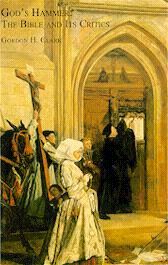
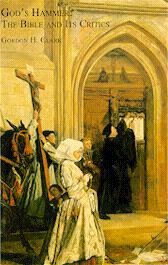
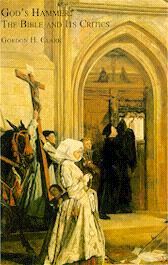
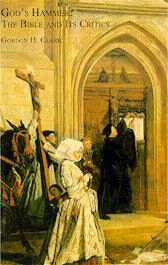
This is the second in a series of posts commenting on the book God’s Hammer by Gordon Clark.

Bible critics, who at sundry times and divers manners attacked the inspiration and truth of the Bible, have in these last days continued to press their case.  This, of course, makes a defense of these ideas most necessary.  In this chapter, however, Clark addresses the issue of inspiration only, reserving a discussion of truth for later chapters.  Clark writes,

The question of this chapter concerns the inspiration of the Bible.  It must be clearly distinguished from another question with which it might be confused:  How may I know that the Bible is true?  These two questions are indeed related, but they are not the same question.  They have even been answered in opposite ways.  A contemporary movement in theology called Neo-orthodoxy claims that the Bible is inspired, but also asserts that it is not completely true.  And obviously some other book, such as Churchill’s The Gathering Storm, could possible be entirely true without being inspired.  Such a book might even be called infallible.  Truth and inspiration therefore must be distinguished. 

Many authors, Christian or not, fail to distinguish and define their terms.  Clark does not make this mistake, and this lends power and clarity to his writing.  He continues,

The two ideas, however, are closely related, especially in the case of the Bible.  The Neo-orthodox writers can hold to an inspired but mistaken Bible only because they have changed the meaning of inspiration.  When the Biblical definition of inspiration is used, there can be no inspiration without truth, even though there often is truth without inspiration.  For the Christian, therefore, the question of truth is a prior question, and unless the Bible is true, there is not much use in discussing inspiration.

A glaring problem with much of the theology written over the past one hundred years is that its  language is fundamentally dishonest. Those who rejected Christ, wanting to cloak their unbelief behind a veil of Biblical vocabulary, deliberately used historic Christian terms while attaching new meanings to them.  The Neo-orthodox theologians – of which we will have more to say later – were one such group.  These men in the same breath could claim that the Bible was indeed inspired by God and that it was full of errors.  They had a different definition of inspired than Gordon Clark.  So then, whose definition was correct?  Was Clark right or the Neo-orthodox?  What does the Bible claim for itself?  Does it assert its own inspiration? How does it define inspiration?  Is the Bible even the place to look to answer these questions, or is it circular reasoning to defend the Scriptures by appealing to the Scriptures?

Read Full Post »

This is the first in a series of posts commenting on the book God’s Hammer by Gordon Clark.                                            
Necessity, authority, sufficiency, clarity.  Historically Protestants have considered these to be hallmark characteristics of Scripture, summing them up under the Reformation slogan sola scriptura.  But beginning in the 19th century, the reformed trumpet began to make an uncertain sound.  In 1893, noted Presbyterian minister and scholar Charles Augustus Briggs was suspended by the Presbyterian Church in the U.S.A. for  teaching that the Bible contains error.  While this was a notable victory, the following decades were not so kind to the Fundamentalist cause, and by the end of the 1920s the PCUSA was firmly in the grip of Modernist ministers preaching a false gospel from a (supposedly) fallible Bible. 

Now the theological debates of a hundred years ago may seem far removed and unimportant to Christians today.  And while it’s tempting to dismiss the Fundamentalist-Modernist conflict over textual criticism, translations and Biblical infallibility as nothing more than a case of pointy headed professors wrangling over words, that would be a big mistake.  The transformation of the PCUSA from a Bible believing church to a tool of the modernists began with an attack on the verbal inspiration and inerrancy of God’s Word.  “Yea hath God said?,” was Satan’s first attack on verbal revelation, and his attacks continue in our day.  Writing in the introduction to God’s Hammer (GH), editor John Robbins comments,

The twentieth century may be a pivotal period in human history, for the doctrines of justification through faith alone and truth through the Bible alone came under such a severe and sustained attack.  That attack, which has been countered by only a few of the professed tens of millions of Christians in America, has come primarily from within the church itself.  It indicated that the wolves are within the sheepfold, and in many cases, are actually posing as shepherds. 

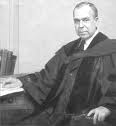
Gordon Clark was one of those few twentieth century theologians who undertook to counter the attacks on Scripture.  And in truth, he did more than simply counter the attacks, with devastating logic he demolished the critical arguments of both modernist and neo-orthodox scholars and demonstrated powerfully from the Scriptures the truth and authority of the Bible.

Over the next several weeks, I’ll be blogging through God’s Hammer chapter by chapter to discuss Clark’s arguments in defense of the Bible.  If you haven’t yet, I urge you to buy and read a copy.  If you’re a long time Clarkian, I urge you to reread it, for God’s Hammer is an apologetic gold mine.  

Comments are welcome.

Read Full Post »

Christians often refer to the Bible as the Word of God.  And that’s certainly appropriate, for that’s what the Bible claims to be:  God’s inspired verbal revelation.  At the same time the Bible describes Jesus Christ as God the Word,  “In the Beginning was the Word, and the Word was with God, and the Word was God” (Jn.1:1).  Is it merely an accident that the term ‘word’ is used of both the Bible and Christ, or is there some connection?  

Writing in his book The Johnanine Logos, Gordon Clark examines the apostle John’s use of the Greek word logos, famously translated ‘Word’ in the first verse of John’s Gospel as a name for Jesus.  Clark then looks at how John uses logos in the rest of his Gospel account and finds after quoting several examples that it always means, “an intelligible proposition [sentence].” So what is the connection between the Logos who is God in verse 1 and the logoi  [plural of logos] that are propositions (sentences) in the remainder of the book?  Clark writes,

The connection is this:  The Logos of verse 1 is the Wisdom of God.  To him his worshippers erected the architectural triumph Hagia Sophia, the church in Constantinople dedicated to the Holy Wisdom of God…Some of this wisdom is expressed in the propositions of the previous list [various verses from John’s Gospel that are said to be logoi].  They are the mind of Christ:  They are the very mind of Christ.  In them we grasp the Holy Wisdom of God.  Accordingly there is no great gap between the propositions alluded to and Christ himself.

The Scriptures are not merely black ink marks on white pages; they are the eternal thoughts of God.  Paul stated, “we have the mind of Christ” (1Cor.2:16).  Christians  have the mind of Christ by understanding and believing the words of Christ recorded in the Scriptures.  And not the words of Christ only, but all the words in all the Scriptures, for, “All Scripture is given by inspiration of God” (2Tim.3:16).  To know God the Word, we must be good students of the Word of God.

Read Full Post »

The Bible alone is the Word of God.  This is the axiom, the starting point, for the whole system of Christian doctrine.  Since all saving knowledge of God is given in Scripture (man has an innate knowledge of God that does not lead to salvation, see Rom.1:18-23 and WCF I.1) it is critical that the church clearly understand and articulate what the Bible has to say about its own origin and authority.  In the early years of the twentieth century the Bible was under attack by liberals, who, by advancing an erroneous doctrine of the inspiration of the Bible, managed to undermine the authority of the Scriptures in the eyes of many.    J. Gresham Machen would have none of this.  Writing in his book Christianity and Liberalism, Machen commented,

The contents of the Bible, then, are unique.  But another fact about the Bible is also important.  The Bible might contain an account of a true revelation from God, and yet the account be full of error.  Before the full authority of the Bible can be established, therefore, it is necessary to add to the Christian doctrine of revelation the Christian doctrine of inspiration.  The latter doctrine means that the Bible not only is an account of important things, but that the account itself is true, the writer having  been so preserved from error, despite a full maintenance of their habits of thought and expression, that the resulting Book is the “infallible rule of faith and practice.”

The Bible alone is the Word of God, and that Word is truth, infallibly communicated by the human authors of Scripture writing under the influence of the Holy Spirit.

Read Full Post »

“All truth is God’s truth,” or so we often hear.  I myself have said this and felt righteous, wise and holy in doing so.  But closer examination reveals a serious problem with this popular maxim: no definition of the word truth.  What does truth mean in this context? Highlighting this problem in a lecture available on The Trinity Foundation website titled “The Ministry of the Trinity Foundation,” Jack Lannom said,

My mistaken belief that all truth is God’s truth was really no different from the idea that all worship is God’s worship.  John Moffat (sic) addressed this idea in an article in The Christian Conscience. ‘ I can imagine Nadab and Abihu talking about the early worship service in the wilderness.  One says to the other, ‘all fire is God’s fire.  God made all fire, therefore it’s all of him.” Or while Moses was up on the mountain, Mount Sinai, the children of Israel could have said to Aaron, “Aaron, all worship is God’s worship.’ ‘ I love this last phrase that John Moffat (sic) says, ‘these analogies have the same deceptive sound of being logical at first, but they are full of the same ambiguity and deceit as the expression all truth is God’s truth.’

These saying – all fire is God’s fire and all truth is God’s truth – are ambiguous and deceitful because the same word is being used to mean different things.  There are many types of fire.  There are campfires, there are brush fires, there’s even a burning lake of fire, but these fires are different things than what God deemed acceptable to himself under the law.  There are many activities that people call worship, but only that worship defined by God is worship proper.  All other so-called worship is really idolatry. 

And so it is with truth.  There are many things people call truth:  scientific truth, historical truth, truth gleaned from personal experience, truth learned from Oprah.  But none of these things are truth as the Bible defines truth.  Christ prayed, “Sanctify them by your truth.  Your word is truth.” 

The Bible alone is the Word of God, therefore the Bible alone is truth.  Those who say “all truth is God’s truth,” are proclaiming that there is truth outside of the Scriptures that man discovers on his own.  But this is false, for we are just as dependent on God for the knowledge of the truth as we are for salvation.  What we should say is, “God’s truth is all truth.” That is the Christian position.

Read Full Post »

While rereading Gordon Clark’s God’s Hammer, I was impressed with the forward written by one of the Bible’s great recent champions, Harold Lindsell.  Lindsell writes,

At the heart of the Christological discussion lies the question:  From whence do we get our knowledge about the person and work of Jesus Christ?  The answer is simple enough.  The only Jesus the Church has known or can know is the Jesus of Scripture.  Thus if Scripture tells us what we need to know about the second person of the Trinity, we are still left with another question:  Is the source (i.e. the Bible and its sixty-six books) from which we get out knowledge about Jesus a reliable book?  This opens the door to three possibilities:

1. The Bible is free from all error in the whole and in the part.

2. The Bible is free from error in some of its parts, but it is false in other parts.

3. The Bible is totally unreliable and cannot be depended on for any truth.

Whoever chooses any one of these propositions depends on some basic presupposition from which the inquirer starts.  In our modern world there are basically two ways men write theology, and each involves a presupposition which ends up in quite different ways. 

In all probability a majority of the scholars in the West today would choose option 2. Marxists and many people who adhere to the Unitarian Universalist denomination would more likely choose  option 3.

But whoever writes theology properly starts with the presupposition that the Bible is a divine book.  They do not deny that there were human authors who were involved in the inscripturation of the Word of God.  The writers of Holy Writ were divinely inspired by the Holy Spirit so that they were kept from writing anything that was false.  The divine authorship by the Holy Spirit guaranteed that the final product would be the errorless Word of God even as the historical Jesus was the sinless Son of God who was conceived by the same Holy Spirit in the womb of the Virgin Mary.  Since God cannot lie, no part of Scripture is false.  The omnipotent God of Scripture has not stuttered in his speech.

There is no more important doctrine that the doctrine of Scripture.  Get it right, your understanding of other doctrines will tend to be sound.  Get it wrong, and you’re hopelessly lost in a sea of subjectivity.  Those who claim Christ while attacking his Word are like the double minded men of James.  Unstable in all their ways, they will receive nothing from the Lord.

Read Full Post »

In the winter of 2001 a friend gave me a book on justification titled The Everlasting Righteousness by Horatius Bonar.  Being relatively new to reformed theology, I was eager to read about the doctrine on which the church stands or falls.  I started reading at the Foreword, and immediately found myself riveted by the stirring introduction.  Here’s what I read,

  It has been nearly 2,000 years since the apostle Paul wrote his letters explaining the gospel of justification by faith alone to the churches in Asia and Europe, and the light of the Gospel shone brilliantly in the spiritual, intellectual, and moral darkness of ancient Rome.  But Antichrist, already at work in the first century, soon sat in the temple of God, expelling and persecuting the saints and suppressing the Gospel of Christ for a millennium.  His dominion ended when God raised another witness to his truth in the sixteenth century.

It has been nearly 500 years since Martin Luther recovered the Gospel in Europe.  Once again, in the sixteenth century, the light of justification by faith alone dispelled the spiritual, intellectual, and moral darkness of medieval Rome.  The resulting civilization owed its salient features to the Gospel of Jesus Christ – to the first Christians and the Reformers – but for the past century the proclamation of that Gospel – and civilization – has been waning…

Clarity, brevity and power were the hallmarks of this writer, who in three brief pages did more to explode false gospels and proclaim the true one than many authors could do in thiry.  “Who writes like this?”  I asked myself.  And at the end of the  essay on page xi I found my answer:  John W. Robbins. 

I had never heard of John Robbins and knew nothing about his work.  The book’s publisher, The Trinity Foundation, was completely unknown to me.  But I was intrigued and wanted to find out more.  Over the next year I was a regular visitor to the Foundation’s web site, and what began with one small book soon turned into a whole library of Trinity Foundation material.  But the effect on me was far greater than the further stuffing of my alrealy overstuffed book shelves.  It was nothing short of a spiritual and intellectual revolution.

After several years of corresponding by email, I had the opportunity to meet Dr. Robbins in January of 2007.  By this time I had read and listened to so much of his work I felt that I already knew him.  But what was he like in person?  When we met he was wearing a flannel shirt, jeans and some old work boots.  Not the sort of thing you’d expect from a brilliant scholar, but Dr. Robbins, or John as he insisted,  was not an ordinary sort of man.  The apostle Paul commented that knowledge puffs up, and I have witnessed many men with a fraction of John’s accomplishments bear witness to the truth of this statement.  But John, like the Savior he loved so well, was not a pretentious man.  He was easy to talk to and quick with a laugh.  He showed me into his study where he had to move stacks of books and papers just so I could find a place to sit on the couch.  And while I was concerned about imposing on his schedule, far from being too busy to talk, he graciously gave me three hours of his time.  In fact, I probably could have stayed longer, but I still had a long drive home that night and had to get on the road.

In the providence of God, John entered into glory a year ago this week.  He was for me and elder brother in the Lord, a mentor, and a friend. Selfishly I wish he were still here.  But though the Lord took him this life, his bold proclamation of God’s truth, which is all truth, remains.

Read Full Post »

Several years ago when I first started reading Trinity Foundation materials, I ran across a statement that John Robbins had made about epistemology and the Bible.  While I don’t recall the exact passage I read, I do remember that he argued that the Bible was the axiom, or starting point, for Christian thought.  

Although I was intrigued by the argument, I wasn’t sure I could defend the position if I were asked to.   So with that in mind, I sent John an email, not really expecting to hear back from him.  To my surprise, I received and email response within just an hour or two that answered my question.  I don’t have John’s email anymore, but the following quote from Gordon Clark makes the same point John made to me,

Logically the infallibility of the Bible is not a theorem to be deduced from some proir axiom.  The infallibility of the Bible is the axiom from which the several doctrines are themselves deduced as theorems.  Every religion and every philosophy must be based on some first principle.  And since a first principle is first, it cannot be “proved” or “demonstrated” on the basis of anything prior (What Do Presbyterians Believe?, p.18) .

The simple idea that every religion or philosophy has a indemonstrable starting point, and that for the Christian that starting point is the infallibility of Bible, is the basis for the whole Scripturalist enterprise.  And when I came to understand this and accept it as true, it turned all of my thinking upside down.  Or perhaps more accurately, right side up.

Apart from an important lesson in theology, I learned one other thing from John that day: the importance of not despising an honest inquiry, however simple it may seem.  John was a busy man, and he easily could have ignored my email and found something more important to do.  But he didn’t.  And for that I am eternally thankful.

Read Full Post »

« Newer Posts