Feeds:
Posts
Comments

Archive for the ‘Theology’ Category

Last week Stephen Welch blogged a post titled Knox Theological Seminary:  A New Haven for Federal Visionists.  If you haven’t already done so, check it out.  It’s a good post.  The article, which also appeared here on The Aquila Report site, breaks the news that Knox Theological Seminary (KTS) has hired Federal Visionists John Armstrong and Peter Leithart.  This is certainly big news.  But to some pre-2007 KTS students , it’s not especially surprising.

At the height of the fall 2007 controversy centering on OT professor Warren Gage and his –  uh, how shall I say it – unique brand of typology, my friend Jason Grabulis started a blog focused on providing accurate news and commentary to KTS students, who had largely been kept in the dark by the administration about the details of the Gage firing/suspension/rehiring circus. Jason, writing on his now defunct Stuff That Matters blog – the administration at Knox out of their concern to keep students up to date and preserve the free flow of information forced Jason to take down the blog on pain of losing his scholarship, the truth may set you free, but at KTS it also gets you the left foot of fellowship, not to worry, though, you can find the full contents of Jason’s blog here – made the following statement on November 10, 2007,

Since some Federal Vision (and some NPP) advocates appear to endorse Dr. Gage and his hermeneutic (for instance, Peter Leithart) – since Dr. Gage’s hermeneutic does provide an exegetical basis for their theology – then will the Federal Visionists see this as an opportunity to move into Knox Seminary and establish a Federal Visionist and New Perspective on Paul institution and ministry?

Good call, Jason.  That’s insight.  Now what do you think about the odds of NT Wright being the next Knox guest of honor?  For my part, I imagine they’re pretty good.  If nothing else, the weather in Ft. Lauderdale’s got to be better than in St. Andrews.

At about the same time another former KTS student, one of Jason’s classmates, made a similar comment,  writing,

Now that Gage and his Federal-Vision-friendly teaching are firmly ensconced at Knox Theological Seminary, and his opponents Beisner, White, and Reymond, who also were opponents of the Federal Vision, are now gone from the school, Knox Seminary is in danger of becoming a bastion of Federal Vision/New Perspective on Paul teaching.  And this danger extends to the Coral Ridge Presbyterian Church as well.  – Imagining a Vain Thing, p.104, n.10

The predicted chickens have finally come home to roost.  And while there’s some satisfaction in being ahead of the curve regarding the doctrinal direction of KTS, that satisfaction is more than offset by the knowledge that the transformation of Knox into a Federal Vision school is no longer a future event, but a present reality.

All this raises an interesting question, now that KTS has gone FV, whither Coral Ridge?  It’s separated from Knox by no more than the breadth of N. Federal (Vision) Highway and wide open to an FV takover…if that hasn’t happened already.

May the Lord defend the truth of his Gospel.

Read Full Post »

Noah’s Park

Quick, somebody call Clarence Darrow!  The fundy hicks are at it again!  Ok, maybe the headlines and stories in the leading Kentucky papers weren’t quite that blatant, but they were pretty close.  The cause of this consternation?  A proposed theme park named Ark Encounter.  It seems that a group in Commonwealth, which is owned in part by Answers in Genesis, wants to construct a theme park based on the Biblical account of Noah’s Ark, a park that will include, among other things, a full-scale replica of the famous craft. 

This is all just too much for leading Bluegrass State intellectuals who are still reeling from the “embarrassment” of the recently opened Creation Museum and the election of Rand Paul to the US Senate.  Here’s a sample of what’s been written,

But these incentives could have been awarded without Gov. Steve Beshear’s public embrace of an expansion of the Creation Museum – a project rooted in outright opposition to science.    Hostility to science, knowledge and education does little to attract the kind of employers that will provide good-paying jobs with a future. – Lexington Herald Leader 12/3/2010

Creationism is a nonsensical notion that the Earth is less than 6,000 years old.  No serious scientist upholds this view.  –  Louisville Courier Journal 12/2/2010 

[T]he proposed creationism park reinforces unfortunate stereotypes of Kentucky and Kentuckians.  – Louisville Courier Journal 12/5/2010

Now it’s not surprising that the newspaper types would be embarrassed by Noah’s Ark.  We’ve come to expect this sort of thing.    But what I find interesting about battles of this sort is how liberal types, who in general have utter disdain for constitutional, limited government, suddenly get their Thomas Jefferson on when they feel Evangelicals are horning in on their turf.  Why the nerve of those fundies! Don’t they know that tax breaks are the exclusive domain of atheists?

For my part, I hope Ark Encounter is a smashing success.  Maybe they can even invite Bruce Waltke to the ribbon cutting.

For further reading click here, here, here, here, here, and here.

Read Full Post »

Today I received the plenary session recordings I had ordered from the recently concluded ETS conference.  These are the sessions in which NT Wright defended and Thomas Schreiner and Frank Thielman attacked the NPP.  Lord willing, I plan to listen to and comment on these sessions over the next several weeks.  I’d like to say I’m looking forward to hearing Schreiner and Thielman take on Wright, but from the comments I’ve seen from around the internet, I don’t hold out a lot of hope the Schreiner and Theilman gave Wright the good old fashioned smack down he deserved. 

Meanwhile, if you entertain any doubt that Wright’s a certified one hundred percent theological crank, flaming whack job, false brother, and damnable heretic, who has no business teaching so much as an afternoon Bible study let alone appearing as plenary speaker at ETS (and yes, I realize this is disrespectful, but Wright richly deserves every bit of it and more), the following quote should help put that to rest,

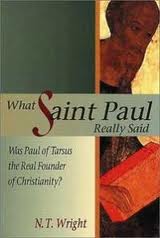
If we use the language of the law court, it makes no sense whatever to say that the judge imputes, imparts, bequeaths, conveys or otherwise transfers his righteousness to either the plaintiff or the defendant.  Righteousness is not an object, a substance or a gas which can be passed across the courtroom.  For the judge to be righteous does not mean that the court has found in his favour.  For the plaintiff or defendant to be righteous does not mean that he or she has tried the case properly or impartially.  To imagine the defendant some how receiving the judge’s righteousness is simply a category mistake.  That is not how the language works.  What Saint Paul Really Said, p.98 

What NT Wright really says amounts to a direct assault on the Gospel of Jesus Christ, for Paul tells us that, “Christ died for our sins according to the Scriptures.” And, among other things, according to the Scriptures means Christ’s righteousness is imputed to those who call on his name.  Wright may find this a baffling  “category mistake” or, as he says elsewhere, “a cold piece of business, almost a trick of thought performed by a God who is logical and correct but hardly one we would want to worship” (Wright like many contemporary heretics hates logic as much as he hates God), but while imputation leaves a bad taste in his mouth, it’s the way God justifies sinners, for as Isaiah writes, “by His stripes we are healed.” And that, Dr. Wright, is imputation, no matter how much you denigrate, dispute, downplay, deny or otherwise despise it.

More to follow.

Read Full Post »

Like a lot of kids growing up in the 70s and 80s, I was a huge comic book fan.  I had a subscription to Spiderman for several years – yes, just like Peter Parker I was a bit of a nerd – and did more than my fair share to help pay the local bookstore’s rent by constantly raiding their collection of overpriced back issues, all wrapped in special comic book protective covers.  Those wrappers were very important.  They added gravitas to the comic books, transforming them – in my mind – from kids stuff to real, serious collectors items.  As far as I know, I still have most of them too.  That is, unless mom threw them out…hmm, maybe I’d better go check on that first. 

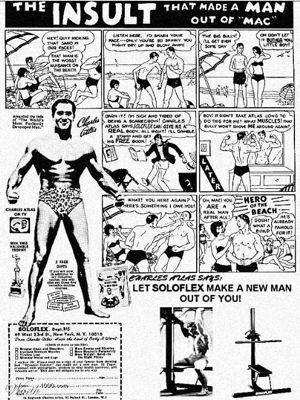
At any rate, though I can’t recall much in the way of detail about the stories I read, one thing I do clearly recall from those comic books was an ad run by Charles Atlas.  The famous one we’ve all seen.  You know, where the beach bully kicks sand in the face of the 98 pound weakling and steals his girlfriend.  Determined not to let it end like that, the wimpy kid goes and orders a Charles Atlas book, bulks up and in the end gives the bully a good thrashing.  He gets his girlfriend back too.  Not a bad return on a ten-cent stamp.  

Now growing up in Cincinnati, I didn’t have a lot of opportunity to go to the beach, so I can’t say that I ever had a bully kick sand in my face.  But of course bullies aren’t found only on the beach.  They’re on playgrounds and at the office too.  Some bullies teach in seminary and preach from the pulpit on Sundays.   

In the New Testament, Diotrephes was such a man.  Writing about him, the Apostle John says,

I wrote to the church, but Diotrephes, who loves to have the preeminence among them, does not receive us.  Therefore, if I come, I will call to mind his deeds which he does, prating against us with malicious words.  And not content with that, he himself does not receive the brethren, and forbids those who wish to, putting them out of the church (3 John 9-10).          

A few years ago, I had a personal encounter with a theological bully named Warren Gage.  He was Professor of Old Testament at Knox Theological Seminary when I was a student at the school. For three hours every Monday morning I’d sit in his class and become physically ill listening to him attack the Reformed faith.  The same faith I heard him swear to uphold at the start of the semester.  He was kicking sand in the face of all of us: any student who came to Knox expecting to get Reformed seminary training, the school that hired him, and the people who donated to Knox thinking it was doctrinally sound.  But unlike the skinny kid in the comic book ad, when Knox had the opportunity to confront the bully and defend Christianity, the school backed down and the bully won the fight.  Today, Warren Gage still teaches at Knox Seminary and has added the title Dean of Faculty to his name.         

(more…)

Read Full Post »

The Westminster Confession begins with a chapter on the doctrine of Scripture.  And it does so for good reason:  all other Christian doctrine depends on it.  A sound view of Scripture will tend to produce sound doctrine in other areas.  Likewise, a defective view of Scripture will tend toward heresy.  The New Perspective on Paul theologians have a defective view of Scripture in at least two areas:  they deny both the inerrancy and sufficiency of Scripture.

Early on in his book What Saint Paul Really Said, NT Wright makes known his low view of Scripture by ironically insinuating that he’s not sure what Saint Paul really said, 

Most of what I say in this book focuses on material in the undisputed letters [of the Apostle Paul], particularly Romans, the two Corinthian letters, Galatians and Philippians.  In addition, I regard Colossians as certainly by Paul, and Ephesians as far more likely to be by him than by an imitator.  But nothing in my present argument hinges on this one way or the other.  – What Saint Paul Really Said, p.8

When Wright says that he regards Ephesians, “as far more likely to by by him [Paul] than by an imitator, he is spaking the subtle language of unbelief, for the epistle begins, “Paul, an apostle of Jesus Christ by the will of God.” For a man with the correct view of Scripture, the authorship of Ephesians is not a question to be pondered, it is a truth to be believed.   

Wright also shows evidence of basic epistemological confusion.  While the word epistemology can sound rather intimidating, the idea it expresses is fairly simple.  Epistemology is the study of how we know what we know.  The proper Christian position on epistemology states that we know what we know because God has revealed it to us in his word.  All truth is graciously given by God in his word, and apart from his word man can know nothing.  The statements of all scientists, philosophers, historians and theologians are to be tested against Scripture.  If they do not agree with the Bible, they are false. 

But Wright doesn’t see it that way.  For him and contrary to the Westminster Confession, the apocrypha are indeed of authority in the church.  Wright writes,

Sanders’ major work on Paul is entitled Paul and Palestinian Judaism.  The echo of Davies was deliberate; Davies was one of Sanders’ teachers, and Sanders saw himself as continuing his emphasis, though in various new ways.  Instead of reading Paul simply against his rabbinic background, he sketched out a much broader canvas of Palestinian Judaism in Paul’s day, looking at the Dead Sea Scrolls (which of course were not available when Davis first wrote), the apocrypha and pseudepigrapha, the wisdom literature, and so on.  His major point, to which all else is subservient, can be quite simply stated.  Judaism in Paul’s day was not, as has regularly been supposed, a religion of legalistic works-righteousness.  If we imagine that it was, and that Paul was attacking it as if it was, we will do great violence to it and to him.  – What Saint Paul Really Said, pp. 18-19     

The problem here is that Wright, along with his mentors Sanders and Davies, does not know what proves what.  Wright erroneously believes that we use the Dead Sea Scrolls, the apocrypha and pseudepigrapha to interpret the Bible, when, in fact, it is the Bible that informs our understanding of these other documents.  We do not use Second Temple Judaism to establish our understanding of the Bible, we use the Bible to establish our understanding of Second Temple Judaism.  

John Robbins made the point that when philosophical (and theological) systems go wrong, they tend to go wrong at the very beginning.  This is certainly the case with NT Wright and the other New Perspective on Paul writers.  Their erroneous and unbiblical epistemology leads them to their erroneous and unbiblical doctrine of justification.

Read Full Post »

About ten years ago a friend of mine gave me a copy of Horatius Bonar’s The everlasting Righteousness.  To say this book effected a big change in my life would be an understatement.  In addition to furthering my understanding of justification by faith alone, the central principle of Christianity, it also served as my introduction to Scripturalism, since the edition I read was published by The Trinity Foundation. 
It’s been a few years since I’ve read The Everlasting Righteousness, and reading it again seemed like a good antidote to the NT Wright/Justification by Faith (but not by Faith Alone) nonsense going on at ETS.  So I sat down with the book tonight and didn’t make it far before I found a gem of a paragraph in the book’s preface.  Here it is in full,

The doctrine of another’s righteousness reckoned to us for justification before God is one of the links that knit together the first and the sixteenth centuries, the Apostles and the Reformers.  The creeds of the Reformation overleap fifteen centuries and land us at once in the Epistle to the Romans.  Judicial and moral cleansing was what man needed.  In that epistle we have both the imputed and imparted righteousness – not the one without the other; both together, and inseparable, but each in its own order, the former the root or foundation of the latter.       

The imputed righteousness of another, Jesus Christ, is the only saving hope for fallen sinners.  Of course the world in its “wisdom”  hates and rejects this truth.  But for the believer it is a tree of life.

Read Full Post »

The Case for Gold

“More and more people are asking if a gold standard will end the financial crisis in which we find ourselves.  The question is not so much if  it will help of if we will resort to gold, but when.  All great inflations end with the acceptance of real money – gold – and the rejection of political money – paper.  The state is now set; monetary order is of the utmost importance.  Conditions are deteriorating, and the solutions proposed to date have only made things worse.  Although the solution is readily available to us, powerful forces whose interests area served by continuation of the present system cling tenaciously to a monetary system that no longer has any foundation.  The time at which there will be no other choice but to reject the current system entirely is fast approaching.  Although that moment is unknown to us, the course that we continue to pursue will undoubtedly hurtle us into a monetary abyss that will mandate a major reform.”

     – The Case for Gold

Timley quote, you say?  Indeed it is.  But what’s amazing about the above paragraph is that it was written by Ron Paul way back in 1982.  Those who were alive then recall the early years of the Reagan administration were tought economic times, tough enough to prompt Congress to at least study the possibility of returning the country to the gold standard.  And if people in 1982 were concerned about out of control federal spending, deficits and inflation,  how much more should they be today!

I highly recommend this book.  It’s an outstanding monetary history of the United States and presents a case for sound money that’s consistent with what Scripture teaches on the subject.  Another thing about this book of interest to Scripturalists is this: if you look real close at the Acknowledgments page, you’ll see that a certain John Robbins is given credit for his assistance with the book.  A while back I read somewhere – I want to say it was on Sean Gerety’s God’s Hammer blog – that John had a large hand in writing the book, much larger that the Acknowledgments lets on.         

Read Full Post »

Logic and Typology

The whole counsel of God concerning all things necessary for His own glory, man’s salvation, faith and life, is either expressly set down in Scripture, or by good and necessary consequence may be deduced from Scripture: unto which nothing at any time is to be added, whether by new revelations of the Spirit or traditions of men.     – Westminster Confession of Faith I.6    

After a recent talk on the subject of the interpretation of Scripture, some one asked me a question about typology.  In essence her question was this:  how do we know a type is a type?  It was a good question.  For if I learned anything during my short stay at Knox Seminary it was that the study of typology can, when undertaken by unlearned and unstable hands, serve as a launching pad for the worst sort of theological nonsense.  Dr. Warren Gage, the current Dean of Faculty at the school, discerned types and antitypes by using what he called “poetic imagination” and “intuition.”  This was his academically respectable way of saying, “I’m making this stuff up as I go along.” “Logic,” he advised us in class one day, “is necessary, but we also need imagination.” This approach to Scripture is not the Biblical, neither is it confessional.  The Biblical and confessional method for determining types is the same method we use to settle all other questions of Christian doctrine:  the application of the laws of logic to Scripture.   

The laws of logic – contradiction, identity, excluded middle – are the principal tools for the interpretation of Scripture.  This was understood by the men who framed the Westminster Confession of Faith (WCF) and is the thought behind the famous quote at the top of this post.  Contrary to the opinion of many contemporary theologians, the laws logic are not something external to Scripture, not something to be curbed, but simply the description of how God thinks.  And man, because he is the image of God, thinks the same way.  The Gospel of John expresses this idea when it notes that Christ, “was the true light which gives light to every man coming into the world.” We think two plus two equals four because God thinks two plus two equals four and he has constructed our minds to be the image of his.          

The WCF recognizes two ways in which the whole counsel of God – and the whole counsel of God includes typology – is communicated in Scripture: 1) express statement, and 2) good and necessary consequence.  An example of an express statement in Scripture can be found in the first verse of the Bible, “In the beginning God created the heavens and the earth.”  This statement tells us several things explicitly.  Creation took place in the beginning, it was an act of God, and it included all things.  But there’s more to this verse that what is stated in explicit terms, there are several necessary consequences or implications in this statement as well.  For instance if creation took place in the beginning, it did not occur at some earlier or later point.  Furthermore this verse implies that the devil or the Big Bang did not perform the work of creation.  Also we can validly conclude that nothing was made that was not made by God. 

If the whole counsel of God is either expressly set down in or necessarily deduced from Scripture, and if typology is part of the whole counsel of God, by good and necessary consequence it follows that any claim that some one or something in the Old Testament is typical of some one or something in the New Testament must be proven by either an express statement or necessary inference from Scripture.  Herbert Marsh expressed this logical, confessional and Biblical approach to typology when he wrote,

Whatever persons or things, therefore, recorded in the Old Testament, were expressly declared by Christ, or by his Apostles, to have been designed as pre-figurations of persons or things relating to the New Testament, such persons or things, so recorded in the former, are types of the persons or things, with which they are compared in the latter.    

This principle, known as Marsh’s dictum, has been the bane of imaginative typologists for nearly 200 years, for it applies directly to typology the same laws of logic that govern all other areas of theology.  Now it’s true that Marsh states that types must be expressly declared, and some might argue that in doing so he has erred by excluding the possibility that types may be implied in Scripture as well as expressly stated.  Very well, I’m open to the argument that there’s such a thing as an implied type, but those who claim this must produce an example.  So far, I’ve yet to see one.  But even if they succeed in doing this, pace Warren Gage and the other addled folks at Knox Seminary, the confessional principle of Biblical interpretation still stands.

Read Full Post »

I happened to glance at the program for the upcoming 62nd Annual Meeting of the Evangelical Theological Society (ETS) and noticed something interesting.  The theme for this year’s meeting is Justification by Faith.  Not, mind you, Justification by Faith Alone as you would expect from an evangelical organization, but simply Justification by Faith. 

According to the letter from the Program Chairman and President-Elect of ETS, Clinton E. Arnold,

This year’s meeting provides us with the opportunity to give renewed consideration to the meaning and significance of the doctrine of Justification by Faith. Thirty years have now elapsed since “The New Perspective on Paul” emerged and challenged the Lutheran and Reformed understandings of justification and a host of related doctrines.  Some have argued that the newer views have compromised the integrity of the gospel.  Advocates of the New Perspective, however, claim that their views more accurately reflect the teaching of the Bible and,specifically, Paul’s teaching on justification.  The rich variety of papers devoted to this year’s theme will no doubt help us all to better understand the issues and help us think through the richness of this important doctrine.

This is a disgrace.  The Apostle Paul refused “to yield submission even for an hour” to false brethren who taught a false gospel of faith and works.  He hurled anathemas at them.  He said of them they, “want to pervert the gospel of Christ.” But the folks at ETS are too gentlemanly for such language.  No, instead they invite wolf, false brother and perverter of the gospel N.T. Wright (he’s one of the plenary speakers at the conference) to spread his heresy at the ETS annual conference, and all this without a hint of rebuke.  Even the title of the conference “Justification by Faith” is a concession to Wright’s false teaching.  The Reformation was all about justification by faith ALONE, but ETS can’t seem to bring itself to say the word.  It seems to me that since the Roman Catholics also believe in justification by faith – it’s the “alone” part they choke on – ETS may as well extend a conference invite to Benedict XVI.  I’m sure he’d feel right at home.

Read Full Post »

This is the second in a series of posts commenting on the book God’s Hammer by Gordon Clark.

Bible critics, who at sundry times and divers manners attacked the inspiration and truth of the Bible, have in these last days continued to press their case.  This, of course, makes a defense of these ideas most necessary.  In this chapter, however, Clark addresses the issue of inspiration only, reserving a discussion of truth for later chapters.  Clark writes,

The question of this chapter concerns the inspiration of the Bible.  It must be clearly distinguished from another question with which it might be confused:  How may I know that the Bible is true?  These two questions are indeed related, but they are not the same question.  They have even been answered in opposite ways.  A contemporary movement in theology called Neo-orthodoxy claims that the Bible is inspired, but also asserts that it is not completely true.  And obviously some other book, such as Churchill’s The Gathering Storm, could possible be entirely true without being inspired.  Such a book might even be called infallible.  Truth and inspiration therefore must be distinguished. 

Many authors, Christian or not, fail to distinguish and define their terms.  Clark does not make this mistake, and this lends power and clarity to his writing.  He continues,

The two ideas, however, are closely related, especially in the case of the Bible.  The Neo-orthodox writers can hold to an inspired but mistaken Bible only because they have changed the meaning of inspiration.  When the Biblical definition of inspiration is used, there can be no inspiration without truth, even though there often is truth without inspiration.  For the Christian, therefore, the question of truth is a prior question, and unless the Bible is true, there is not much use in discussing inspiration.

A glaring problem with much of the theology written over the past one hundred years is that its  language is fundamentally dishonest. Those who rejected Christ, wanting to cloak their unbelief behind a veil of Biblical vocabulary, deliberately used historic Christian terms while attaching new meanings to them.  The Neo-orthodox theologians – of which we will have more to say later – were one such group.  These men in the same breath could claim that the Bible was indeed inspired by God and that it was full of errors.  They had a different definition of inspired than Gordon Clark.  So then, whose definition was correct?  Was Clark right or the Neo-orthodox?  What does the Bible claim for itself?  Does it assert its own inspiration? How does it define inspiration?  Is the Bible even the place to look to answer these questions, or is it circular reasoning to defend the Scriptures by appealing to the Scriptures?

Read Full Post »

« Newer Posts - Older Posts »