Feeds:
Posts
Comments

Archive for the ‘Theology’ Category

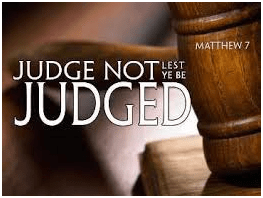
“Judge not lest you be judged,” is a favorite quote of unbelievers. They delight in hurling them at Christians during an argument. And all too often, these words have exactly the effect intended, that is to reduce the Christian is reduced to silence. After all, are not these words not found in Scripture? Were they not spoken by Jesus himself? The answer to these questions is yes and yes. But do these words really mean, as the unbelievers seem to think they do, that Christians have not basis for making moral judgments? The short answer is no.

My Introduction to Irrationalism

As is the case with most who grow up in church, I was not taught to think rigorously. I recall many years ago asking someone at my church about a passage I did not understand. It seemed to me that there was a contradiction in Scripture, so I asked for an explanation and was given the standard quote from Isaiah 55, saying God’s thoughts and God’s ways are higher than ours. This was then interpreted to mean we just have to accept that some things in the Bible do not and cannot make sense to our finite minds. There are mysteries, tensions, and apparent contradictions in the Bible that finite man simply cannot understand with mere human logic.

I didn’t know it at the time, but this was my introduction to irrationalism. The person with whom I spoke provided me the best answer he knew. I have no reason to believe he had any intention of deliberately misleading me. And yet, mislead me he did. And it would be many years before, by the grace of God, I found my way out of that intellectual cul-de-sac.

(more…)

Read Full Post »

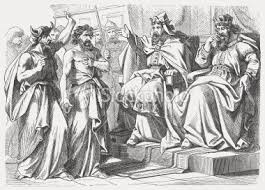
Ahab and Jehoshaphat listen to Michiah.

Ahab and Jehoshaphat listen to Michiah.

“Should you help the wicked,” asked the prophet of the defeated and humiliated king upon his return to Jerusalem, “and love those who hate the LORD?” The prophet was Jehu.  The king was Jehoshaphat.  The occasion was the aftermath of a crushing defeat inflicted by the Syrians on the allied armies of Israel and Judah.

Jehoshaphat was a godly man; one of the few good kings Judah ever had.  But in spite of this, he made a major spiritual and strategic mistake in seeking alliance with Ahab, the evil king of Israel.  I Kings 22 and 2 Chron. 18 provide the details of the alliance.  Jehoshaphat went on a state visit to see Ahab in Samaria, the capital of the northern kingdom.  During the visit, Ahab persuaded Jehoshaphat to join him in a grand alliance of Israel and Judah and to make war against the Syrians, all for the purpose of recapturing for Israel territory that had been lost to Syria earlier.  In other words, it was an Old Testament version of a crusade against the infidel.

Jehoshaphat made several errors that led to his defeat.  The first of which was that he, apparently, did not consult  the Lord before traveling to Israel to meet with Ahab.  The Scriptural record shows no evidence of Jehoshaphat ever seeking the Lord’s counsel as to whether he should go to Samaria.  It appears that he did this on his own.

Jehoshaphat’s second mistake was not heeding the voice of the Lord when it became clear that the military alliance would end in disaster.  The prophet Michiah plainly told Ahab in  Jehoshaphat’s hearing that the offensive against Syria would fail miserably.  His words were, “I saw all Israel scattered on the mountains, as sheep that have no shepherd” (I Kings 22:17).  Jehoshaphat heard all of this, and yet followed Ahab into battle anyway.

In all this, Jehoshaphat also managed to serve as Ahab’s dupe.  Ahab reacted angrily to Michiah’s prophesy of defeat at the hands of Syria, but he had the good sense to hedge his bets.  When Ahab and Jehoshaphat went into battle, Ahab disguised himself, but told Jehoshaphat to wear his royal robes.  Jehoshaphat did so, and nearly lost his life when the Syrians mistook him for the king of Israel, against whom they had been ordered to fight.

(more…)

Read Full Post »

A glance at the website of Knoxt Theological Seminary (hereafter, Knox) reveals that the Fort Lauderdale based school, founded in 1989, is celebrating its first 25 years by “Honoring the Legacy.” The school certainly seems to be doing well. The website is attractive and up to date. According to one of the banner headlines on the website, Knox was named as one of the “Top 20 Theological Seminaries in the U.S.” by Sharefaith Magazine. This, or course, may very well be true. But it leaves open the question whether Knox actually teaches the truth in its classrooms, which is the only real test of whether the seminary is, in fact, actually honoring its legacy.

Princeton Theological Seminary was, until taken over by the liberals in the first few decasdes of the 20th centry, long the foremost bastion of reformed teaciing in the United States. When he founded Knox in 1989, Dr. D. James Kennedy envisioned that the school would serve as a New Princeton. A school that combined both the Biblical faith and rigorous scholarship that were the hallmarks of the Old Princeton. This was the original vision and true legacy of Knox.

Coming back to that “Top 20” ranking by Sharefaith, a qucik glance at the complete Top 20 list raises the question whether the Knox of 2014 is truly honoring its legacy or simply living off its reputation . For listed right along side Knox on the Top 20 list are such bastions of Biblical truth as Fuller Theological Seminary, The University of Chicago Divinity School and the University of Notre Dame. Does anyone familiar with original vision for Knox really think that the school’s legacy is honored by comparing it to Fuller, the University of Chicago or Notre Dame? If not, why does the Knox administration think so? The answer is simple, the current vision for Knox is not the original vision, but those who run the school hope you won’t notice the difference.

I’ve written at some lenght about Knox in the past (see, here, here, here, here, here, and here). For those unfamiliar with Knox, the history of the school falls into two distinct periods: 1989 through September 2007, post-September 2007. I use this framework, for it was in September 2007 that the original vision for Knox as a New Princeton was supplanted by a new, decidedly different vision. Those intersted in the details may follow the links at the top of this paragraph. But for an apples to apples comparison that makes manifiest the radical difference between the true legacy of Knox and the current school, one could hardly do better than comparing the Academic catalogs of the old and new Knox.

Having attended Knox in the Fall of 2006, I will let my copy of the 2006 Academic catalog stand for the Old Knox. For the new Knox, please reference the electronic version available on the Knox website.

(more…)

Read Full Post »

Jeremiah 5:31 The prophets prophesy falsely, And the priests rule by their own power; And My people love to have it so. But what will you do in the end? (Jer. 5:3)

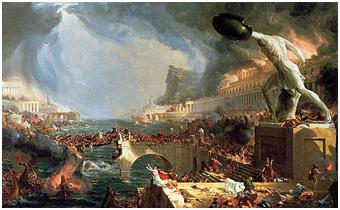
It’s long been popular to compare the obvious decline of American society over the past 100 years to that of the Roman empire. Perhaps some of this owes to the influence of Edward Gibbon’s famous Decline and Fall of the Roman Empire. Some purport to draw lessons from the Roman experience that can be applied in our day. Some will spot similarities between events in the Roman empire and those of contemporary times, and drawing from these likenesses the idea that America is in terminal, inevitable decline. Others of a more optimistic point of view hope to drawn lessons from the Roman example on how to stop or even reverse the decline.

But long before Rome famously declined and fell, for that matter, long before the city of Rome was even founded, two other kingdoms passed through experienced their own decline and fall. I speak of Israel and Judah. The books of Judges, Samuel, Kings, Chronicles, and the prophets could rightfully be called The History of the Decline and Fall of the Hebrew Republic. In them, we read how a nation originally founded as a constitutional republic, first devolved into a monarchy, next split into two separate kingdoms, and then following independent, centuries long glide paths of decline finally met their ruin.

If we want to examine the decline of American society, it is to these examples, rather than that of Rome, to which we should turn our attention. The experience of Israel and Judah are much more helpful in assessing out current condition as a nation than Rome ever could be, chiefly because we do not have to speculate as to why things happened as they did. Unlike even the best histories of Rome, the Scriptural record provides us not only a perfectly accurate account of the key events in the history of Israel, but also an infallible commentary on why these events occurred as they did. Let us now turn to God’s inspired history to see what lessons we may draw about the condition of the United States at the beginning of the 21st century.

(more…)

Read Full Post »

“I believe things happen for a reason,” or so the saying goes. It’s remarkable how often people give voice to this pop-culture proverb. But unlike most of the world’s supposed wise sayings, this one happens to be a true. In fact, one suspects it is far more true than most people realize.

Things do happen for a reason. But it’s not because of karma, or fate, or the alignment of the stars. The reason is this: God planned it that way from all eternity and inexorably brings his plans to fruition in his works of providence. Not just some things. Not just the big things. Not even just the pleasant things. But all things.

And he does it for his own glory.

Read Full Post »

For we must all appear before the judgment seat of Christ, that each one may receive the things done in the body, according to what he has done, whether good or bad. – 2 Cor. 10:5

The Bible asserts, and Christians hold, that sinners are justified by belief alone in Christ Jesus. Good works play no part in salvation. But if good works do not save us, what then is their purpose?

Glorify God

One answer to this question is that good works glorify God. Paul put it this way, “Therefore, whether you eat or drink, or whatever you do, do all to the glory of God” (1 Cor. 10:31). Echoing this idea, the Westminster Shorter Catechism tells us that part of man’s chief end is to glorify God. When we do good works, not only do we glorify God, but we prompt others to do the same. Jesus said, “Let you lifth so shine before men, that they may see your good works and glorify your Father in heaven” (Matt. 5:16).

(more…)

Read Full Post »

Ham vs. The Science Guy

While listening to the Ken Ham, Bill Nye evolution debate tonight, I was reminded of something a Latin professor told my class many years ago. He related to us a story about a Harvard classics professor, who, so the story went, would make the same statement to his incoming class of hot-shot graduate students, “You may have small opinions,” he would say to them, “tenuously held.” The professor, it seems, sought to disabuse his students of the notion that they were in the business of discovering truth. At the end of the day, the most even a brilliant scholar could claim for his conclusions was that they were his opinions. They were not truth.

This bothered me a bit at the time. “Is there any hope at all of discovering truth,” I thought to myself. In retrospect, I realize the wisdom of the Harvard professor. Indeed, he was right. Classics does not furnish us with truth. But this is not a shortcoming unique to that field. All other secular academic disciplines fail in the very same way, including, though this is hard for may to believe, science.

(more…)

Read Full Post »

Summary: There is abundant evidence, at least in the eyes of some observers, that Western civilization is undergoing a collapse. In fact, it already may have collapsed. That war, brutality, coercion, and immorality are on the rise is not in dispute. But what are we to make of this? Some view these as signs of civilizational collapse; others take them as evidence of progress. Who is right? The answer must be found in the more foundational philosophical discipline of ethics.

What is it that makes for a great writer or thinker? One could spend a great deal of time arguing this question. Many would hold the test of time to be an important criterion. Does an author’s work remain relevant ten, twenty or a hundred years after publication, or does time, like an ever rolling stream, bear all its import away? By this standard alone, the work of Gordon Clark achieves greatness. Reading through this section of chapter 2, the relevance of Clark’s work to our current day situation in the West is obvious. In his 2005 forward to the Trinity Foundation edition of A Christian View of Men and Things (CVMT), John Robbins observed, “Although it is now more than fifty years old, A Christian View of Men and Things is as timely as it was in 1952 [the year CVMT was first published], perhaps even more timely, for the crisis of our age has deepened, and the solution to that crisis has not changed.”

In Chapter 2 of CVMT under the heading “An Appraisal”, Clark walks the reader through contemporary evidence for the collapse of civilization. Working in ascending order from the most specific to the most general, Clark discusses the increase in war, brutality, coercion and immorality evident in the US and throughout the West. The timing of his remarks is worth noting, for Clark wrote CVMT in the early 1950s. a period many Americans fondly recall as a sort of Father-Knows-Best golden age of American civilization. A time when you could leave your house unlocked and not worry. A time when abortion was illegal. A time before anyone had ever heard of school shootings, LSD or the sexual revolution. In other words, the good old days.

(more…)

Read Full Post »

Summary:

Clark examines the ideas of two famous and influential 20th Century historians, Arnold Spengler and Arnold Toynbee. Spengler likened civilizations to biological organisms. Just as living creatures are born, grow mature, decline and die, so too do civilizations. He believed that events in the history of one civilization could be seen as contemporaneous to events in another civilization due to their occurring at the same point the their respective societies’ lifecycles. Further, Spengler was a determinist. He held that the West – as with all civilizations – would decline and die. Nothing can be done to prevent this.

Arnold Toynbee attempted to sound a more optimistic tone. He rejected Spengler’s biological analogy and claimed that, while, yes, 25 of 26 civilizations have collapsed, this does not imply that the West is fated to follow their fate.

Did either one of these noted scholars prove his point, or is the jury still out? Given their methods, could either one of them have managed to prove his point? These are questions to ask while reading Clark’s analysis of their writings.

Finally, Clark offers his opinion on the state of the West today. Although he expresses disagreement with Spengler and Toynbee on several points, he is in agreement with them in this: the West is in the midst of a decline.

“It’s the end of the world as we know it, and I feel fine,” or so went the refrain of a popular 80’s song by R.E.M. Armageddon, at least in my experience, is, and has been for some time, big business. In fact, I don’t ever recall a time when I’ve not been regaled with some end-of-the-world scenario or another. As a boy, I recall watching The Late Grate Planet Earth in a darkened church basement. The mushroom cloud at the end tends to leave a big impression on a 10 year old. The Planet of the Apes featured a famous scene with the Statue of Liberty half buried in the sand. Mel Gibson first gained international fame as an actor in Mad Max where he played a lawman in post-nuclear holocaust Australia. More recently, the financial crisis of 2008 has spawned a “prepper” movement, whose members, believing that society is on the verge of a major breakdown, seek to mitigate the effects of the coming collapse by making ready ahead of time. Dystopian films and TV shows enjoy great popularity with audiences.

(more…)

Read Full Post »

Summary:

This section breaks down into four main headings.

    I. The origins of the debate over progress (37).

    II. A historical sketch of the development of the idea of progress (37-39).

    III. A discussion of the main elements of the philosophy of progress (39-40).

    IV. A review of the main arguments used to establish progress as a law of history (40-41).

Years ago during a freshman level history class in college, a professor of mine made the point that the ancient Greeks had a cyclical view of history. For them, history was just a repetition of the same cycles over and over, much like the seasons. At the time, I thought it was among the most foolish things I’d ever heard. I was thoroughly steeped in the idea of history as progress. These many years later, I still don’t agree with the cyclical view, though I can at least understand why an intelligent person might take that position.

Of course, the Bible teaches that history will have an end, and that end was declared by God before the creation of the world. History, far from being a random series of events, has a purpose, which will culminate when Christ returns to judge the world in righteousness. In that sense the idea of progress in history is perfectly consonant with Christianity. But this is not the type of progress Clark has in view in this section. The philosophy of progress discussed here is of the purely secular sort.

The progress discussed here is the secular view. Clark argues that the Middle Ages, focused as they were on contemplation, showed little interest in worldly progress. This changed with the coming of such thinkers as Francis Bacon, Rene Descartes and Baruch Spinoza.

(more…)

Read Full Post »

« Newer Posts - Older Posts »