Feeds:
Posts
Comments

Archive for the ‘Politics’ Category

George Will is a smart guy and widely recognized as such. He’s also to a large degree intellectually enslaved to establishment ideas about how the world works, or at least how it ought to work.

In a recent column analyzing various Republican presidential candidates, Will was quite good in his analysis of Newt Gingrich, saying that he, “was the least conservative candidate,” in the field and did a good job supporting this claim. According to Will, a vote for Gingrich is a vote for the status quo.

In general, Will was pretty good in his analysis of the other candidates as well, with one exception: his analysis of Ron Paul. Paul, in Will’s thinking, is an isolationist.
(more…)

Read Full Post »

CNN Republican Debate

It was interesting to hear all the foreign policy talk last night at the Republican debate. If nothinig else, it confirmed my opinion that none of the cadidates save Ron Paul has any business going niear the Oval Office.

For the most part, the Republican position on foreign policy seems to be no-fly-zones, sanctions, dronings  and threatened invasions, war, more war,  and a good righteous tongue lashings against countries without nukes.  On the other hand if you, like Pakistan, have a nuke, you’re our best buddy well deserving of foreign aid so long as you don’t do anything really stupid like not fully cooperate with the US war on terror.

Now you tell me, why wouldn’t the Iranian mullahs want a nuke? It’s the only way a nation gets any respect from the US foreign policy establishment.  In today’s world, not having a nuke is like brining a knife to a gun fight.

Further, what’s the deal with foreign aid? There is no consititional or moral ground for the US federal government to take money from American taxpayers and give it to foreign governments. All such funding is theft, and the day it stops will be a huge step forward for American foreign policy.

The war on terror is a joke.  Terrorism, as has been pointed out by others much better qualifed than I, is a tactic.  War is declared against nations, not tactics.  There has been no declaration of war on terror by congress and there never will be.  If congress ever tried to do this, the logical absurdity of such an act would be apparent even to an average Republican presidential candidate.

Read Full Post »

While it doesn’t explicitly say so, a piece published on the EconocmicPolicyJournal blog indicates that presidential candidate Michelle Bachmann and her husband left their church due to its teaching that the papacy is the Antichrist.

There was a time when understanding this truth was a political asset.  Now, apparently,  it’s an embarrassment.  But then again, so is the sight of a woman running for president.  Baby, we’ve definitely come a long way.

Read the article here.

Read Full Post »

Way to Go Dr. No

“The United States is in a time of economic crisis, but this is no excuse to abandon the principles that have built this great country and spread its ideals to the darkest recesses of the planet. Rep. Paul has abandoned this mission, abandoned the United States’ citizens, and abandoned the citizens of the world in their quest for their God-given natural rights.” – Jordan Marks, Senior National Director Yang Americans for Freedom

As the saying goes, ROFLOL. There’s nothing, and I mean nothing, funnier than watching establishment conservative types have an aneurism after listening to a Ron Paul speech. The echoes of Rep. Paul’s words to CPAC (Conservative Political Action Conference) had barely died away when the spoon bangers at Young Americans for Freedom decided to give Dr. Paul the left foot of fellowship – pace Sean Gerety – by booting him off the organizations advisory committee.

Check out the speech that garnered Dr. Paul the CPAC straw poll victory and the enmity of Young Neocons for Statism.


Now that’s what I call rockin’ the free world.

Read Full Post »

The Gipper Turns 100

Growing up in the 70’s, the first president I remember was Richard Nixon.  Of course, what I really remember about Nixon was the disgraceful Watergate scandal.  The uproar over it seemed to drag on forever and left me with a decided negative impression of politicians.  Not that that’s all bad.  It’s certainly better than implicitly trusting and worshipping them the way so many seem to.  Even the Scriptures exhort us, “put not your trust in princes,” so it’s not as though being skeptical of the government is unchristian.  But that doesn’t excuse Nixon’s actions.  His lying caused enormous damage to the nation at a time when sound leadership was desperately needed. 

The election of 1976 brought us Jimmy Carter.  What I remember about Carter was his lecturing us about what we can’t do – we can’t turn the heat up, we can’t turn the air conditioning down, we can’t put out Christmas lights,  we can’t free the hostages in Iran, we can’t even make Billy Carter go away – and finding him thoroughly depressing.  And depressing pretty much the mood of the whole country at the time. 

That all changed in 1980.  Reagan was elected, and suddenly it seemed as though the country had its swagger back.  Reagan was known as the great communicator, and with good reason.  He could articulate the case for freedom and limited government with simplicity, charm and power.  And though his actions didn’t live up to his rhetoric, it’s not fair to say that he was all hat and no cattle.  He stood up to the Soviets, he backed Fed Chairman Paul Volker’s successful fight against inflation, he cut income taxes and successfully battled organized labor during the illegal PATCO (the air traffic controllers union) strike of 1981.  Reagan, in short, was the most effective and best president of my lifetime. 

Here’s Reagan’s speech at the 1964 GOP Convention in support of Barry Goldwater.  It’s a classic.  Much of what he says is still relevant today, and for those of you who did not live through the Reagan presidency, this will give you some idea of why his is still a revered figure.                   

Read Full Post »

Noah’s Park III

Yesterday I received a comment from Mark Looy directing me to an article in the Louisville Courier-Journal. The article, written by Mr. Looy, explained the State of Kentucky’s involvement in the Ark Encounter project. Regarding the implication in an earlier Courier-Journal article that the Kentucky would be giving a large tax grant to Ark Encounter, Looy commented,

“Even if the Ark fails to meet projections, there is no risk to the state. Contrary to what The Courier-Journal has implied, taxpayers will not help pay for the construction and operation of the Ar. The only people to pay taxes related to operating the Ark will be the visitors through sales tax paid at the attraction (e.g., on tickets and food). The state will rebate a portion of that sales tax to the Ark Encounter LLC based on meeting attendance-performance marks. The incentives are not a grant from Kentucky.” [Emphasis mine]

There’s a big difference between giving the Ark Encounter a rebate of the tax revenue generated by the park, revenue which never would have been generated were it not for the construction of the attraction, and forking over tens of millions of dollars of taxpayer money to a privately run company. Answers in Genesis to my knowledge has never accepted tax grants, and I’m glad to hear that this is the case with Ark Encounter.

So this raises the question, if Ark Encounter is not feeding at the taxpayer trough, what real objection do the folks at the Louisville Courier -Journal, the Cincinnati Enquirer and other organs of opinion have to the construction of a privately financed project by people who have never taken a dime of taxpayer money and have a track record of producing impressive attendance results at the Creation Museum?

Read Full Post »

Noah’s Park II

For in six days the LORD made the heavens and the earth, the sea, and all that is in them, and rested the seventh day. Therefore the LORD blessed the Sabbath day and hallowed it. – Exodus 20:11

As plans move ahead to build Ark Encounter, a historically themed attraction centered around a full-scale replica of Noah’s Ark, opposition from the usual suspects is building as well. When I first wrote about this story a few weeks ago, the local intellegensia were concerned about the constitutionality of the State of Kentucky providing tax incentives to Ark Encounter. This, they said, was a breach of the anti-establishment clause. But theirs was a weak argument. Ark Encounter is set up as an Limited Liability Corporation and managed by a subsidiary ministry of Answers in Genesis. It is not a church, and therefore the anti-establishment clause does not apply in this case. But even if Ark Encounter were a church, the Constitution’s anti-establishment clause applies only to the federal government, not to state governments, so there would still be no constitutional ground for denying the organization a tax break, or even, as appears to be the case with Ark Encounter, some sort of State funding. Not that I’m in favor of state-funded churches. I think they’re a terrible idea. But then so is misapplying the Constitution.


Having failed to dissuade Kentucky Governor Steve Beshear to dump the tax breaks on constitutional grounds, Ark Encounter opponants are now trying a new tactic: attacking Ark Encounter’s attendance projections that Kentucky used as the basis for granting the tax incentives. Here’s a few sample quotes,

  • Projections that 1.6 million people a year would visit Ark Encounter – the proposed Biblical theme park in Grant County to be financed in part with Kentucky tax incentives – are wildly optimistic, according to a half-dozen theme-park experts.
  • “Frankly, anyone who believes that this park will draw 1.6 million visitors a year really does believe that the Earth was created in just six days,” said Robert Niles, editor of themeparkinsider.com, an online publication.
  • Timothy Beal, a religion professor at Cleveland’s Case Western Reserve University and author of “Roadside Religion: In Search of The Sacred, the Strange and the Substance of Faith,” said Ark Encounter risks alienation many Christians if, as promised, it promotes the literal Biblical interpreetation that the Earth was created in six days. “I think there are fewer and fewer people who are interested in that debate, including Christians,” Beal said.

Fairly harsh stuff, that. But to those who witnessed the uproar surrounding the construction of the Answers in Genesis Creation Museum, it comes as no surprise. For in the years leading up to the museum’s groundbreaking, there were what seemed like endless legal challenges put forth by its opponents. If I recall correctly, their main charge was that building the museum where it was planned would result in zoning violations. All this seemed rather strange to me, for the area surrounding the museum’s property was and is largely undeveloped. I mean, it wasn’t as if AiG was going out of its way, like one local municipality did, to bulldoze a neighborhood for the noble and necessary purpose of expanding an already large shopping center, or tear down a longstanding and profitable business district in order to build a taxpayer funded football stadium that sits empty 364 days a year like Hamilton County. No, AiG was guilty of something much worse: wanting to build a privatly funded museum that presents Genesis as actual history, not as myth, magic or metaphore. In the end, the critics’ real objections were to the Christian doctine of creation, not the construction of a building on a rural section of interstate. But if you followed the story in the local press, you’d have thought the folks at AiG were real estate robber barons bent on ripping off the unsuspecting innocents of Northern Kentucky.

And just as in the case of the Creation Museum, I believe the real reason behind the move against Ark Encounter is philosophical: secularists reject the Bible as history and hate and fear those who believe it. This fight should be an interesting one.

Read Full Post »

Not Yours to Give

And you will cry out in that day because of your king whom you have chosen for yourselves, and the LORD will not hear you in that day.  – I Samuel 8:18.

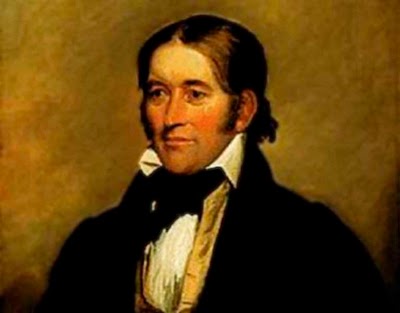
Trinity Reviews have a way of being eye-openers, and the article Not Yours to Give  published by the Trinity Foundation in 1981 certainly was that for me many years ago.  For one, I had never given much consideration to Davy Crockett beyond the image I had of him as a frontiersman, but this essay disabused me of that caricature. Col. Crockett was a man of many accomplishments and great integrity, not the cartoon-like character that I had supposed him to be .  But a second and more important lesson I took from the essay was the immorality of unconstititional federal government spending.       

The article centers around a story Crockett related about a vote he once cast in Congress.  Crockett had voted to appropriate taxpayer money for the relief of fire victims in Georgetown and was rebuked by a constituent for his vote.  The unhappy constituent explained to Crockett that he would not vote for him again and told him the reason why,

The power of collecting and disbursing money at pleasure is the most dangerous power that can be entrusted to a man…If you had the right to give anything, the amount was simply a matter of discretion with you, and you had as much right to give $20,000,000 as $20,000.  If you have the right to give to one, you have the right to give to all; and, as the Constitution neither defines charity nor stipulates the amount, you ae at liberty to give to any and everything which you may believe, or profess to believe, is a charity, and to any amount you may think proper.  You will very easily perceive what a wide door this would open for fraud and corruption and favoritism on the one hand, and for robbing people on the other.   

One of the curses of big government is its habit of  taking wealth from those who are politically out of favor giving it to those who are in favor.  I Samuel 8 gives us a picture of this.  In relating the behavior of the king so adamantly demanded by the Israelites, Samuel said, 

And he will take the best of your fields, your vineyards, and your olive groves, and give them to this servants.  He will take a tenth of your grain and your vintage, and give it to his officers and servants.  (ISam.8:14, 15.)

None of these things – the fields, vineyards, olive groves, grain and vintage  – were the king’s to give, but he would plunder the people in order that he might reward those who had or could help him.  This same situation obtains today, for what has been dubbed the welfare-warfare state – our massive social welfare bureaucracy on one hand combined with a powerful military-industrial complex on the other – is simply an example of politicians rewarding those who reward them, regardless of the morality or constitutionality of the act.  Add to this the bailout culture now in place since the 2008 financial crisis and it should come as no surprise that we now have a $14 trillion national debt.   

One of the most effective academic and popular critics of big government in recent years is Walter Williams.  Dr. Williams, an economist at George Mason University, has mentored numerous people in free-market economics, the rule of law and constitutional government over the years through his books and columns.  His most recent column is an excellent example of his work in this area.          

Citing several examples of past presidents’ opinions on the Constitution and federal government spending, Williams shows us that the lesson in Not Yours to Give was taken to heart, not just by Davy Crockett, but  by Americans generally up through the end of the 19th century.  Here are a few quotes from William’s article,

Charity is no part of the legislative duty of the government.  (James Madison)

I can find no warrant for such an appropriation in the Constitution, and I do not beleive that the power and duty of the General Government ought to be extended to the relief of individual suffering which is in no manner properly related to the public service or benefit.  (Grover Cleveland)

Congress has not unlimited powers to provide for the general welfare, but only those specifically enumerated.  (Thomas Jefferson) 

If this nation is going to have any hope for a future without severe poverty and oppressive tyranny, Americans had better relearn the simple lessons of limited, Biblical, constitutional government understood so well by earlier generations.  Read the rest of Williams article here.

Read Full Post »

For a long time now I’ve followed Lewrockwell.com.  It’s a libertarian blog touting Austrian economics and anarcho-libertarian politics.  Now while I don’t count myself a libertarian – libertarianism does not take its ethics, politics or economics from Scripture, the requirement for a Scripturalist – and cannot endorse the anarchism advocated by the site, I do appreciate its stand for individual liberty and against big government.

That being said, I’ve always found it odd that a website dedicated to “anarcho-capitalism” as they like to call it would attempt to defend the principles of anarchy and capitalism by using the philosophy of the Roman Catholic Church-State, for Romanist dogma supports neither.  First, Romanist political theory is certainly not friendly toward libertarian anarchy, or for that matter even sober, Biblical constitutional government.  Rather, Rome’s political doctrine of subsidiarity – “according to which, ‘a community of a higher order should not interfere in the internal life of a community of a lower order, depriving the latter of its functions, but rather should support it in case of need and help co-ordinate itsactivities with the rest of society, always with a view to the common good’ ” – is hierarchical and interventionist in the extreme.  

And while its political theory tends toward fascism, Rome’s economic thought is just as oppressive.  In its 1994 Catechism, Rome rails against capitalism by stating,

She [Rome] has likewise refused to accept, in the practice of “capitalism,” individualism and the absolute primacy of the marketplace over human labor…regulating it [the economy] solely by the law of the marketplace fails social justice, for ‘there are many human needs which cannot be satisfied by the market.’ Reasonable regulation of the marketplace and economic initiatives, in keeping with a just hierarchy of values and a view to the common good, is to be commended.   – Catechism of the Catholic Church, 2425.   

Rome, ignoring Christ’s teaching about private property”is it not lawful for me to do what I wish with my own things?,” posits “reasonable regulation of the marketplace” – reasonable in whose eyes? – as a preferable alternative to the Biblical economic model of laissez-faire capitalism.

Yet for all this, there are many articles on Lewrockwell.com that attempt to cast Romanism in the role of defender of liberty and Protestantism as its foe.  For example, libertarian stalwart Murray Rothbard, citing Erik von Kuehnelt-Leddihn’s book Liberty or Equality, approvingly sums up Kuehnelt-Leddihn’s argument in an article posted on the website by stating that the book’s,

main gist…is the thesis that Catholicism makes for a libertarian spirit (albeit “anti-democratic”) while Protestantism makes for socialism, totalitarianism, and a collectivist spirit.

Yes of course, we all know how collectivist those Calvinist colonialists were.  Writing in a book review, Rothbard slanders the English Reformation as “The Cultural Revolution in 16th Century England,” and advances the idea that the English Reformers were nothing but a bunch of Protestant bullies who beat up helpless and saintly monks, bishops and cardinals, stripped their altars and stole their lunch money. 

Roman Catholic Thomas Woods regularly advances the idea that Romanism and capitalism are compatible systems and has even written a book on the subject titled The Church and the Market

Now I can have some sympathy for a freedom-minded Roman Catholic scholar who constantly must struggle with the cognitive dissonance arising from the clash of his capitalist principles and the social teaching of the Roman Catholic Church-State.  His is not a fate to be envied. But my sympathy is limited.  For such a man is double minded, refusing to see the screaming contradiction between capitalism and the oppressive economic dogma of Rome.  As James tells us, let not such a man expect that he will receive anything of the Lord.  He is unstable in all his ways.

Read Full Post »

Awhile back, I’m not really sure why, I started getting weekly newsletter emails from a group called InsideCatholic.  And although I don’t recall signing up for their email list, I decided not to unsubscribe since the articles were written for the purpose of explaining and defending Roman Catholic social teaching, an area of particular interest to me.  Not that I agree with the Romanists, mind you.  Far from it.  I find the social and economic teaching of the Roman Catholic Church-State as repellant as its false gospel.  But there’s something to be said for reading the arguments of your opponents. 

The most recent email had an article titled “Does the UCCB [United States Conference of Catholic Bishops] Understand Subsidiarity?”, which turned out to be an interesting conflation of two very different systems of government:  subsidiarity and federalism.  The author, Deal W. Hudson, whose biography states that he’s a Southern Baptist turned Roman Catholic, would have us believe that the US Constitution is compatible with Romanist political philosophy.  Hudson writes,

While the bishops objected vigorously to the presence of abortion funding in the legislation, they seem untroubled by the question of its general constitutionality, one that comports closely with the principle of subsidiarity as articulated in Catholic social teaching. 

It seems that Dr. Hudson is as confused about the Constitution as he is about the Bible, for the principles of the Constitution do not comport with those of subsidiarity.  According to Pope Pius XI, subsidiarity,

is a fundamental principle of social philosophy, unshaken and unchangeable…The state should leave to these smaller groups the settlement of business of minor importance.  It will thus carry out with greater freedom, power, and success the tasks belonging to it, because it alone can effectively accomplish these, directing, watching, stimulating (do these guys sound like good Keynesians or what?) and restraining… – Pius XI, Quadragesimo Anno, 1931, 40-41, in Robbins, Ecclesiastical Megalomania, 152.

(more…)

Read Full Post »

« Newer Posts - Older Posts »